
 Worksheets
Intro to Physical Science
Total questions: 37
Worksheet time: 28mins
Name
Class
Date
1.
Add 5.364g + 6.7g and use significant figures.
a)
12g
b)
12.1g
c)
12.06g
d)
12.064g
2.
You are in lab and your partner accidentally gets their hair stuck in a triple beam balance. What should have your partner done?
a)
A. Worn a hat in class
b)
B. Skipped class
c)
C. Got a hair cut
d)
D. Tied/pulled their hair back
3.

Clean up ___________________
a)
As soon as you finish your experiment
b)
by disposing of all materials down the sink with lots of water
c)
by disposing of all materials in the waste bins provided
d)
as directed by your teacher
4.
In an experiment, this is the part that you change.
a)
The Constant Variable
b)
The Dependent Variable
c)
The Independent Variable
d)
The Control Group
5.
What step does every scientific experiment begin with?
a)
hypothesis
b)
question/problem
c)
procedures
d)
conclusion
6.
How many variables can be tested in a controlled experiment?
a)
one
b)
two
c)
three
d)
as many as possible
7.
Convert 0.25 m to mm
a)
25
b)
2.5
c)
250
d)
0.025
8.
7,000 milligrams = _____ grams
a)
7
b)
70
c)
700
d)
70,000
9.
A summary based on evidence or facts.
a)
hypothesis
b)
predict
c)
conclusion
d)
independent variable
10.
The variable that is being measured.
a)
dependent variable
b)
independent variable
c)
control
d)
experiment
11.
A testable prediction.
a)
law
b)
conclusion
c)
hypothesis
d)
control
12.
Information obtained through one or more of the five senses.
a)
hypothesis
b)
observation
c)
predict
d)
infer
13.
A substantiated explanation based on rigorously tested evidence.
a)
theory
b)
law
c)
hypothesis
d)
conclusion
14.
A summary of many experimental results and observations; it tells how things work.
a)
theory
b)
law
c)
conclusion
d)
hypothesis
15.
The procedure(s) used to test a hypothesis.
a)
observation
b)
experiment
c)
infer
d)
control
16.
"kg" is a unit of _____
a)
Weight
b)
Mass
c)
Length
d)
Volume
17.
"cm3" is a unit of _____
a)
Volume
b)
Mass
c)
Density
d)
Time
18.
"mm" is a unit of _____
a)
Mass
b)
Time
c)
Weight
d)
Length
19.
1 kg is equal to ______
a)
1000 mg
b)
100 g
c)
1000 g
d)
100 mg
20.
The Metric system is based around the number _____
a)
2
b)
5
c)
10
d)
12
21.
The prefix kilo- means _____
a)
10 Units
b)
1 Unit
c)
100 Units
d)
1000 Units
22.
The amount of space occupied by an object
a)
Volume
b)
Mass
c)
Density
d)
Time
23.
The amount of matter that makes up an object
a)
Mass
b)
Density
c)
Volume
d)
Weight
24.
"mL" is a unit of _____
a)
Volume
b)
Mass
c)
Weight
d)
Density
25.
"m" is a unit of __________
a)
Mass
b)
Weight
c)
Length
d)
Time
26.

what is the mass indicated on the triple beam balance shown in the image?
a)
354.6 g
b)
350.46 g
c)
35.46 g
d)
463.5 6
27.
When using a metric ruler, the first thing you should check before recording your distance is
a)
that the object is lined up at the zero mark
b)
that the ruler is flat on a table
c)
the air temperature is between 6 and 40 degrees Celsius
d)
all people in your group have their own ruler
28.
Before placing an object on the pan of the triple beam balance, make sure
a)
it is zeroed out
b)
all riders are pushed the the right hand side of the beams
c)
the object your measuring is as cold as possible
d)
that are no other people in the room
29.
The metric system is only used in a few countries.
a)
True
b)
False
30.
If scientists cannot obtain exact numbers, they may rely on an
a)
calculation
b)
estimate
c)
guess
d)
assumption
31.
____________________ is the study of Matter and Energy
a)
chemistry
b)
physical science
c)
observation
d)
geology
32.
A _____________________ is something that scientists use to represent an object or process
a)
mass
b)
matter
c)
model
d)
weight
33.
How close a measurement is to the true value is called..
a)
Accuracy
b)
Precision
c)
Significant
d)
Estimate
34.
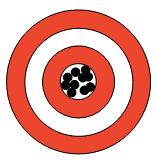
?
a)
High Accuracy & High Precision
b)
High Accuracy & Low Precision
c)
Low Accuracy & High Precision
d)
Low Accuracy & Low Precision
35.
A set of data are all close to each other, but they are not close to the actual value. This set of data can be described as...
a)
accurate
b)
precise
c)
both precise and accurate
36.
In science, your hypothesis must be ______________.
a)
correct
b)
manipulated
c)
controlled
d)
testable
37.
One useful tool that may help a scientist interpret data by revealing unexpected patterns is a
a)
variable
b)
graph
c)
theory
d)
law
100 %

