
 Worksheets
Genetics 2.5
Total questions: 20
Worksheet time: 16mins
Name
Class
Date
1.

This is an example of what?
a)
Complete dominance
b)
Incomplete dominance
c)
Codominance
d)
None of the above
2.
What does heterozygous mean?
a)
An organism that has the same genes for a trait (TT or tt)
b)
An organism that has different genes for a trait (Tt)
c)
When neither gene is fully dominant; offspring is a mixture of both
d)
the different forms of a trait (hair color--> brown, blonde, red
3.

If T=Tall & t=short, what is the genotypic ratio?
a)
1:3
b)
3:1
c)
1:2:1
d)
2:2
4.

If a Homozygous red snapdragon and a Heterozygous pink snapdragon were crossed - what percentage of the offspring would be homozygous white?
a)
0%
b)
25%
c)
50%
d)
75%
5.

Which process and type of resulting cells are represented?
a)
mitosis, gametes
b)
mitosis, body cells
c)
meiosis, gametes
d)
meiosis, body cells
6.

Which best describes the process shown?
a)
mutation in which the DNA content of the gene is ltered
b)
segregation of sister chromatids
c)
condensation and segregation of the alleles
d)
crossing-over which alleles are exchanged
7.
How many times in meiosis does the cell divided?
a)
2
b)
4
c)
3
d)
1
8.

The sex of an offspring is determined by ______________________.
a)
the mother
b)
the father
c)
the mother and the father
d)
by the environment
9.

Term for homozygous organisms that display two dominant phenotypes at the same time
a)
codominance
b)
incomplete dominance
c)
multiple alleles
d)
linked genes
10.

Red/green color blindness is a recessive trait. A woman who is a carrier for this allele marries a normal-vision male. What is the probability that they will have a child who is color blind?
a)
1/4
b)
1/2
c)
3/4
d)
1
11.
A person with type O blood marries a person with type AB blood. Possible blood genotypes of their children are
a)
I(A)i and I(B)I(B)
b)
I(B)I(B) and I(A)I(A)
c)
I(A)i and I(B)i
d)
I(A)I(B) and ii
12.

Which species’ DNA is most similar to the DNA of the toothed whale?
a)
Hippopotamus
b)
Baleen Whale
c)
Grazing Mammals
d)
Camels
13.
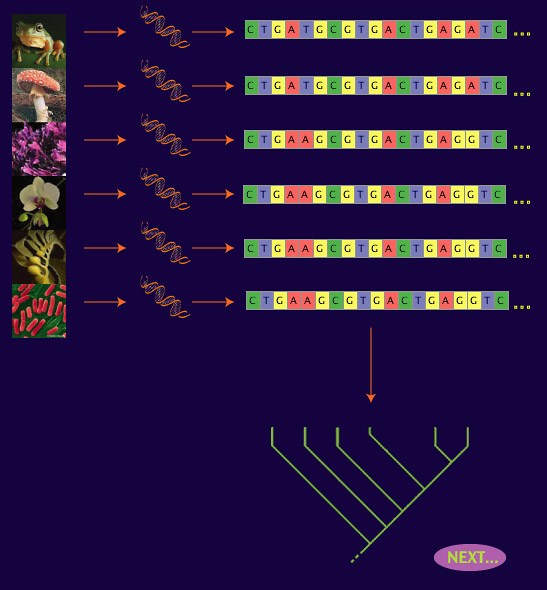
Two organisms that are closely related would have
a)
very similar DNA sequence
b)
exactly the same DNA sequences
c)
no proteins in common
d)
completely different DNA sequence
14.
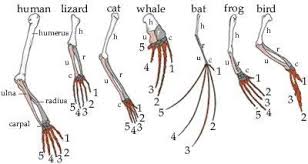
What is this an example of?
a)
vestigial structures
b)
embryology
c)
homologous structures
d)
fossil record
15.
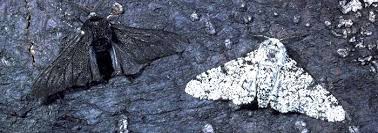
Predict which moth would increase in population
a)
light
b)
dark
16.
The cause of artificial selection is…
a)
The environment
b)
Humans
c)
Mutation
d)
Gene Flow
17.

Which of the following is a term for a group of similar organisms that can reproduce fertile offspring?
a)
individual
b)
population
c)
species
d)
fossil
18.

Which layer is the oldest
a)
B
b)
A
c)
E
d)
C
19.

The Physical remains of a plant or animal preserved in rock or Earth's crust.
a)
Adapt
b)
Fossil
20.
In natural selection, the selective agent is the
a)
humans
b)
mutations
c)
breeders
d)
environment
100 %

