Wayground logo

Free Printable Worksheets

Font size

S
M
L
XL
Worksheets

AP Human Geography- Unit 2: Population and Migration

Total questions: 48

Worksheet time: 43mins

Name
Class
Date
1.
Explain Thomas Malthus's population theory.
a)
He concluded that the world's population increase was higher than the development of food supplies.
b)
He concluded that crude birth rates must balance crude death rates.
c)
He concluded that population increased arithmetically while food production increased linguistically.
d)
He concluded that population growth was outpacing available resources in every country, according to algebraic calculations.
2.
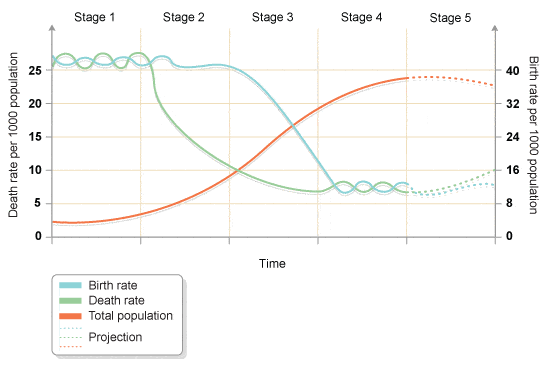
A crude birth rate of approximately 10 per 1,000 is typical of a country in which stage of the demographic transition?
a)
stage 1
b)
stage 2
c)
stage 3
d)
stage 4
3.
Where are people most likely not to live?
a)
places that are too hot
b)
places that are too cold 
c)
places that are too high in elevation
d)
All the answers are correct
4.
What is the average number of births women bear in their lifetimes known as?
a)
total increase rate
b)
total fertility rate
c)
crude fertility rate
d)
crude birth rate
5.
What demographic feature has the most significant future implications?
a)
that the less developed countries have the highest combined crude death rate
b)
that the most rapid growth is occurring in the less developed countries
c)
that people are uniformly distributed across Earth
d)
that the natural increase rate is larger every year
6.

In what stage of the demographic transition are most European countries?

a)

1

b)

2

c)

3

d)

4

7.
What does an "upside down" population pyramid indicate?
a)
lots of children
lots of children
b)
lots of middle age people
c)
lots of elderly/older people
d)
lots of teens
8.
The ratio of people who are too young or too old to work compared to the working population is called the
a)
dependency ratio
b)
population pyramid
c)
interconnected ratio
d)
retirement ratio
9.
The annual worldwide natural increase rate is
a)
1.2%
b)
12%
c)
12 million
d)
12 trillion
10.

This caused a jump in the worlds' population in the late 1700's and helped send England into stage 2:

a)

the Renaissance

b)

the Industrial Revolution

c)

the Medical Revolution

d)

the Scientific Revolution

11.
The world's most populated country is
a)
India
b)
Nigeria
c)
China
d)
Indonesia
12.
The world's most populated region is 
a)
North America
b)
East Asia
c)
South Asia
d)
Africa
13.
Zero population growth occurs when the TFR (total fertility rate) is at
a)
1.2
b)
2.1
c)
2.7
d)
1.9
14.
A characteristic of stage 3 of the demographic transition shows
   
a)
High birth and death rates
b)
Low death and high birth rates
c)
Declining birth and death rates 
d)
High death and low birth rates
15.
What is the portion of earth's surface occupied by permanent human settlement?
a)
Ecumene 
b)
Census 
c)
Cohort 
d)
Pandemic
16.
Which of the following is a pull factor?
a)
Insufficient Food Supply
b)
High Crime Rate in Native Country
c)
Higher Paying jobs in New Country
d)
High Crime Rate in New Country
17.

Which of the following are part of EG Ravenstein’s (The Bloke with the cloke) Laws of Migration?

a)

most migrants are male

b)

most migrants move short distances

c)

most long distance migrants move to large urban areas

d)

all of the above

18.
According to Ravenstein’s Laws of Migration, which group is most likely to move?
a)
older adults
b)
younger adults
c)
children
d)
families
19.
What is the internal migration pattern as seen in the US?
a)
South and West
b)
North and East
c)
North and West
d)
South and East
20.
Which areas of the world generally have net out-migration?
a)
Asia and North America
b)
Africa and Europe
c)
Africa and Asia
d)
Latin America and Europe
21.
According to EG Ravenstein, which of the following is NOT true?
a)
Most migrants are young adults.
b)
Most migration is over very long distance
c)
Migration is most often for economic reasons.
d)
Migration occurs in steps.
22.
The wave of immigrants into America around 1900-1915 was different from earlier waves of migration because most were from what area?
a)
Southern and Eastern Europe
b)
Asia
c)
Africa
d)
Latin America
23.
Since the 1980's, most US In-Migration has come from
a)
Europe
b)
East Asia
c)
Latin America
d)
South Asia
24.
Most migrants move for 
a)
economic reasons
b)
cultural reasons
c)
environmental reasons
d)
persecution reasons
25.
If a country's Immigration is LESS than it's Emigration it has
a)
net in-migration
b)
net out-migration
c)
it's population is increasing
d)
it needs to set quota laws
26.
Which of the following is a PULL factor?
a)
A hurricane
b)
failed harvest
c)
increase in taxes
d)
opening a new factory
27.
The ability to move from one place to another is
a)
mobility
b)
migration
c)
net migration
d)
voluntary migration
28.
The most important intervening obstacle preventing Eastern Europeans from leaving their homes between World War 2 and the 1990s was
a)
the Danube River
b)
the Alps
c)
communist control of the region
d)
lack of financial resources
29.
The Atlantic Ocean is an example of
a)
an environmental push factor
b)
an intervening obstacle
c)
an environmental  pull factor
d)
an economic factor
30.
Most migrants to the US from 1800-1850 came from which part of Europe?
a)
north and east
b)
north and south
c)
north and west
d)
south and east
31.
According to the 1986 Immigration Reform and Control Act signed by President Reagan, undocumented workers 
a)
are immediately arrested
b)
were allowed to pursue citizenship
c)
jailed if caught a third time
d)
no longer able to go to public school
32.
What is an example of forced migration?
a)
Spanish moving to Mexico
b)
African slaves brought to the Americas.
c)
Syrians moving to Turkey
d)
African Americans moving north at the end of the civil war
33.
Guest workers in Europe and the Middle East are low-status but legal residents.
a)
true
b)
false
34.
Many guest workers go to the oil fields in Midland Texas.
a)
True
b)
False
35.
Many guest workers go to work in the oil field in SW Asia (Middle East).
a)
true 
b)
false
36.
Which would not be an environmental pull factor?
a)
clear, dry air in Arizona
b)
lumberjack job in the Pacific Northwest
c)
beautiful clear water by the beach
d)
Rocky Mountain scenery
37.
The main PUSH factor for a refugee is 
a)
economic
b)
environmental
c)
natural disaster
d)
political
38.
Brain drain is
a)
when you can't come up with the answer on a test
b)
emigration from MDCs to LDCs
c)
emigration of talented and smart people
d)
forcing emigration for political reasons
39.
What is land suited for agriculture known as?
a)
agricultural density
b)
population density
c)
physiological land
d)
arable land
40.
What is the most populous country in Southeast Asia?
a)
Indonesia
b)
Cambodia
c)
Thailand
d)
Vietnam
41.
How are Stages 1 and 4 of the demographic transition model similar?
a)
both have low growth rates
b)
both have low life expectancies
c)
both have low dependency ratios
d)
both have low death rates
42.
How could a country increase its physiological density?
a)
increasing the amount of agricultural land
b)
increasing the size of the population
c)
increasing the areas of its urban centers
d)
limiting the number of farmers
43.
What does a country have if the physiological density is very high and its arithmetic density is very low?
a)
a large number of farmers, although the number of farmers is not as great as the number of people living in the cities
b)
too many people for the available resources, particularly in regards to agricultural land
c)
too few farmers for the large area of land suitable for agriculture
d)
a small percentage of land suitable for agriculture, even if there seems to be plenty of space available to live in
44.

A country with a large amount of arable land and a small number of farmers will have a

a)

low arithmetic density

b)

high physiological density

c)

low agricultural density

d)

high agricultural density

45.

A decline in a country's crude birth rate would result in an increase in that country's

a)

life expectancy

b)

doubling time

c)

total fertility rate

d)

natural increase rate

46.

One demographic feature with the most significant future implications is that

a)

the less developed countries have the highest combined crude death rate.

b)

the natural increase rate is larger every year.

c)

the most rapid growth is occurring in the less developed countries.

d)

there are fewer people in the world now than at the peak in the middle of the twentieth century.

47.

Wilbur Zelinsky's model of migration predicted

a)

migrants move most frequently for economic reasons.

b)

intraregional migration is more important than interregional migration in terms of political and economic resources.

c)

migration characteristics vary with the demographic transition.

d)

women are more likely to migrate than men.

48.

If your ancestors migrated to the United States during the 1840s and 1850s, barring any other evidence, you might strongly suspect that they originated in

a)

Spain or Portugal.

b)

Norway or England.

c)

Italy or Poland.

d)

Ireland or Germany.