
 Worksheets
2.03 Types of Bonds
Total questions: 37
Worksheet time: 22mins
Name
Class
Date
1.
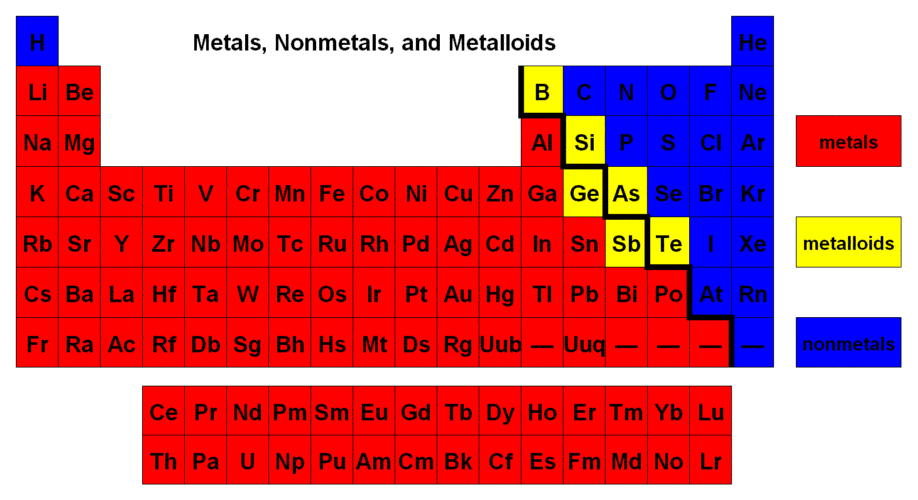
What elements generally make an ionic bond?
a)
metal and nonmetal
b)
2 or more nonmetals
c)
metal
d)
none of the above
2.
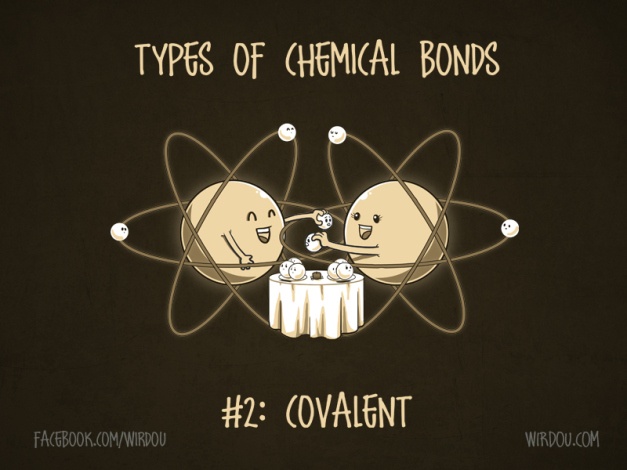
In chemical compounds, covalent bonds form when
a)
the electronegativity difference between two atoms is very large.
b)
electrons are completely transferred between two metals.
c)
pairs of electrons are shared between two nonmetal atoms.
d)
two nonmetal atoms are attracted to each other by opposite charges.
3.
What charges repel?
a)
Same
b)
Opposite
4.
When forming an ionic bond, a metal atom
a)
Gains electrons to form a cation
b)
Loses electrons to form a cation
c)
Gains electrons to form an anion
d)
Loses electrons to form an anion
5.
Once atoms chemically bond, they can never be separated.
a)
True
b)
False
6.
Which substance contains bonds that involve a transfer of electrons from one atom to another?
a)
CO2
b)
NH3
c)
KBr
d)
Cl2
7.
O + O
a)
Ionic
b)
Polar Covalent
c)
Metallic
d)
Nonpolar Covalent
8.
Predict the bond that will form between Se and Cl.
a)
Ionic
b)
Covalent
c)
Metallic
d)
Nonpolar
9.
S + O
a)
Ionic
b)
Polar Covalent
c)
Metallic
d)
Nonpolar Covalent
10.
Predict the bond that will form between Be and F.
a)
Ionic
b)
Polar Covalent
c)
Metallic
d)
Nonpolar Covalent
11.
Predict the bond that will form between Sr and S.
a)
Ionic
b)
Polar Covalent
c)
Metallic
d)
Nonpolar Covalent
12.
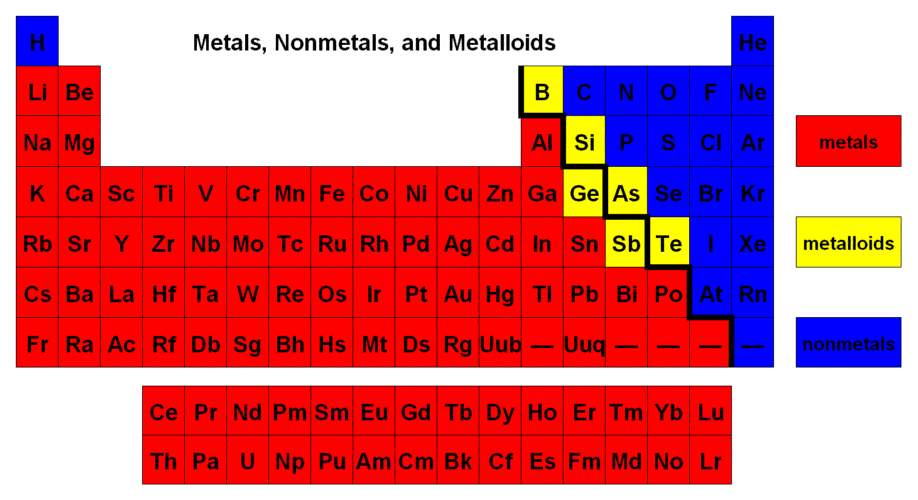
What elements generally make a covalent bond?
a)
metal and nonmetal
b)
2 or more nonmetals
c)
metal
d)
none of the above
13.
What elements generally make an ionic bond?
a)
metal and nonmetal
b)
2 or more nonmetals
c)
metal
d)
none of the above
14.
Sodium Chloride (Table Salt) is an example of a.....
a)
Ionic bond
b)
Covalent bond
c)
Isotopic bond
15.
Is hydrogen considered a metal or a non-metal?
a)
A metal
b)
Nonmetal
c)
Metalloid
16.
In chemical compounds, covalent bonds form when
a)
the electronegativity difference between two atoms is very large.
b)
electrons are completely transferred between two metals.
c)
pairs of electrons are shared between two nonmetal atoms.
d)
two nonmetal atoms are attracted to each other by opposite charges.
17.
Group numbers on the periodic table help us determine
a)
The number of valence electrons
b)
Color of the elements
c)
Number of energy levels
d)
Atomic Masses
18.
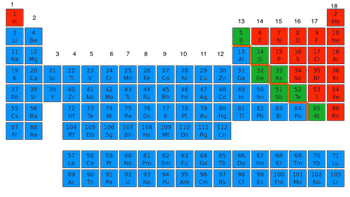
Where are metals located on the periodic table?
a)
Blue
b)
Green
c)
Red
19.
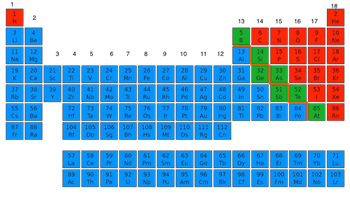
Where are the nonmetals located on the periodic table?
a)
Blue
b)
Red
c)
Green
20.
In the modern periodic table elements are arranged by:
a)
atomic mass
b)
atomic number
c)
valence electrons
d)
number of isotopes
21.
Each column in the periodic table is called a
a)
period
b)
group
c)
cluster
d)
unit
22.
The atomic number tells you what?
a)
number of electrons
b)
number of protons
c)
number of neutrons
d)
the sum of electrons and protons in an atom.
23.
Elements which are shiny, conduct electricity and heat are called
a)
metal
b)
nonmetal
c)
metalloid
d)
nonexistent
24.
Which group of the periodic table is composed of inert (not reactive) gases?
a)
alkali metals
b)
alkaline earth metals
c)
halogens
d)
noble gases
25.
Which is a halogen?
a)
Helium
b)
Chlorine
c)
Oxygen
d)
Neptune
26.
Which is an alkali metal?
a)
Magnesium
b)
Iron
c)
Sodium
d)
Europium
27.
Which element is not a metal?
a)
Au
b)
Re
c)
Al
d)
B
28.
Ionic Bonding involves...
a)
The transfer of protons
b)
The transfer of nuetrons
c)
The transfer of electrons
d)
None Of the above
29.
What do atoms that form positive ions tend to do?
a)
Tend to lose electrons
b)
Tend to lose protons
c)
Tend to gain electrons
d)
Tend to gain protons
30.
What happens when the sodium atom loses an electron?
a)
It become negatively charged
b)
It become positively charged
c)
none
31.
What usually forms the positive ion?
a)
Metal
b)
Non Metals
c)
None
32.
What usually forms the negative ion?
a)
nonmetals
b)
metal
c)
none
33.
What two types of atoms make a covalent bond?
a)
2 Nonmetals
b)
1 Nonmetal and 1 Metal
c)
2 Metals
d)
2 Noble Gases
34.
What happens when an atom loses an electron?
a)
Neutral (no charge)
b)
Positive charge
c)
Negative charge
35.
What happens when an atom gain an electron?
a)
Neutral(no charge)
b)
Positive charge
c)
Negative charge
36.
What charges attract?
a)
Opposite
b)
Same
37.
Covalent compounds
a)
Share electrons
b)
transfer electrons
c)
contain a sea of electrons
d)
conduct electricity
100 %

