
 Worksheets
Genetics
Total questions: 35
Worksheet time: 37mins
Name
Class
Date
1.
the passing of genetic traits from parent to offspring.
a)
heredity
b)
trait
c)
gene
d)
allele
2.
Magda is a tall, 11 year old drummer. She has a scar on her right cheek. She is good at swimming. Which of her traits did Magda most likely inherit?
a)
height
b)
the scar
c)
ability to swim
d)
ability to play drums
3.
A dog gives birth to 5 puppies. What percentage of the chromosomes does each puppy share with the mother?
a)
25%
b)
50%
c)
75%
d)
100%
4.
the condensed form of DNA is called________________
a)
an allele
b)
a gene
c)
a chromosome
d)
a phenotype
5.
Where, in the eukaryotic cell, is DNA located?
a)
ribosomes
b)
nucleus
c)
E.R.
d)
cytoplasm
6.
The study of heredity and the variation of inherited characteristics is called?
a)
gene
b)
genetics
c)
meiosis
d)
hybrid
7.
The passing of traits from parent to offspring
a)
Heredity
b)
Genetics
c)
Hybrid
d)
Probability
8.
one set of instructions for an inherited trait
a)
heredity
b)
allele
c)
trait
d)
gene
9.
A single piece of coiled DNA found in the cells; contains genes that encode traits.
a)
gene
b)
chromosome
c)
trait
d)
DNA
10.
A characteristic that an organism can pass on to its offspring through its genes
a)
protein
b)
trait
c)
DNA
d)
gene
11.
Which of the following states a difference between singlecelled
organisms and multicelled
organisms?
organisms and multicelled
organisms?
a)
Singlecelled
organisms are dead while multicelled
organisms are
alive.
organisms are dead while multicelled
organisms are
alive.
b)
Singlecelled
organisms do not have organs while multicelled
organisms have organs.
organisms do not have organs while multicelled
organisms have organs.
c)
Multicelled
organisms are made up of cells performing the same
function while singlecelled
organisms are not.
organisms are made up of cells performing the same
function while singlecelled
organisms are not.
d)
Neither has a nervous system
12.
Which of the following states a difference between single-celled
organisms and multi-celled
organisms?
organisms and multi-celled
organisms?
a)
multicellular
b)
single cellular
13.
Bacteria are
a)
multi-cellular
b)
unicellular
14.
Which characteristic is NOT inherited?
a)
Hairline (straight or widow's peak)
b)
Spoken language (English, Spanish, etc...)
c)
Earlobes (attached or detached)
d)
Hair type (straight or curly)
15.
Inherited traits can include cleft chin, freckles and color blindness.
a)
True
b)
False
16.

What is the name of the genetic material that is inside the nucleus?
a)
Cytoplasm
b)
Hydrochloric Acid
c)
Mitochondria
d)
DNA
17.
Which characteristic is a lion least likely to pass on to its offspring?
a)
fur color
b)
length of tail
c)
scars on leg
d)
body size
18.
What characteristic would a child not inherit from parents?
a)
freckles
b)
eye color
c)
hair style
d)
dimples
19.
The passing of traits from parents to offspring is called _______________.
a)
probability
b)
recessive
c)
heredity
d)
genes
20.
A cell is...
a)
something we study in science class
b)
Not important
c)
a multicellular object
d)
the basic unit of life
21.
Large number of specialized cells
a)
Unicellular/Single Cell Organism
b)
Multicellular /Multi-Celled Organism
22.

Riding a bike
a)
inherited trait
b)
learned behavior
23.

A dog playing fetch is an example of?
a)
inherited trait
b)
learned behavior
24.
Which is an example of an inherited trait?
a)
Reading
b)
Speaking Spanish
c)
Having stripes
d)
Throwing a baseball
25.
Which characteristic would most likely be inherited by a baby?
a)
brown hair
b)
crying a lot
c)
ability to jump high
d)
his ability to talk
26.
Katie observes three birds sitting on a tree branch in her yard. All three birds are red with brown on their chests. Which best explains why the three birds have similar appearances?
a)
The birds have similar diets.
b)
The birds live in the same habitat.
c)
The birds are sitting in the same tree.
d)
The birds are members of the same population.
27.
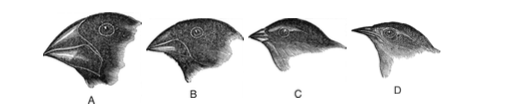
Base your answer(s) to question(s) on the diagram below and on your knowledge of biology. The diagram shows the heads of four different species of Galapagos Islands finches.
The four different types of beaks shown are most likely the result of
The four different types of beaks shown are most likely the result of
a)
gene manipulation
b)
natural selection
c)
unchanging environmental conditions
d)
patterns of behavior learned from parents
28.
"Survival of the Fittest" describes which theory
a)
a) natural selection
b)
b) gravity
c)
c) heredity
d)
d) string theory
29.
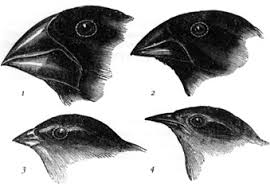
Which process produced the two different types of beaks in the ground finch and the tree finch?
a)
artificial selection
b)
geographical distribution
c)
natural selection
d)
disuse of the beak
30.

All of the following statements are reasons for selective breeding except:
a)
To produce offspring with desirable characteristics
b)
Farmers increase their profit by improving crops
c)
To improve the quality of food products
d)
To increase migration patterns
31.
The purpose of selective breeding is to
a)
Get bigger animals
b)
get smaller animals
c)
create animals with desirable traits
d)
create animals with bad traits
32.
In which scenario could natural selection occur?
a)
a wolf with a heavy fur coat survives harsh winters better than other wolves and passes the trait on
b)
a woodpecker learnes how to eat a new type of beetle.
c)
a shark receives a neutral mutation
d)
a mother passes a deadly mutation on to her child.
33.
Problems with selective breeding include
a)
Better animals
b)
More Meat
c)
Animals can have bad health problems
d)
more diversity
34.

When humans breed organisms with specific traits to influence the traits of the next generation, it is __________.
a)
adaptation
b)
natural breeding
c)
natural selection
d)
selective breeding
35.

The graph shows how the finch population in Burke Lake changed during the past 50 years. What is one thing you can infer based on the information presented in the graph?
a)
Thin-beaked finches prey on wide-beaked finches.
b)
Wide-beaked finches are better suited for life in an ocean environment.
c)
Thin-beaked finches are better suited to the environment in Burke Lake.
d)
Wide-beaked finches are better suited to the environment in Burke Lake.
100 %

