
NEW
Font size
S
M
L
XL
 Worksheets
APES Unit 1 Review
Total questions: 40
Worksheet time: 57mins
Name
Class
Date
1.
Which of these is not an example of a commons?
a)
Aquifers
b)
The ocean
c)
Privately owned farms
d)
Highways
2.
What is an ecological footprint?
a)
footprint of earths resources in relation to the rest of the world
b)
visual of an individuals usage in relation to the rest of the world
c)
the use of resources
d)
The use of footprints in relation to the rest of the world
3.
What can be done to solve problems related to the tragedy of the commons?
a)
Privatization
b)
Regulations, restrictions and quotas
c)
Public education
d)
All of the above
4.
What term describes the positive benefits that wildlife or ecosystems provides to people?
a)
ecosystem services
b)
ecosystem
c)
biodiversity
5.
When lava cools what does it form?
a)
igneous rock
b)
fossils
c)
sedimentary rock
d)
metamorphic rock
6.
Which layer of the atmosphere contains the ozone layer
a)
Troposphere
b)
Stratosphere
c)
Mesosphere
d)
Thermosphere
7.
All of the following are effects of El Nino except
a)
Global Average Temperatures Rising
b)
Upwelling
c)
Flooding
d)
Warmer Pacific OCean
8.
What is a cause of El Nino?
a)
Warm water pushing westward
b)
Cold Water upwells along South America
c)
Weakening of Trade Winds
d)
Strengthening of Trade Winds
9.
Which layer of the atmosphere contains water vapor?
a)
Troposphere
b)
Stratosphere
c)
Mesosphere
d)
Thermosphere
10.
Which of the following is an example of an ecosystem service?
a)
A parasite attains nutrients from its host
b)
Copper is extracted from mines
c)
Wetlands provide flood control for cities
d)
Tsunamis clear the coastland of debris
11.
Which statement BEST summarizes the Tragedy of the Commons?
a)
Self-interests
outweigh public interest
b)
Public
interests outweigh self-interest
c)
It
is all right to be selfish as long as you think of the big picture.
d)
It
is a tragedy when biodiversity disappears.
12.

Which list is in the correct order of atmospheric layers starting from Earth's surface?
a)
troposphere, stratosphere, mesosphere, thermosphere, exosphere
b)
Thermosphere, stratosphere, troposphere, mesosphere, exosphere
c)
Exosphere, troposphere, mesosphere, stratosphere, thermosphere
d)
mesosphere, stratosphere, thermosphere, exosphere, troposphere
13.

Which of the following contributes to the unequal warming of earth?
I. variation in the angle of sunlight that reaches Earth
II. variation in the amount of surface area over which the Sun's rays are distributed
III. variation in the amount of sunlight reflected from clouds
I. variation in the angle of sunlight that reaches Earth
II. variation in the amount of surface area over which the Sun's rays are distributed
III. variation in the amount of sunlight reflected from clouds
a)
I only
b)
I and II only
c)
II and III only
d)
III only
14.

Which of the following has the highest albedo?
a)
soil
b)
snow
c)
water
d)
pavement
15.

Gyres do all of the following EXCEPT
a)
redistribute heat in the ocean
b)
result from the Coriolis effect
c)
rotate clockwise in the Northern Hemisphere
d)
redistribute nutrients from the deep ocean
16.
According to Plate Tectonic Theory, the reason the plates move is
a)
Surface winds push the plates
b)
The weight of the ocean forces the plates to move
c)
Large monsters under the crust are moving the plates
d)
Convection currents within the earth's mantle move the plates
17.
Which type of soil is best for growing plants?
a)
clay
b)
sand
c)
dirt
d)
loam
18.

From top to bottom, name the layers of soil.
a)
bedrock, topsoil, humus, clay
b)
humus, topsoil, clay,silt
c)
humus, topsoil, bedrock, subsoil
d)
humus, topsoil, subsoil, bedrock
19.
Rock that forms when minerals form from solutions or sediment from older rocks get pressed and cemented together.
a)
Sedimentary Rock
b)
Metamorphic Rock
c)
Igneous Rock
20.

This rock started as molten magma. What type of rock is this?
a)
Sedimentary
b)
Igneous
c)
Metamorphic
21.

This rock was formed by smaller pieces of rock that settled at the bottom of a lake millions of years ago. What type of rock is this?
a)
Sedimentary
b)
Igneous
c)
Metamorphic
22.
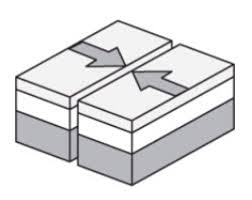
Name the boundary
a)
convergent boundary
b)
divergent boundary
c)
transform boundary
d)
sergent boundary
23.

Name the boundary
a)
convergent boundary
b)
divergent boundary
c)
transform boundary
d)
sergent boundary
24.
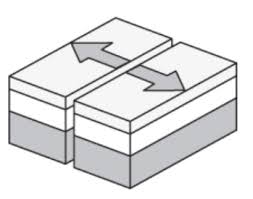
Name the boundary
a)
convergent boundary
b)
divergent boundary
c)
transform boundary
d)
sergent boundary
25.
A subduction zone is formed...
a)
when one tectonic plate sinks below another
b)
at every type of convergent plate boundary
c)
at every type of divergent plate boundary
d)
at transform boundaries
26.

Soil sample that is 60% clay, 30% silt, and 10% sand has which texture?
a)
clay
b)
clay loam
c)
sandy loam
d)
silt
27.
99% of the earth's water is unavailable or unsuitable for human use because:
I. of its salinity
II. it is polluted
III. it lies in inaccessible areas
I. of its salinity
II. it is polluted
III. it lies in inaccessible areas
a)
I only
b)
II only
c)
I and II
d)
I and III
28.
An underground zone from which groundwater can be obtained is:
a)
Recharge Zone
b)
An Aquifer
c)
Discharge Zone
d)
Water shed
29.
Use of water from the Ogallala aquifer in the Great Plains region of the United States is not sustainable because
a)
it is recharged more slowly than it is being used.
b)
industrial use has fallen off but household use has expanded.
c)
it originated many centuries ago.
d)
Increase usage for agriculture to produce ethanol
30.
Which describes the problems with the Aral Sea in Central Asia?
a)
Diversion of rivers increased the water levels and decreased salinity.
b)
Diversion of water decreased the water levels and increased salinity.
c)
Increased drilling for oil created numerous oil spills.
Increased drilling for oil created numerous oil spills.
d)
Dust storms prevented recreation.
31.
A cone of depression may develop
a)
in any area where artesian wells are common
b)
in areas where the water table is rapidly drained for human use.
c)
in unconfined aquifers where water is used for irrigation.
in unconfined aquifers where water is used for irrigation.
d)
near a deep well from which a great deal of water is rapidly pumped.
32.

Levees do which of the following?
I. Prevent flooding
II. Cause flooding downstream
III. Prevent deposition of sediment on floodplains
I. Prevent flooding
II. Cause flooding downstream
III. Prevent deposition of sediment on floodplains
a)
I only
b)
II only
c)
III only
d)
I, II, and III
33.

A dike is
a)
a barrier that runs across a river or stream to control the flow of water.
b)
a structure built to prevent ocean waters from flooding adjacent land
c)
a canal or ditch used to carry water from one location to another.
d)
the body of water created by damming a river or stream.
34.

What is the purpose of an aqueduct?
a)
To protect river channels
b)
To store water
c)
To move water from an area of plenty to an area of need
d)
To aid in fish migration
35.
The water table is
a)
located anywhere water is visible on the surface.
b)
the uppermost level at which water fully saturates rock or soil.
c)
located where water under pressure rises
d)
all the water in a particular watershed.
36.
Groundwater recharge:
a)
is the result of precipitation
b)
occurs rapidly in confined aquifers
c)
does not occur in unconfined aquifers
d)
sometimes occurs as a spring
37.
Which irrigation method is most efficient?
a)
Furrow
b)
Spray
c)
Flood
d)
Drip
38.
Water is a good solvent. This statement explains which of the following phenomena?
I. High concentrations of dissolved ions in seawater.
II. Capacity of living organisms to store many types of molecules in solution in their cells.
III. Easy transport of toxic substances through the environment.
I. High concentrations of dissolved ions in seawater.
II. Capacity of living organisms to store many types of molecules in solution in their cells.
III. Easy transport of toxic substances through the environment.
a)
I only.
b)
II only.
c)
I and III.
d)
I, II, and III.
39.
Greenhouse gases in the Earth’s atmosphere
a)
are in steady state.
b)
are decreasing.
are decreasing.
c)
are increasing.
are increasing.
d)
prove that inputs are equal to outputs.
40.
An example of a positive feedback loop is
I.warmer temperatures of Earth’s surface decreasing the evaporation of water.
II.water evaporation creating low-altitude clouds reflecting sunlight back into clouds.
III.water evaporation creating high-altitude clouds absorbing terrestrial energy that would have escaped the atmosphere.
I.warmer temperatures of Earth’s surface decreasing the evaporation of water.
II.water evaporation creating low-altitude clouds reflecting sunlight back into clouds.
III.water evaporation creating high-altitude clouds absorbing terrestrial energy that would have escaped the atmosphere.
a)
I only
b)
II only
c)
III only
d)
I and II
Reset

