
 Worksheets
Astronomy
Total questions: 36
Worksheet time: 26mins
Name
Class
Date
1.
Why does the Moon have different phases?
a)
It follows the Sun around the Earth.
b)
It moves around the Earth.
c)
It moves around the Sun.
2.
We can see the light shining on the Moon during the New Moon Phase.
a)
True
b)
False
3.
When the Moon is between the Earth and the Sun, it is most likely in what phase?
a)
New
b)
Last Quarter
c)
Full
4.
Is the Moon bigger or small than the Earth?
a)
Bigger
b)
Smaller
c)
The same
5.
When the Earth is between the Moon and the Sun, it is most likeky a:
a)
Full Moon
b)
Half Moon
c)
Last Quarter Moon
6.
The Moon gets its light from the
a)
Earth
b)
Stars
c)
Sun
7.
About how long does it take the Moon to complete it's cycle?
a)
1 week
b)
1 month
c)
1 year
8.

What moon phase is this?
a)
waxing crescent
b)
waxing gibbous
c)
waning crescent
d)
waning gibbous
9.

What moon phase would be seen from Earth when the moon is at position 1?
a)
new moon
b)
first quarter
c)
last quarter
d)
full moon
10.

What moon phase would be seen from Earth when the moon is at position 5?
a)
new moon
b)
first quarter
c)
full moon
d)
last quarter
11.

What moon phase is this?
a)
waxing crescent
b)
waxing gibbous
c)
waning crescent
d)
waning gibbous
12.

What phase of the moon would be visible from Earth when the moon is at position 1?
a)
new moon
b)
first quarter
c)
full moon
d)
last quarter
13.

What phase of the moon would be visible when the moon is at position 3?
a)
new moon
b)
first quarter
c)
full moon
d)
last quarter
14.

What moon phase would be visible from Earth when the moon is at position 5?
a)
first quarter
b)
last quarter
c)
new moon
d)
full moon
15.

What moon phase is this?
a)
first quarter
b)
last quarter
c)
waxing crescent
d)
waning crescent
16.

What moon phase is this?
a)
new moon
b)
full moon
c)
waxing crescent
d)
waning crescent
17.
What does "waxing" mean?
a)
growing
b)
shrinking
c)
lighted
d)
dark
18.
What does "waning" mean?
a)
growing
b)
shrinking
c)
lighted
d)
dark
19.
What side of the moon is the light on when the moon is waning?
a)
left
b)
right
c)
front
d)
back
20.
What side of the moon is the light on when the moon is waxing?
a)
left
b)
right
c)
front
d)
back
21.
The spinning of an object on its axis is called______
a)
orbit
b)
rotation
c)
revolution
d)
tide
22.
Day and night is caused by the _____________ of earth on its axis.
a)
revolution
b)
orbit
c)
rotation
23.
The earth orbits around...
a)
The sun.
b)
the moon
c)
other planets
d)
the Milky Way
24.
It takes the Earth _______ days to travel all the way around the Sun.
a)
28
b)
100
c)
24
d)
365
25.
What is responsible for the moon's illumination?
a)
infrared rays
b)
sunlight reflecting on the surace of the moon
c)
sunlight bouncing off the earth's atmosphere
d)
gamma rays
26.
At which time would your shadow be the shortest?
a)
7:00 am
b)
7:00 pm
c)
12:00 pm
d)
3:30 pm
27.
The sun appears to rise in the...
a)
North
b)
South
c)
East
d)
West
28.

This is a_________
a)
Waning Gibbous Moon
b)
tilt
c)
sun
d)
Waxing Gibbous Moon
29.

Name the moon phase
a)
Waxing Gibbous
b)
Waxing Crescent
c)
Waning Crescent
d)
Waning Gibbous
30.

Name the moon phase
a)
Waning Crescent
b)
Waxing Crescent
c)
Waning Gibbous
d)
Waxing Gibbous
31.
The sun rises in the ______ and sets in the ________.
a)
East, West
b)
West, East
c)
North, South
d)
East, South
32.
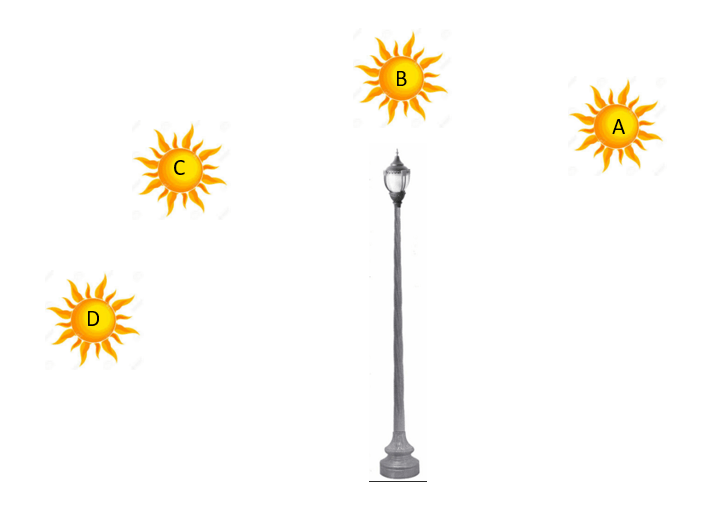
At which location of the sun would the shadow of the light pole be the longest?
a)
A at 11 a.m
b)
B at noon
c)
C at 2 p.m.
d)
D at 6 p.m.
33.
The spinning of an object on its axis is called______
a)
orbit
b)
rotation
c)
revolution
d)
tide
34.
Day and night is caused by the _____________ of earth on its axis.
a)
revolution
b)
orbit
c)
rotation
35.
The Earth's _______ is an imaginary line that goes from the North Pole to the South Pole.
a)
vernal equinox
b)
axis
c)
solar eclipse
d)
solar flare
36.
The sun appears to move across the sky each day. What causes this?
a)
the spinning of the Earth's axis
b)
The path of the sun around the Earth
c)
the production the nuclear energy around the sun
d)
the tilt of the Earth on its axis
100 %

