
NEW
Font size
S
M
L
XL
 Worksheets
SB1b. Cellular Reproduction
Total questions: 20
Worksheet time: 11mins
Name
Class
Date
1.

Have you ever heard of a skin graft? Skin cells can be harvested from one area and be grown in order to help burn victims or other skin injuries. Which process would result in the development of more skin cells in this treatment?
a)
Mitosis
b)
Meiosis
c)
Crossing Over
d)
Interphase
2.

When an area of a chromatid is exchanged with the matching area on a chromatid of its homologous chromosome, _________________ occurs
a)
crossing over
b)
mutagenesis
c)
hybridization
d)
fertilization
3.

Is the following cell diploid or haploid?
a)
Diploid
b)
Haploid
4.

What phase is represented?
a)
metaphase 1
b)
metaphase 2
c)
anaphase 1
d)
anaphase 2
5.

What is one of the advantages, why is it better to reproduce sexually versus asexually?
a)
survival of the fittest
b)
overproduction
c)
genetic variation
d)
cloning
6.

Body cells may produce additional body cells by means of _________. Organisms that reproduce sexually produce gametes by means of the process of _________.(DOK2).
a)
mitosis; meiosis
b)
meiosis; mitosis
c)
mitosis; conjugation
d)
meiosis; gametogenesis
7.

The organism shown in the drawing below usually reproduces through the __________ process called binary fission.
a)
asexual
b)
heterosexual
c)
isosexual
d)
sexual
8.

During cell division, or mitosis, an exact duplicate of the original cell is produced. The instructions for cell division are found in the __________ which are found in the __________.(DOK2)
a)
Nucleus: RNA
b)
Chromosomes: nucleus
c)
Nucleus: nucleolus
d)
Ribosomes: RNA
9.

Meiosis makes four __________ cells.(DOK2)
a)
diploid
b)
haploid
c)
metabolic
d)
prokaryotic
10.

The stages of mitotic cell division are shown in the diagram above. At which stage are the chromosomes at the equator of the cell? (DOK2)
a)
Anaphase
b)
Prophase
c)
Metaphase
d)
Telophase
11.

Sea stars (starfish) can reproduce asexually by fragmentation if their arms are cut off, or sexually by releasing sperm and eggs into the water. Which of these is the major difference between asexual and sexual reproduction in sea stars?
a)
The chromosome number is reduced in sea stars during sexual reproduction.
b)
The number of chromosomes is increased in sea stars during sexual reproduction.
c)
The appearance of the sea stars is changed as a result of asexual reproduction.
d)
There is no genetic variation in the sea stars as a result of asexual reproduction.
12.

Arrange the stages of mitosis shown in the diagram above in sequential order. Use the numbers on the image to indicate the order. Hint: Do not use 3, because those cells are in interphase. (DOK2)
a)
1 2 3 4 5
b)
4 5 2 1
c)
2 1 5 4
d)
1 2 5 4
13.

Mitosis is useful for the creation of new cells which is important for all of the following EXCEPT
a)
organism growth.
b)
repair of damage.
c)
replacement of worn out cells.
d)
generation of gametes, also known as sex cells.
14.
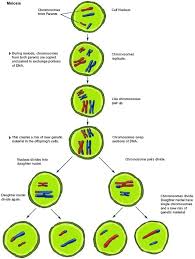
This diagram shows which cellular process that occurs in organisms?
a)
endocytosis
b)
mitosis
c)
meiosis
d)
phagocytosis
15.

Which of these correctly distinguishes mitosis from meiosis?(DOK3)
a)
Mitosis occurs in germ cells and meiosis occurs in somatic cells.
b)
Crossing over takes place in mitosis and not in meiotic cell division.
c)
Meiosis produces four 2N daughter cells; mitosis produces two 2N daughter cells.
d)
The number of chromosomes remains the same in mitosis and is reduced by half in meiosis.
16.

At the end of meiosis II, how does the DNA in each of the four new cells compare to the DNA from the original cell? (DOK3)
a)
half as much and genetically the same as the original
b)
twice as much and genetically the same as the original
c)
half as much and genetically different from the original
d)
twice as much and genetically different from the original
17.

This picture shows which process?
a)
mitosis
b)
meiosis
c)
the cell cycle
d)
binary fission
18.

A human body cell has 46 chromosomes. How many chromosomes does a female egg cell have?
a)
23
b)
24
c)
46
d)
48
19.
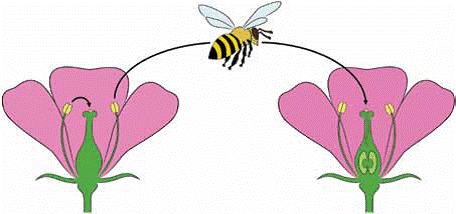
The bee is accidentally responsible for transferring pollen from the anther to the stigma. Following the bee's visit, what takes place NEXT in the life cycle of a flowering plant? (DOK3)
a)
Germination
b)
Pollination
c)
Fertilization
d)
Seed production
20.

This picture shows which process?
a)
mitosis
b)
meiosis
c)
the cell cycle
d)
binary fission
Reset

