
 Worksheets
Unit 2 Review
Total questions: 64
Worksheet time: 2hrs 2mins
Name
Class
Date
1.
Point that are contained in the same line-
a)
ray
b)
segment
c)
collinear
2.
This proceeds infinitely from a definite starting point.
a)
segment
b)
line
c)
ray
3.
This is a finite or measurable piece of a line.
a)
segment
b)
ray
c)
line
4.
Points that are not contained by one line are called ___________.
a)
coplanar
b)
collinear
c)
noncoplanar
d)
noncollinear
5.
A set of points extending forever in two directions is a _______________.
a)
Space
b)
Line
c)
Segment
d)
Ray
6.
When two planes intersect, they intersect _________________________.
a)
at a point
b)
in a line
c)
at three points
d)
in two lines
7.
Points that lie in the same plane are called ______________________.
a)
Collinear
b)
Coplanar
c)
Noncollinear
d)
Noncoplanar
8.
How many points determine a plane?
a)
two collinear points
b)
three collinear points
c)
three noncollinear points
d)
two noncollinear points
9.
The set of all points that two or more figures have in common are called __________________.
a)
a line
b)
a plane
c)
an intersection
d)
an angle
10.
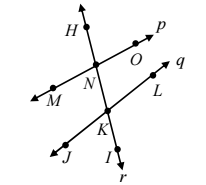
Name 4 collinear points
a)
HMNO
b)
IKNO
c)
MJOL
d)
HNKI
11.

A line that contains point M.
a)
Line q
b)
Line p
c)
Line r
d)
Line NH
12.

An example of 2 non-collinear points.
a)
D, E
b)
C, B
c)
M, E
d)
F, B
13.

Give another name for line k.
a)
Line BC
b)
Line BCE
c)
Line ED
d)
Line k is the only name, there isn't another name.
14.

A plane containing point A.
a)
Plane DEA
b)
Plane k
c)
Plane CDF
d)
Plane F
15.
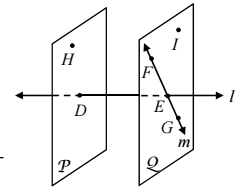
Give another name for plane Q.
a)
Plane FEGI
b)
Plane FEG
c)
Plane m
d)
Plane FGI
16.

a)
A
b)
B
c)
C
d)
D
17.

a)
A
b)
B
c)
C
d)
D
18.
Used to prove that a conjecture is false.
a)
Counterexample
b)
Inductive Reasoning
c)
Concluding statement
d)
Conjecture
19.
Which number is a counterexample to the following statement? :
All numbers that are divisible by 2 are divisible by 4
All numbers that are divisible by 2 are divisible by 4
a)
0
b)
12
c)
28
d)
42
20.
Using the statements:
If it is Friday, then I will get paid.
It is Friday.
Write the conclusion.
If it is Friday, then I will get paid.
It is Friday.
Write the conclusion.
a)
It is not Friday
b)
It is Friday
c)
I will not get paid
d)
I will get paid
21.
What does this symbol ↔ mean?
a)
and
b)
or
c)
if and only if
d)
implies
22.
Using the Law of Syllogism, which of the following completes the statement to form a valid conclusion?
If it is snowing heavily, then school will be canceled.
If school is canceled, the big test will not be given today.
It is snowing heavily, then...
If it is snowing heavily, then school will be canceled.
If school is canceled, the big test will not be given today.
It is snowing heavily, then...
a)
Look out for the snowplows while driving to school.
b)
The big test will not be given today.
c)
The roads will be hard to drive on.
d)
You should call the school to see if school is canceled.
23.
Which is a valid conclusion from these statements?
If a quadrilateral is a rhombus, then it is a parallelogram.
If a quadrilateral is a parallelogram, then its opposite angles are congruent.
If a quadrilateral is a rhombus, then it is a parallelogram.
If a quadrilateral is a parallelogram, then its opposite angles are congruent.
a)
Opposite angles of a quadrilateral are congruent
b)
Opposite angles of a rhombus are congruent
c)
Every quadrilateral is a rhombus
d)
Every parallelogram is a rhombus
24.
Which statement is a valid conclusion based on the argument?
If a polygon is a regular pentagon, then the polygon has exactly five congruent angles.
The polygon is a regular pentagon.
If a polygon is a regular pentagon, then the polygon has exactly five congruent angles.
The polygon is a regular pentagon.
a)
Therefore, the polygon is a rectangle.
b)
Therefore, the polygon is a regular quadrilateral.
c)
Therefore, the polygon has exactly five congruent angles.
d)
Therefore, the polygon has congruent sides.
25.
Determine whether the stated conclusion is valid.
Given: If an animal is a dog, then they like biscuits.
Sammy is a dog.
Conclusion: Sammy likes biscuits.
Given: If an animal is a dog, then they like biscuits.
Sammy is a dog.
Conclusion: Sammy likes biscuits.
a)
Invalid
b)
Valid
c)
Sammy is a Great Dane
d)
Sammy is really a cat.
26.
Draw a conclusion from the statement.
Given: If a parasite lives in or on a host organism, then it harms its host.
A virus is a parasite.
Conclusion: ?
Given: If a parasite lives in or on a host organism, then it harms its host.
A virus is a parasite.
Conclusion: ?
a)
The virus will harm the host.
b)
I have a cold.
c)
The virus lives in or on a host
d)
Invalid
27.
Draw a conclusion from the statement.
Given: If you live in Orlando, then you live in Florida.
Roger lives in Orlando.
Conclusion: ?
Given: If you live in Orlando, then you live in Florida.
Roger lives in Orlando.
Conclusion: ?
a)
Roger lives in Disney Land
b)
Roger is an old person.
c)
Roger lives in Florida
d)
Roger lives in Orlando
28.
Use the Law of Syllogism to draw a conclusion from the two given statements:
Statement 1: If you exercise regularly, then you have a healthy body.
Statement 2: If you have a healthy body, then you have more energy.
Conclusion: ?
Statement 1: If you exercise regularly, then you have a healthy body.
Statement 2: If you have a healthy body, then you have more energy.
Conclusion: ?
a)
You have more energy
b)
If you exercise regularly, then you have more energy
c)
You have a healthy body
d)
If you do not have a healthy body, then you do not exercise regularly
29.
Use the Law of Detachment to draw a conclusion from the two given statements. If not possible, write "no valid conclusion".
Given:
If you study for one hour each day, then you will score well on the exam.
Sally scored well on the exam.
Conclusion: ?
Given:
If you study for one hour each day, then you will score well on the exam.
Sally scored well on the exam.
Conclusion: ?
a)
Sally studied for 1 hour each day.
b)
Sally did not study for 1 hour each day
c)
If Sally does well on the exam, she studied for 1 hour each day.
d)
No valid conclusion
30.
Identify the hypothesis and conclusion of the conditional statement:
If you give me twenty dollars, then I will be your best friend.
If you give me twenty dollars, then I will be your best friend.
a)
Hypothesis: I will be your best friend
Conclusion: you give me twenty dollars
Conclusion: you give me twenty dollars
b)
Hypothesis: you give me twenty dollars
Conclusion: I will be your best friend
Conclusion: I will be your best friend
c)
Hypothesis: if you have to pay for friends
Conclusion: then you probably should reevaluate your life
Conclusion: then you probably should reevaluate your life
d)
Hypothesis: you will not have to pay twenty dollars
Conclusion: if you have lots of friends
Conclusion: if you have lots of friends
31.
Given, "If angles are congruent, then the measures of the angles are equal." Identify the converse.
a)
If the measures of the angles are equal, then the angles are congruent.
b)
"If angles are not congruent, then the measures of the angles are not equal."
c)
If the measures of the angles are not equal, then the angles are not congruent.
d)
If the angles are not congruent, then the measure of the angles are equal.
32.
If something is an angle, then it is acute. What is an appropriate counterexample?
a)
70⁰
b)
45⁰
c)
120⁰
d)
True. There is no counterexample.
33.
Given, "If angles are congruent, then the measures of the angles are equal." Identify the contrapositive.
a)
If the measures of the angles are equal, then the angles are congruent.
b)
If angles are not congruent, then the measures of the angles are not equal.
c)
If the measures of the angles are not equal, then the angles are not congruent.
d)
If the angles are not congruent, then the measure of the angles are equal.
34.

Which of the following is the inverse to the statement:
"If you diet and exercise, then you will lose weight."
"If you diet and exercise, then you will lose weight."
a)
If you don't diet and exercise, then you will not lose weight.
b)
If you don't diet and exercise, then you will lose weight.
c)
If you lose weight, then you dieted and exercised.
d)
If you don't lose weight, then you diet and exercise.
35.
Given, "If I have a Siberian Husky, then I have a dog." Identify the inverse.
a)
If I do not have a Siberian Husky, then I do not have a dog.
b)
If I have a dog, then I have a Siberian Husky.
c)
If I do not have a dog, then I do not have a Siberian Husky.
d)
If I do not have a Siberian Husky, then I have a dog.
36.
Given, "If I have a Siberian Husky, then I have a dog." Identify the contrapositive.
a)
If I do not have a Siberian Husky, then I do not have a dog.
b)
If I have a dog, then I have a Siberian Husky.
c)
If I do not have a dog, then I do not have a Siberian Husky.
d)
If I do not have a Siberian Husky, then I have a dog.
37.
Given, "If angles are congruent, then the measures of the angles are equal." Identify the converse.
a)
If the measures of the angles are equal, then the angles are congruent.
b)
"If angles are not congruent, then the measures of the angles are not equal."
c)
If the measures of the angles are not equal, then the angles are not congruent.
d)
If the angles are not congruent, then the measure of the angles are equal.
38.
Given, "If angles are congruent, then the measures of the angles are equal." Identify the inverse.
a)
If the measures of the angles are equal, then the angles are congruent.
b)
"If angles are not congruent, then the measures of the angles are not equal."
c)
If the measures of the angles are not equal, then the angles are not congruent.
d)
If the angles are not congruent, then the measure of the angles are equal.
39.
Given, "If angles are congruent, then the measures of the angles are equal." Identify the contrapositive.
a)
If the measures of the angles are equal, then the angles are congruent.
b)
If angles are not congruent, then the measures of the angles are not equal.
c)
If the measures of the angles are not equal, then the angles are not congruent.
d)
If the angles are not congruent, then the measure of the angles are equal.
40.
Conditional: If it does not rain today, then we will have practice.
What is this statement called: If it rains today, then we will not have practice.
What is this statement called: If it rains today, then we will not have practice.
a)
Converse
b)
Inverse
c)
Contrapositive
d)
Negation
41.
Conditional: If Maria gets married, then the reception will be at the country club.
What is this statement: If the reception is at the country club, then Maria will be getting married.
What is this statement: If the reception is at the country club, then Maria will be getting married.
a)
Converse
b)
Inverse
c)
Contrapositive
d)
Negation
42.
Original: If Emily is not late to class, then she will not be marked tardy.
What is this? If Emily is late to class, then she will be marked tardy.
What is this? If Emily is late to class, then she will be marked tardy.
a)
Converse
b)
Inverse
c)
Contrapositive
d)
Negation
43.
Original: If Jenny buys a guitar, then she will not buy a keyboard.
What is this? If Jenny does buy a keyboard, then she will not buy a guitar.
What is this? If Jenny does buy a keyboard, then she will not buy a guitar.
a)
Converse
b)
Inverse
c)
Contrapositive
d)
Negation
44.
When can a biconditional statement be true?
a)
When the inverse and the converse are both true
b)
When the original statement (conditional statement) & the contrapositive are both true.
c)
When the converse is true.
d)
When the original statement (conditional statement) and the converse are both true.
45.

Solve for x
a)
x = 2
b)
x = 4
c)
x = 6
d)
x = 8
46.

Find HG.
a)
8
b)
9
c)
10
d)
11
47.
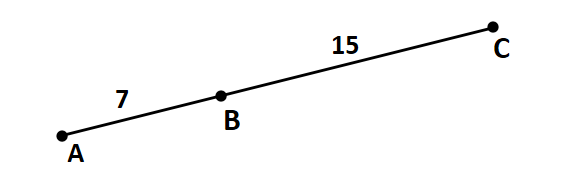
Find AC
a)
7
b)
8
c)
22
d)
23
48.
Consider the related biconditional statement for the conditional
statement “If Shelly lives in Texas, then she lives in the United States.”
Which of the following statements is true about the related biconditional statement?
Which of the following statements is true about the related biconditional statement?
a)
The biconditional is true
because the conditional is true.
b)
The biconditional is false
because the conditional and its converse are false.
c)
The biconditional is true
because the conditional and its converse are true.
d)
The biconditional is false
because the converse of the conditional is false.
49.
What is the biconditional that matches the statement: "A right angle is an angle with 90 degrees."
a)
If an angle has 90 degrees, then it is a right angle.
b)
If an angle is a right angle, then it has 90 degrees.
c)
An angle is a right angle if and only if it has 90 degrees.
50.
What phrase does a biconditional statement use?
a)
if, then
b)
if, when
c)
if and only if
d)
then, if
51.
What is the biconditional that matches the statement below: An even number is a number that is divisible by 2.
a)
A number is even if and only if it is divisible by 2.
b)
If a number is divisible by 2, then it is even.
c)
If a number is even, then it is divisible by 2.
52.
Conditional statement
a)
If p, then q.
b)
If q, then p.
c)
If not p, then not q.
d)
If not q, then not p.
53.
Converse statement
a)
If p, then q.
b)
If q, then p.
c)
If not p, then not q.
d)
If not q, then not p.
54.
Inverse statement
a)
If p, then q.
b)
If q, then p.
c)
If not p, then not q.
d)
If not q, then not p.
55.
Contrapositive statement
a)
If p, then q.
b)
If q, then p.
c)
If not p, then not q.
d)
If not q, then not p.
56.
Write the biconditional.
a)
If I win, then you don't lose.
b)
If I win, the you lose.
c)
I win if and only if you don't lose.
d)
If you don't lose, then I win.
57.

Use the figure to write and solve an equation for x.
a)
5
b)
6
c)
7
d)
8
58.
Solve for x
a)
x = 2
b)
x = 4
c)
x = 6
d)
x = 8
59.
Given that A is between B and C, which Segment Addition statement is correct?
a)
AB + BC = AC
b)
BC + BA = BC
c)
BA + AC = BC
d)
AB + BC = AC
60.
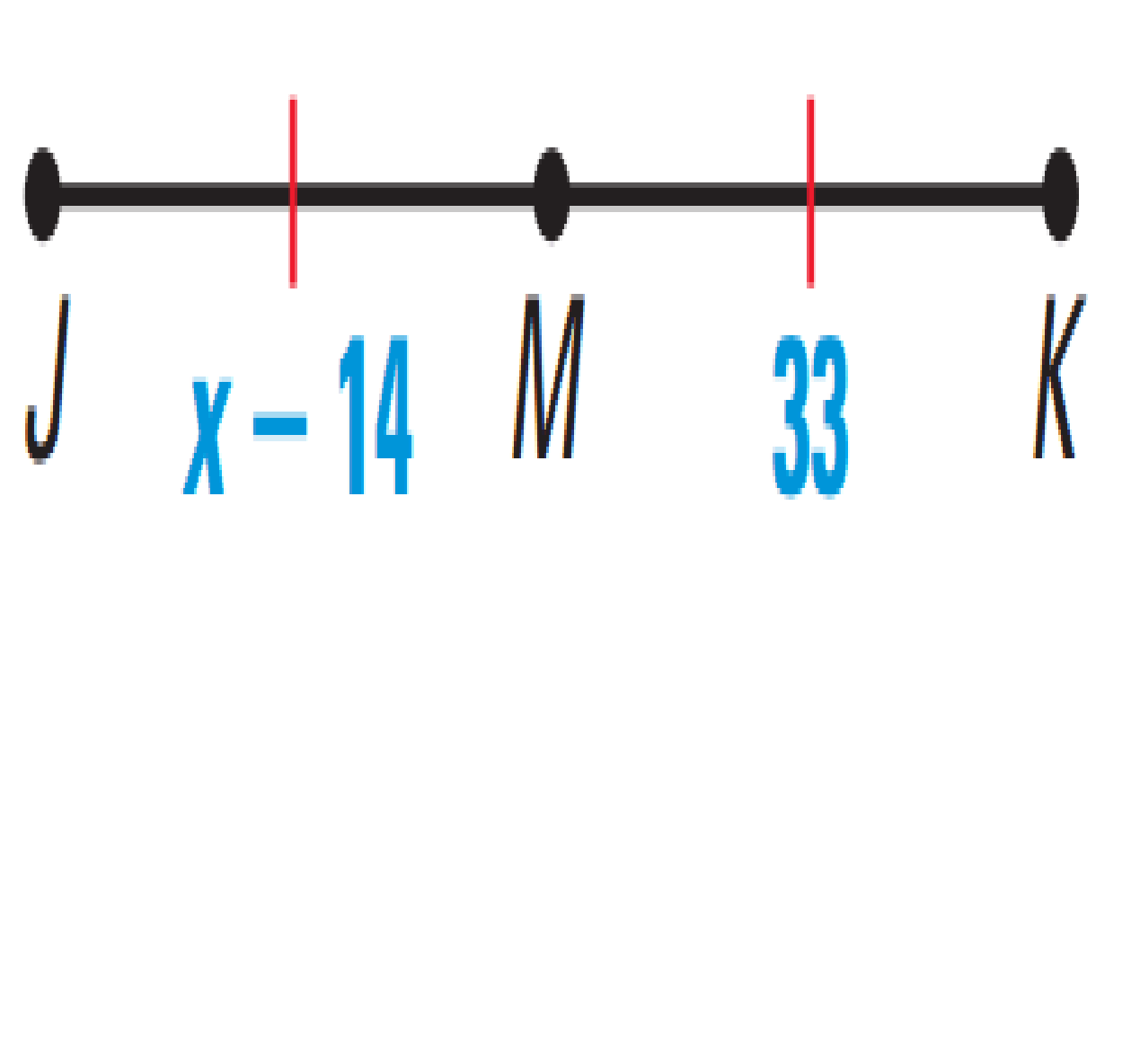
Find the value of x.
a)
x=47
b)
x=19
c)
x=33
d)
x= -47
61.
Q is the midpoint of PR.
PQ = 6x – 7 and QR = 5x + 1.
Find the length of PR.
PQ = 6x – 7 and QR = 5x + 1.
Find the length of PR.
a)
8
b)
16
c)
41
d)
82
62.
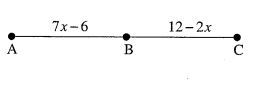
B is the midpoint of AC. Find AB.
a)
2
b)
16
c)
8
d)
4
63.

a)
9
b)
0
c)
8
d)
-8
64.
What is the midpoint between (3, -1) and (7, -5)
a)
(5, -2)
b)
(10, -6)
c)
(5, -3)
d)
(2, -2)
100 %

