
 Worksheets
TDC 22 Ocean Currents and Plate Tectonics
Total questions: 50
Worksheet time: 24mins
Name
Class
Date
1.
The Coriolis Effect is caused by
a)
Earth rotating around the sun
b)
Earth rotating on its axis
c)
The tides
d)
Gravity
2.
Due to the Coriolis Effect, water in the northern hemisphere moves
a)
clockwise
b)
counter clockwise
c)
both
d)
neither
3.
Due to the Coriolis Effect, water in the southern hemisphere moves
a)
clockwise
b)
counter-clockwise
c)
both
d)
neither
4.
Warm ocean currents generally come from
a)
The North Pole
b)
The South Pole
c)
The Equator
d)
Both A and B
5.
Cold ocean currents generally come from
a)
The North Pole
b)
The South Pole
c)
The Equator
d)
Either Pole
6.
A horizontal movement of ocean water that is caused by wind and that occurs at or near the ocean's surface.
a)
Gulf Stream
b)
Global Conveyor Belt
c)
Surface Current
d)
Gyre
7.
The Gulf stream carries _____________ water from the east coast of The United States to the West coast of Europe.
a)
Cold
b)
Warm
c)
Freezing
d)
Fresh
8.
The California Current (west coast) carries _________ water from canada
a)
Cold
b)
Warm
c)
Freezing
d)
Fresh
9.
Two types of water currents are
a)
local and global
b)
sea and land
c)
surface and deep
d)
warm and cold
10.
How do warm-water currents affect the coastal areas along which they flow?
a)
Cool the coast
b)
Warm the coast
c)
Cause snow to fall
d)
Cause higher tides
11.
What name is given to large, destructive waves caused by underwater earthquakes and volcanoes?
a)
Spring tide
b)
Longshore current
c)
Tsunami
d)
Swell
12.
Upwelling is associated with
a)
a decrease in access to nutrients for phytoplankton
b)
cooler, nutrient-rich waters being pushed up from deeper ocean waters
c)
temperature gradients moving water from the equator to the poles
d)
an increase in human fatalities
13.

The current that Marlin and Dorry take in "Finding Nemo" is a warm water current known as the ____________________
a)
East Australian Current (EAC)
b)
Antaractic Subpolar Current (ASC)
c)
California Current (CCD)
d)
Canary Atlantic Middle Current (CAM)
14.
What can you infer about the water at the surface of the ocean, compared to the water hundreds of meters below?
a)
Surface water tends to be saltier
b)
Surface water tends to be denser
c)
Surface water tends to be warmer
d)
Surface water tends to be calmer
15.
Ocean currents have an affect on which two things
a)
climate and weather
b)
temperature and density
c)
land and sea
d)
equator and poles
16.
The hot "line" around the center of the earth is called the
a)
Equalibrium
b)
Equator
c)
Tropic of Cancer
d)
Tropic of Capricorn
17.
The type of plate boundary where two plates come together is a .....
a)
Convergent Boundary
b)
Divergent Boundary
c)
Transform Boundary
d)
Plate Boundary
18.

What type of event will occur at this boundary?
a)
Earthquake
b)
Volcano Eruption
c)
Tornado
d)
Mountain Building
19.
A divergent boundary occurs when plates ....
a)
Pull apart
b)
Come together
c)
Slide past each other
d)
subducting
20.
Which of the following is the name of the ancient supercontinent formed 28 Million Years ago.
a)
Pangea
b)
Gondwanda
c)
Laurasia
d)
Neverland
21.
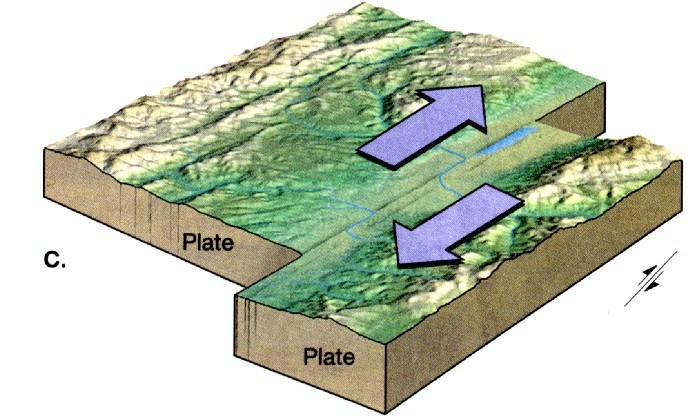
What type of plate boundary is this?
a)
Transform
b)
Convergent
c)
Divergent
d)
Plate
22.
The theory that says Earth's continents once made up an ancient supercontinent, and have been drifting apart ever since, is called the theory of...
a)
Pangea
b)
Plate Tectonics
c)
Natural Selection
d)
Gravity
23.
Oceanic Trenches are formed by _______ plate boundaries
a)
Convergent
b)
Transform
c)
Plate
d)
Divergent
24.
Mountains are created when....
a)
Two continental plates collide
b)
Two oceanic plates pull apart
c)
An Oceanic plate subducts under a Continental Plate
d)
Two continental plates pull apart
25.

The physical layer of Earth made of solid rock and soil is called the ___________.
a)
mesosphere
b)
lithosphere
c)
asthenosphere
d)
mantle
26.
The physical layer of Earth made of molten rock and fire is called the ___________.
a)
mesosphere
b)
lithosphere
c)
asthenosphere
d)
mantle
27.
Which type of plate boundary would cause mountains to form?
a)
Transform
b)
Convergent
c)
Divergent
d)
Reform
28.
The Great Rift Valley in Africa and the Mid-Ocean Ridge were all created by this boundary
a)
Divergent
b)
Convergent
c)
Reform
d)
Transform
29.
What are the two types of crust
a)
continental and oceanic
b)
ocean and upper
c)
lower and upper
d)
pizza and subway
30.
Earthquakes and volcanoes are most likely found in which locations?
a)
At plate boundaries
b)
in oceans
c)
in the middle of continents
d)
in the middle of plates
31.
The Himalayas in Asia are an example of what type of plate boundary?
a)
divergent
b)
continent-to-continent convergent
c)
ocean-to-continent convergent
d)
transform
32.
Transform boundaries are most likely to produce what phenomenon?
a)
volcanoes
b)
deep sea trenches
c)
underwater mountain ranges
d)
earthquakes
33.
Which of the following is NOT a tectonic boundary?
a)
Convergent
b)
Divergent
c)
Sedergent
d)
Transform
34.
Two tectonic plates collide at a _______ plate boundary.
a)
convergent
b)
divergent
c)
transform
35.
Most volcanoes and earthquakes occur...
a)
along the coast
b)
along tectonic plate boundaries
c)
in the Arctic
d)
in the ocean
36.

What type of boundary is the SAN ANDREAS FAULT on?
a)
Covergent
b)
Transformers
c)
Divergent
d)
Transform
37.

What is the name of the plate boundary that slides past each other?
a)
Divergent
b)
Convergent
c)
Transform
d)
Mr. C the Slide Man
38.
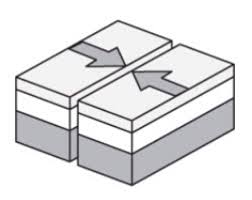
Name the boundary
a)
convergent boundary
b)
divergent boundary
c)
transform boundary
d)
sergent boundary
39.

The huge pieces of the earth's crust are called ____________________________.
a)
crust
b)
plates
c)
directions
d)
seismos
40.

The outside layer of the earth is called ______________________.
a)
core
b)
crust
c)
mantle
d)
outer core
41.

This famous transform fault is located in the western United States creates significant earthquake activity for California
a)
New Madrid
b)
Denali Fault
c)
Ramapo Seismic Zone
d)
San Andreas
42.

Where 2 plates are moving apart
a)
Convergent Boundary
b)
Divergent Boundary
c)
Transform Boundary
43.

Name this plate boundary.
a)
divergent
b)
convergent
c)
transform
d)
allegiant
44.

Name this plate boundary.
a)
divergent
b)
convergent
c)
transform
d)
transformers
45.

Name this plate boundary.
a)
divergent
b)
convergent
c)
transform
d)
insurgent
46.
An area with upwelling current is a great place for fishing
a)
True
b)
False
47.
Warm ocean currents generally come from
a)
The North Pole
b)
The South Pole
c)
The Equator
d)
Both A and B
48.
Cold ocean currents generally come from
a)
The North Pole
b)
The South Pole
c)
The Equator
d)
Either Pole
49.

Upward flow of cold, nutrient rich water from the ocean bottom
a)
Neap Tide
b)
Capillary action
c)
Upwelling
d)
Mr. Jordan
50.
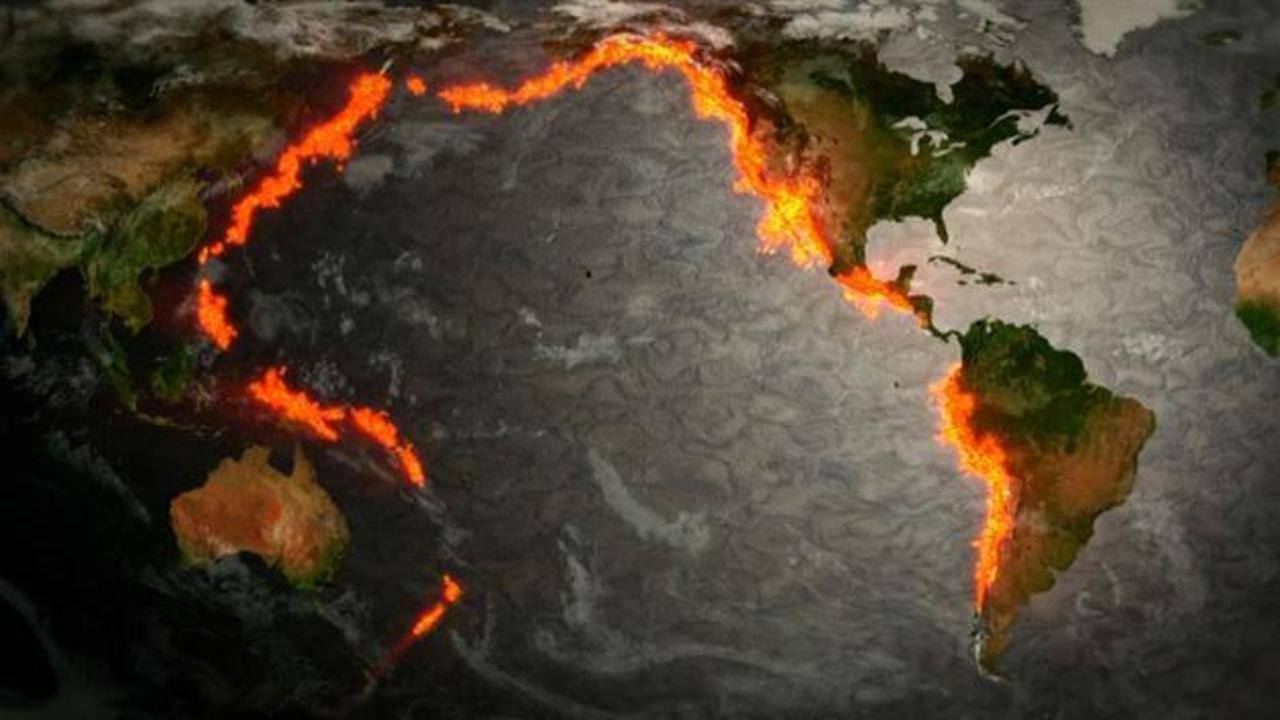
Which ocean in the world is also known as the "Ring of Fire"
a)
Atlantic
b)
Indian
c)
Arctic
d)
Pacific
100 %

