
 Worksheets
Rocks and Minerals
Total questions: 135
Worksheet time: 2hrs 26mins
Name
Class
Date
1.
Metamorphic rocks are existing rocks that have been changed into new rocks by _____.
a)
heat
b)
time
c)
pressure
d)
All of the above
2.
The continuous series of change that rocks undergo is known as the _____.
a)
rock cycle
b)
water cycle
c)
hibernation
d)
metamorphisis
3.
True or False:
The cleavage of a mineral is the way the mineral shines or reflects light.
The cleavage of a mineral is the way the mineral shines or reflects light.
a)
True
b)
False
4.
What is the name of the mineral that leaves a white streak when scraped across a surface and is used to make powder.
a)
graphite
b)
talk
c)
gold
d)
fingernail
5.
What type of rock would you most likely find a fossil inside of?
a)
sedimentary
b)
igneous
c)
metamorphic
d)
diamond
6.
True or False:
Sedimentary rocks always form under water.
Sedimentary rocks always form under water.
a)
true
b)
false
7.
What type of rock is formed when magma and lava cools and hardens?
a)
minerals
b)
sedimentary
c)
igneous
d)
metamorphic
8.

a)
Gold
b)
Hematite
c)
Pyrite
d)
Galena
9.

a)
luster
b)
streak
c)
scratch
d)
hardness
10.
a)
Gold
b)
Hematite
c)
Pyrite
d)
Galena
11.
a)
luster
b)
streak
c)
scratch
d)
hardness
12.

a)
Fluorite
b)
Talk and Calcite
c)
Talc
d)
none of the above
13.

a)
Talc
b)
Gypsum
c)
Fluorite
d)
Talc and Gypsum
14.
Emily was looking at a rock and saw tiny crystals. Emily should know that all rocks are made up of _____.
a)
diamonds
b)
minerals
c)
fossils
d)
dirt
15.

a)
Talc
b)
Gypsum
c)
Talc and Gypsum
d)
Fluorite
16.
a)
Talc
b)
Gypsum
c)
Fluorite
d)
Talc and Gypsum
17.
Emily was looking at a rock and saw tiny crystals. Emily should know that all rocks are made up of _____.
a)
diamonds
b)
minerals
c)
fossils
d)
dirt
18.
What would you use to determine the hardness of a mineral?
a)
color tiles
b)
streak test
c)
Mohs Scale
d)
weight scale
19.
What type of rock is formed when an existing rock has been changed into a new rock?
a)
sedimentary
b)
igneous
c)
minerals
d)
metamorphic
20.
True or False:
A mineral is a solid, nonliving material with a definite chemical makeup.
A mineral is a solid, nonliving material with a definite chemical makeup.
a)
True
b)
False
21.
What would you use to determine the hardness of a mineral?
a)
color tiles
b)
streak test
c)
Mohs Scale
d)
weight scale
22.
What type of rock is formed when an existing rock has been changed into a new rock?
a)
sedimentary
b)
igneous
c)
minerals
d)
metamorphic
23.
True or False:
A mineral is a solid, nonliving material with a definite chemical makeup.
A mineral is a solid, nonliving material with a definite chemical makeup.
a)
True
b)
False
24.
What layer of the Earth are minerals found in?
a)
outer core
b)
inner core
c)
mantle
d)
crust
25.
What type of rock forms when sand, particles of rock, bits of soil, and remains of once-living things are cemented?
a)
igneous
b)
sedimentary
c)
minerals
d)
metamorphic
26.
Which of the following is NOT a property that can be used to identify a mineral?
a)
luster
b)
color
c)
weight
d)
hardness
27.
What type of rocks would I most likely see at the top of a volcano?
a)
igneous
b)
metamorphic
c)
sedimentary
d)
minerals
28.
How could you determine the streak of a mineral?
a)
streak test
b)
balance test
c)
weight test
d)
scratch test
29.
Which of the following is a type of rock?
a)
igneous
b)
metamorphic
c)
sedimentary
d)
All of the above
30.
A solid material that is made up of one or more minerals.
a)
mineral
b)
rock
c)
fossil
d)
soil
31.
What do we call the scientist who studies rocks?
a)
geologist
b)
rock scientist
c)
rockologist
d)
mineralogist
32.
A mineral is a living object
a)
True
b)
False
33.
A solid material that is made up of one or more minerals.
a)
mineral
b)
rock
c)
fossil
d)
soil
34.
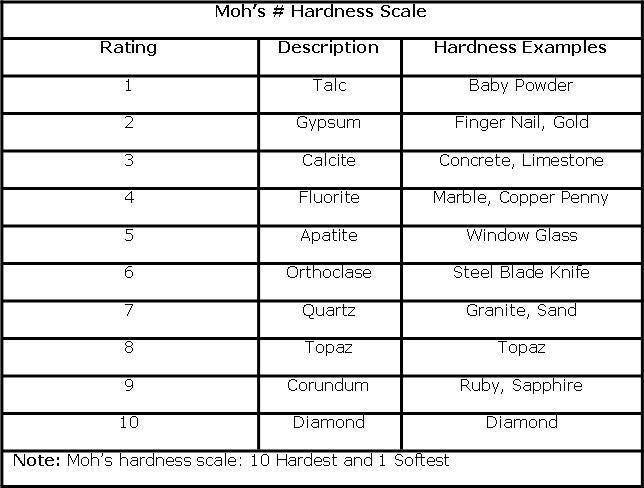
Diamond has a hardness of ___ on Mohs Hardness Scale.
a)
1
b)
5
c)
8
d)
10
35.
Dull, silky, waxy, pearly, and earthy are terms that best describe which property of minerals?
a)
luster
b)
color
c)
streak
d)
cleavage
36.
How do you test the hardness of a mineral?
a)
Throw it against a wall
b)
Step on it
c)
Scratch Test
d)
Kick it until it breaks
37.

The mineral in the picture has a ____________ luster.
a)
Nonmetallic
b)
Metallic
c)
Pearly
d)
Earthy
38.
Which of the following properties does the Mohs scale measure?
a)
Luster
b)
Hardness
c)
Density
d)
Streak
39.
The ___________ of a mineral is the way the mineral shines or reflects light.
a)
Hardness
b)
Color
c)
Sparkle
d)
Luster
40.
A mineral's resistance to being scratched is called?
a)
streak
b)
luster
c)
hardness
d)
heft
41.

a)
Gold
b)
Hematite
c)
Pyrite
d)
Galena
42.
Emily was looking at a rock and saw tiny crystals. Emily should know that all rocks are made up of _____.
a)
diamonds
b)
minerals
c)
fossils
d)
dirt
43.
Mrs. Ashimi has an object. What is a good question to ask her to figure out if it is a rock or a mineral?
a)
Is it round?
b)
Does it come from the Earth?
c)
Is it pure or made of more than one thing?
d)
Can you see through it?
44.
Pick the correct difference between a rock and a mineral.
a)
A rock can be made up of minerals, but minerals cannot be made up of a rock.
b)
A mineral can be made up of rocks, but rocks cannot be made up of minerals.
c)
A rock always has the same shape, while minerals may be different in shape.
d)
A mineral always has the same shape, while a rock may be different in shape.
45.
Which of the following best explains a hardness scale?
a)
a scale that tests the hardness of a mineral by scratching other materials
b)
a scale that tests the hardness of a rock by scratching other materials
c)
a scale that tests the hardness of a mineral by being rubbed on other materials
d)
a scale that tests the hardness of a rock by being rubbed on other materials
46.
Terry rubs together a soft mineral and a hard mineral. What will most likely happen when the minerals are rubbed against each other?
a)
The softer mineral will scratch the harder mineral.
b)
The minerals will both leave scratches on the other.
c)
The harder mineral will scratch the softer mineral.
d)
The minerals will not leave any scratches on each other.
47.

Which object is a mineral?
a)
A
b)
B
c)
C
d)
D
48.
What is Luster?
a)
The color of a mineral when it is ground into a powder.
b)
A measure of how easily a mineral can be scratched.
c)
The way a mineral shines, or reflects light.
49.
What is a Mineral?
a)
A nonliving solid material that has a definite chemical make up and is found in Earth's outermost layer.
b)
A measure of how easily a mineral can be scratched.
c)
The way a mineral shines, or reflects light.
50.
What is a Streak?
a)
The tendency on a mineral to split easily along flat surfaces.
b)
A measure of how easily a mineral can be scratched.
c)
The color of a mineral when it is ground into a powder.
51.
Another way to test hardness is...
a)
Mineral scale
b)
Moh's scale
c)
Streak scale
52.
What is an igneous rock?
a)
Rock that forms when melted, or molten rock from deep below Earth's surface cools and hardens.
b)
A solid material made up of one or more minerals.
c)
Rock that forms when existing rocks are changed by heat, pressure, or chemicals beneath the Earth's surface.
53.
What is metamorphic rock?
a)
Rock that forms when melted, or molten rock from deep below Earth's surface cools and hardens.
b)
A solid material made up of one or more minerals.
c)
Rock that forms when existing rocks are changed by heat, pressure, or chemicals beneath the Earth's surface.
54.
What is a rock?
a)
Rock that forms when melted, or molten rock from deep below Earth's surface cools and hardens.
b)
A solid material made up of one or more minerals.
c)
Rock that forms when existing rocks are changed by heat, pressure, or chemicals beneath the Earth's surface.
55.

This rock was found near the mouth of a volcano. What type of rock is this?
a)
Sedimentary
b)
Igneous
c)
Metamorphic
56.

This rock was molten lava that cooled quickly as it came out of a volcano. What type of rock is this?
a)
Sedimentary
b)
Igneous
c)
Metamorphic
57.
In order for a metamorphic rock to form, _______ is needed.
a)
Pressure
b)
Heat
c)
Heat and Pressure
d)
Weathering
58.
Is magma below or above ground
a)
above
b)
below
59.
What are Igneous Rocks that form as magma cools underground called
a)
extrusive rocks
b)
intrusive rocks
60.
What are 3 properties that are used to identify minerals?
a)
luster, color and sound
b)
smell, color and hardness
c)
luster, color and hardness
d)
luster, smell and hardness
61.

This rock cooled on the outside of a volcano and contained air bubbles when it was forming. What type of rock is this?
a)
Sedimentary
b)
Igneous
c)
Metamorphic
62.

This rock started as molten magma. What type of rock is this?
a)
Sedimentary
b)
Igneous
c)
Metamorphic
63.
A slow cooling igneous rock will have _____ crystals
a)
large
b)
small
c)
average
d)
black
64.
_____ rock forms when magma ______ & solidifies.
a)
Sedimentary; thickens
b)
Igneous; thickens
c)
Metamorphic; deepens
d)
Igneous; cools
65.
If magma cools ____, it has a ____ texture.
a)
quickly; course-grained
b)
quickly; fine-grained
c)
slowly; course-grained
d)
slowly; fine-grained
66.
If magma cools ____, it has a ____ texture.
a)
quickly; course-grained
b)
quickly; fine-grained
c)
slowly; course-grained
d)
slowly; fine-grained
67.
Texture is based on:
a)
size & shape of a rock's mineral grains
b)
how/where a rock forms
c)
the minerals a rock is made up of
68.
A rock is a naturally-occuring solid mixture of one or more minerals and ___ matter.
a)
organic
b)
inorganic
69.
Formed from heat and pressure
a)
Igneous
b)
Metamorphic
c)
Sedimentary
70.
Hot molten rock that forms beneath Earth' surface
a)
felsic
b)
magma
c)
rock cycle
d)
stratification
71.
Which of these is a characteristic of a mineral?
a)
It is organic
b)
It exists in a liquid state
c)
It is a naturally formed
d)
It has a varying chemical composition
72.
What is Hardness?
a)
The tendency of a mineral to split easily along flat surfaces.
b)
A measure of how easily a mineral can be scratched.
c)
The way a mineral shines, or reflects light.
73.
Sedimentary rock is formed through the process of
a)
Cementation
b)
Stratification
c)
Erosion
d)
Foliation
74.
When magma cools quickly, what kind of texture does rock have?
a)
coarse grained
b)
large grained
c)
medium grained
d)
fine grained
75.
What are the main categories of sedimentary rock?
a)
extrusive and intrusive
b)
clastic, chemical, & organic
c)
felsic and mafic
d)
foliated and non-foliated
76.
What do scientists call the rock that is formed when magma cools below the surface
a)
extrustive igneous rock
b)
intrustive igneous rock
c)
erupitve rock
d)
volcanic
77.
Besides clastic and chemical, what is the other kind of sedimentary rock?
a)
extrusive
b)
foliated
c)
organic
d)
intrusive
78.
What kind of metamorphic rock has its minerals grains arranged in planes or bands?
a)
extrustive
b)
foliated
c)
non-foliated
d)
intrusive
79.
the chemical makeup of a rock
a)
rock
b)
texture
c)
rock cycle
d)
composition
80.
Metamorphic rock in which minerals are NOT arranged in bands
a)
stratification
b)
non-foliated
c)
extrusive igneous rock
d)
strata
81.
rock that cools at the Earth's surface
a)
non-foliated
b)
extrusive igneous rock
c)
strata
d)
intrusive
82.
rock that cools below the Earth's surface
a)
non-foliated
b)
extrusive igneous rock
c)
strata
d)
intrusive igneous rock
83.
How did the humans use rocks in the past?
a)
to play sports
b)
to tell time
c)
to write
d)
to make tools
84.
During the rock cycle, what forms when the magma cools?
a)
igneous rocks
b)
sedimentary rock
c)
metamorphic rock
d)
foliated rock
85.
What types of rock are there? (Que tipo de rocas hay?)
a)
Igneous, Sedimentary, Metamorphic
b)
Igneous, Sediments, Metamorphic
c)
Sedimentary, Magma, Igneous
d)
Compaction, Sedimentary, Igneous
86.
How are rocks classified? (Como son las rocas clasificadas?)
a)
Texture, mineral composition, crystal structure (Textura, composicion de minerales, estructura de crystal)
b)
Texture, grain, mineral composition
c)
Texture, color, grain
d)
Color, Grain, color composition
87.
What are the two grain sizes? (Cuales son los dos tamanos de grano)
a)
Coarse and fine (grueso y fino)
b)
Small and large (pequeno y grande)
c)
big and little (grande y pequeno)
d)
tiny and huge (chico y enorme)
88.

Obsidian is an example of what type of grain? (Obsidian es un ejemplo de que tipo de grano?)
a)
Fine sand (arena fina)
b)
Large fragment (pedazo grande)
c)
No visible grain (Grano no visible)
89.
Is color a good characteristic to classify rocks? (El color es una buena caracteristica para clasificar rocas?)
a)
Yes
b)
No
90.

What type of grain does the limestone in the picture have? (Que tipo de grano tiene la roca mostrada en la foto?)
a)
Coarse grain
b)
Fine grain
c)
No visible grain
91.

What type of grain does the rock in the picture show? (Que tipo de grano tiene la roca mostrada en la foto?)
a)
Coarse grain
b)
Fine grain
c)
No visible grain
92.
What can rocks made of? (De que estan hechas las rocas?)
a)
Minerals
b)
Fossils and Minerals
c)
Many minerals, crystals
d)
Fossils, minerals, plants, other rocks
93.
Rocks can be organic and inorganic (Las rocas pueden ser organicas e inogranicas)
a)
True
b)
False
94.
What type of sedimentary rock forms from the remains of material that was once living?
a)
Chemical
b)
Clastic
c)
Organic
95.

Which mineral property is being shown here?
a)
luster
b)
hardness
c)
cleavage
d)
streak
96.
A mineral is a living object
a)
True
b)
False
97.

Which of these minerals is softer than glass?
a)
Topaz
b)
Corundum
c)
Calcite
d)
Orthoclase
98.

Can a glass plate scratch apatite?
a)
Yes
b)
No
99.

Can a penny scratch fluorite?
a)
Yes
b)
No
100.
A naturally formed, inorganic solid with a crystalline structure
a)
density
b)
streak
c)
mineral
d)
non silicate mineral
101.
The solid, geometric form of a mineral produced by a repeating pattern of atoms
a)
crystal
b)
density
c)
element
d)
fracture
102.
I took a mineral and dropped it on the ground. I saw that it broke into a million pieces of all sizes. This is called what?
a)
Cleavage
b)
Fracture
c)
Hardness
d)
Density
103.
Dull, silky, waxy, pearly, and earthy are terms that best describe which property of minerals?
a)
luster
b)
color
c)
streak
d)
cleavage
104.

Diamond has a hardness of ___ on Mohs Hardness Scale.
a)
1
b)
5
c)
8
d)
10
105.
If a mineral does not break smoothly, and leaves an uneven surface:
a)
cleavage
b)
fracture
c)
hardness
d)
inorganic
106.
The color of the powdered form of a mineral found by rubbing a mineral against a white tile.
a)
Luster
b)
Cleavage
c)
Streak
d)
Fracture
107.
What is the scale that is used to indicate hardness of a mineral?
a)
Red Scale
b)
Moh's scale
c)
Einstein Scale
d)
Fracture Scale
108.

Hardness of 2-3, cubic crystals and cleavage, and tastes salty.
a)
calcite
b)
halite
c)
quartz
d)
gypsum
109.

Hardness of 3, rhombic cleavage and crystals, and fizzes in acid.
a)
calcite
b)
halite
c)
gypsum
d)
quartz
110.

Hardness of 7, conchoidal fracture, hexagonal crystals, and vitreous luster.
a)
calcite
b)
halite
c)
gypsum
d)
quartz
111.

Metallic gray cubes, hardness of 2-4, high specific gravity (feels very heavy for its size).
a)
gypsum
b)
copper
c)
galena
d)
hornblende
112.

Yellow metallic, hardness 6-7, cubic crystals, conchoidal fracture, greenish-black
a)
pyrite
b)
gold
c)
sulfur
d)
kaolinite
113.

Metallic to earthy gray, hardness of 1-2, unclear cleavage, writes on paper
a)
graphite
b)
galena
c)
pyrite
d)
hematite
114.

Vitreous translucent to transparent mineral, hardness of 4, 4-directions of cleavage, glows in UV light, can be multi-colored (used in tooth paste)
a)
quartz
b)
galena
c)
corundum
d)
fluorite
115.

Pearly, opaque, hardness of 1, indistinct cleavage, soapy feel
a)
talc
b)
gypsum
c)
calcite
d)
kaolinite
116.

Adamantine luster, hardness of 10, octahedral cubic crystals
a)
quartz
b)
corundum
c)
hornblende
d)
diamond
117.
The mineral in the picture has a ____________ luster.
a)
Nonmetallic
b)
Metallic
c)
Pearly
d)
Earthy
118.

What mineral property is shown in the picture?
a)
Cleavage
b)
Hardness
c)
Streak
d)
Fracture
119.

Which property of minerals does the photo represent?
a)
fracture
b)
streak
c)
luster
d)
cleavage
120.
How hard is a penny on MOH's scale of hardness?
a)
2.5
b)
3.5
121.
How hard is a steel nail on MOH's scale of hardness?
a)
5.5
b)
6.5
122.

a)
granite
b)
conglomerate
c)
pumice
d)
obsidian
123.
What does a 1 in the Mohs hardness scale mean?
a)
The mineral is really hard
b)
The mineral is softer than glass
c)
The mineral harder than a penny
d)
The mineral is softer than a fingernail
124.
What is a mineral streak
a)
How hard the mineral is
b)
Powdered form of the mineral
c)
How light reflects off the mineral surface
d)
Vitreous luster
125.
Which of the following minerals can be scratched by a nail, but not by a penny?
a)
flourite
b)
selenite
c)
pyrite
d)
quartz
126.
Which of the following common objects has a hardness of 4.5?
a)
iron nail
b)
penny
c)
glass
d)
fingernail
127.
Which of the following minerals is fool´s gold?
a)
magnetite
b)
pyrite
c)
galena
d)
corundum
128.
What are the only two minerals that you can easily scratch with your fingernail?
a)
quartz and feldspar
b)
calcite and magnetite
c)
selenite and corundum
d)
selenite and talc
129.
Which of the following is not a property that all minerals have in common
a)
Organic
b)
Crystal Structure
c)
Chemical Composition
d)
Naturally Occuring
130.
A substance that keeps its shape because its particles can’t flow freely?
a)
Crystal
b)
solid
c)
liquid
d)
inorganic
131.
Which of the following must be true for a substance to be considered a mineral?
a)
It must be organic
b)
It must be glassy
c)
It must be a gem
d)
It must be naturally occurring
132.
What is the scale that is used to indicate hardness of a mineral?
a)
Red Scale
b)
Moh's scale
c)
Einstein Scale
d)
Fracture Scale
133.
Many minerals form from the cooling of magma. If the magma cools slowly, what size are the crystals?
a)
small
b)
large
c)
no crystals
134.
____________ is determined by scratching a mineral with other minerals.
a)
fracture
b)
hardness
c)
streak
d)
color
135.
The tendency for a mineral to split along specific planes of weakness to form, smooth flat surfaces.
a)
Cleavage
b)
Fracture
c)
Crystallization
d)
Fracture
100 %