
 Worksheets
Convection Ocean Currents
Total questions: 20
Worksheet time: 30mins
Name
Class
Date
1.
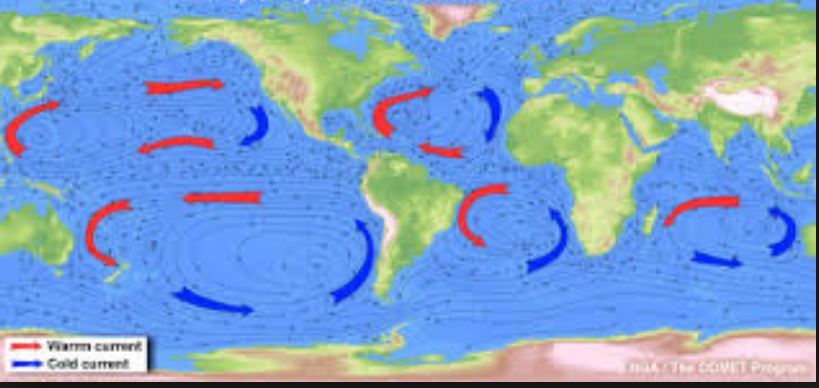
Analyze the image. What could explain why certain parts of the ocean have warmer temperatures?
a)
the uneven heating of the Earth's surface
b)
the rising of cold air and the sinking of warm air
c)
hurricanes
2.
Analyze the image. The red arrows represent warm water rising and the blue arrows represent cold water sinking. What type of heat transfer is responsible for this movement?
a)
conduction
b)
convection
c)
radiation
3.

Analyze the image.
Heat transfer can happen 1 of 3 ways. Which type of heat transfer do you think is responsible for the heating of the Earth's surface by the Sun?
Heat transfer can happen 1 of 3 ways. Which type of heat transfer do you think is responsible for the heating of the Earth's surface by the Sun?
a)
conduction
b)
convection
c)
radiation
4.
Which current affects the west coast?
a)
California Current
b)
Gulf Stream Current
c)
Caribbean Sea Current
5.
Which current affects the east coast?
a)
California Current
b)
Gulf Stream Current
c)
Caribbean Sea Current
6.

Analyze the map.
Why is it warmer in Charleston than it is in San Diego even though they are the same distance from the Equator?
Why is it warmer in Charleston than it is in San Diego even though they are the same distance from the Equator?
a)
San Diego is affected by the Gulf Stream
b)
Charleston is affected by the California current
c)
Charleston is affected by the Gulf Stream
7.
Analyze the map.
Why is it colder in San Diego than it is in Charleston even though they are the same distance from the Equator?
Why is it colder in San Diego than it is in Charleston even though they are the same distance from the Equator?
a)
San Diego is affected by the Gulf Stream
b)
Charleston is affected by the California current
c)
San Diego is affected by the California Current
8.
Which of the following brings cold water from the north near the poles?
a)
California Current
b)
Gulf Stream
c)
niether
9.
Which of the following brings warm water from the South near the Equator?
a)
California Current
b)
Gulf Stream
c)
neither
10.

Which of the following describes what is happening in a low pressure system?
a)
cold air sinking
b)
cold air rising
c)
warm air rising
11.

Which of the following describes what is happening in a high pressure system?
a)
cold air sinking
b)
cold air rising
c)
warm air rising
12.
When heat is transferred during convection, heat will always move from _________ to __________ temperatures.
a)
low to high
b)
high to low
c)
they don't move
13.
When heat is transferred during convection, heat will always move from _________ to __________ temperatures.
a)
low to high
b)
high to low
c)
they don't move
14.
In a convection cell, what is created when air moves from high to low pressure?
a)
wind
b)
sunny skies
c)
warmer temperatures
15.
Why don't hurricanes affect the west coast?
a)
the water on the coast of California is too shallow to sustain a hurricane
b)
the water on the coast of California is too warm to sustain a hurricane
c)
the water on the coast of California is too cold to sustain a hurricane
16.
Where warm air rises the air is less dense and the pressure is ___________
a)
low
b)
high
17.
Where cold air sinks the air is more dense and the pressure is ___________
a)
low
b)
high
18.
Hurricanes can only form where the ocean water is ______________________.
a)
80 degrees and above
b)
below 80 degrees
c)
above 50 degrees
19.
Which of the following is correct?
a)
warmer ocean currents = warmer climate
b)
cooler ocean currents = warmer climate
c)
warmer ocean currents = cooler climate
20.

Analyze the diagram. What is the name of this phenomenon?
a)
convection cell
b)
radiation cell
c)
conduction cell
100 %

