
 Worksheets
ERMS- 8th American Revolution ch. 4
Total questions: 62
Worksheet time: 34mins
Name
Class
Date
1.
Who was put in charge of the Continental Army?
a)
Abraham Lincoln
b)
Alexander Hamilton
c)
George Washington
d)
Benjamin Franklin
2.
Why were both Continental Congress held?
a)
To vote for the first president
b)
To decide when to go to war with Great Britain
c)
To discuss a solution to the colonists’ complaints of Great Britain
d)
To write the Constitution
3.
What did the Continental Congress decide to do with British trade?
a)
Buy British goods
b)
Raise tariffs
c)
Destroy all British goods
d)
Boycott all British goods
4.

Where did the First Continental Congress meet?
a)
Philadelphia
b)
Boston
c)
Annapolis
d)
Baltimore
5.
What goal did the First Continental Congress have?
a)
state concerns of colonists to the king
b)
form an army
c)
establish a colonial government to fight the king
d)
create a flag and national anthem
6.
The First Continental Congress was called for all the following reasons except _________
a)
Respond to the Coercive Acts
b)
Respond to Magna Carta
c)
Advised building a colonial militia
d)
Organized a boycott on all ENGLISH GOODS
7.
Who fought in the Revolutionary War?
a)
the British against the colonists
b)
the French against the British
c)
the French against the colonists
d)
the colonists against the Native Americans
8.
What was the biggest disagreement at the Second Continental Congress?
a)
Who would be the first president.
b)
How to deal with France.
c)
Should the colonists seek a peaceful or violent resolution
d)
Who would get to sign the Declaration of Indpendence first.
9.
How did the delegates of the Second Continental Congress decide to handle the British?
a)
paying off the king to leave them alone.
b)
recruiting more foreign soldiers to come fight for them.
c)
creating an army of their own
d)
by compromising
10.
The "shot heard 'round the world" was which battle?
a)
Battle of Bunker Hill
b)
Battle of Lexington
c)
Battle of Trenton
11.
The __________ were colonists that supported independence from Britain.
a)
militia
b)
Loyalists
c)
Patriots
d)
minutemen
12.
The _____________ were colonists that did not want to separate from Britain.
a)
militia
b)
Loyalists
c)
Patriots
d)
minutemen
13.
In a final effort to avoid war with Britain, the colonies sent ______ to the king.
a)
a petition
b)
money
c)
ships and cargo
d)
weapons
14.
Why did the British soldiers march to Concord?
a)
They marched to Concord to burn houses and kill livestock to cut off food to the colonists
b)
They didn't march to Concord
c)
They marched to Concord to search for and destroy weapons they believed the colonists to have
15.
Lexington and Concord were the first battles in what war?
a)
Revolutionary War
b)
World War I
c)
War of 1812
16.

The Intolerable Acts, First Continental Congress, and Common Sense all happened during what era?
a)
The era of westward expansion
b)
The era of Good Feelings
c)
The Revolutionary Era
d)
The Jacksonian Era
17.

The Sugar Act, Quartering Act, and the Stamp Act all contributed to the start of the Revolutionary War by....
a)
Restricting trade with American Indians
b)
Imposing regulations on colonial agriculture
c)
Angered colonists who believed that civil liberties had been violated
d)
Punishing colonists for resisting the authority of Parliament
18.

What was the immediate effect due to the passing of the Stamp Act in 1765?
a)
Colonists sought military support from France.
b)
Colonists organized boycotts of British goods.
c)
Colonists signed the Declaration of Independence.
d)
Colonists dumped tea into the Boston Harbor
19.
What was the main point of Common Sense?
a)
We should not go to war and be loyal to the king
b)
Complete Colonial independence from England
c)
King George III should NOT repeal the 13 ACTS imposed on the colonies
d)
"We should be loyal to the King"
20.

What does the motto "E pluribus unum" mean?
a)
"Liberty or Death"
b)
"out of many, one"
c)
"the King we trust"
d)
"justice for all"
21.

Which of the following was NOT a major task accomplished at the First Continental Congress?
a)
Wrote a letter to King George III explaining the complaints of the colonists
b)
Formed an army
c)
Discussed the Intolerable Acts
d)
Agreed to meet again in the Spring
22.
To Great Britain, the signing of the Declaration of Independence was
a)
an act of loyalty.
b)
an act of treason.
c)
an act of bravery.
d)
an act of insanity.
23.

According to the Declaration of Independence, what truth was "self-evident"?
a)
All men are created equal
b)
Rights are given by good kings
c)
Government exists to protect us from ourselves
d)
Only a democracy can protect our rights
24.
According to the Declaration of Independence, where does government get its power?
a)
From the King
b)
From the Supreme Court
c)
From God
d)
From the people
25.

Why was the Declaration of Independence written?
a)
To stop taxes from the British Empire.
b)
To make a United States army.
c)
To gain independence from the British Empire
d)
To install their own king in America
26.
Why did so many African-American slaves sign on with the British Army?
a)
No African- Americans fought for the British.
b)
The British had better uniforms.
c)
Better food and training in the British Army
d)
The British offered freedom to any slave that fought in their army
27.
Who was the main author of the Declaration of Independence?
a)
Benjamin Franklin
b)
Samuel Adams
c)
Thomas Jefferson
d)
Paul Revere
28.
What was the date that the Declaration of Independence was signed?
a)
July 4, 1776
b)
July 2, 1776
c)
July 4, 1787
d)
July 2, 1775
29.
What country did The United States declare independence from?
a)
Britain
b)
France
c)
Spain
d)
Belgium
30.
Thomas Jefferson was inspired by a famous man of the Enlightenment. His name was...?
a)
William Penn
b)
Roger Sherman
c)
John Locke
d)
Robert Livingston
31.
Who gives government the ability to govern?
a)
the people
b)
Parliament
c)
the King
d)
the Sons of Liberty
32.
A ________ is a person who speaks for a group of people.
a)
colonist
b)
king
c)
representative
d)
soldier
33.
Why did General Thomas Gage send troops to Lexington and Concord?
a)
to seize weapons and arrest leaders
b)
to meet with the local governors
c)
to buy weapons and pay Paul Revere
d)
to arrest George Washington
34.
Army formed in 1775 by the Second Continental Congress & led by General George Washington.
a)
Green Mountain Boys
b)
Mercenaries
c)
Continental Army
d)
Traitor
35.
American victory over British troops in 1777, that was a turning point in the American Revolution.
a)
Battle of Saratoga
b)
Treaty of Paris
c)
American Revolution
d)
Olive Branch Petition
36.
Letter sent by the Second Continental Congress to King George III in 1775 in an attempt to avoid war.
a)
Treaty of Paris
b)
Olive Branch Petition
c)
Battle of Saratoga
d)
Declaration of Independence
37.
Soldiers from one country who are paid to fight for another country.
a)
Soldier
b)
Green Mountain Boy
c)
Traitors
d)
Mercenaries
38.
Treaty signed in 1783 that officially ended the American Revolution. Great Britain recognized the United States as an independent country
a)
Declaration of Independence
b)
Treaty of Paris
c)
Olive Branch Petition
d)
Generalization
39.
What is a milita?
a)
professional soldiers
b)
King George III's troops
c)
average people volunteering to serve as soldiers
d)
people killed in the Boston massacre
40.
Why was "the shot heard round the world" important?
a)
It was really loud
b)
it was how Paul Revere got people's attention
c)
it marked the start of the Revolution
d)
it represented all the deaths in the war
41.
Which of the following is not one of the 4 parts of the Declaration?
a)
The Olive Branch Petition
b)
Preamble
c)
Resolution of Independence
d)
List of Grievances
42.
Which Continental Congress sent the Olive Branch Petition?
a)
First
b)
Second
c)
Third
d)
None
43.
The colonists did this to protest early taxes.
a)
Boycotted all British Goods.
b)
Bought British goods
c)
Bought goods from Spain
d)
Burned all British goods
44.
This act taxed all paper goods such as newspaper, playing cards.
a)
Sugar Act
b)
Stamp Act
c)
Declaratory Act
d)
Intolerable Acts
45.
The man that started the Sons of Liberty was?
a)
Patrick Henry
b)
John Adams
c)
Sam Adams
d)
Benjamin Franklin
46.
When you refuse to buy a product as a protest it is?
a)
Buy out
b)
Repulsion
c)
Boycott
d)
Bigot
47.
Which law, boycotted by the colonists, outraged colonists by taxing items produced AND sold in the American colonies?
a)
Sugar Act
b)
Currency Act
c)
Townshend Act
d)
Stamp Act
48.
Who were the Sons of Liberty?
a)
A secret organization of educated men that were strongly against the British in the colonies
b)
A biker gang
c)
A tribe of indians that would attack British troops at random
49.
Which battle is considered the Turning Point of the American Revolution?
a)
Battle of Trenton
b)
Battle of Saratoga
c)
Lexington & Concord
d)
Battle of Bunker Hill
50.
The French began to support the Americans after this battle
a)
Lexington and Concord
b)
Yorktown
c)
Saratoga
d)
Treaty of French
51.
What 2 major battles did the Americans win?
a)
Trenton and Saratoga
b)
Philadelphia and New York
c)
New York and Saratoga
d)
Trenton and New York
52.
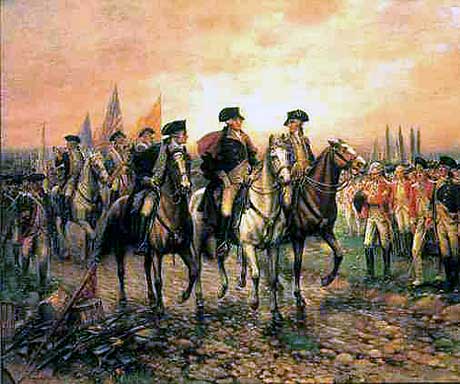
Which battle ended the American revolution?
a)
Battle of Lexington and Concord
b)
Battle of Saratoga
c)
Battle of Yorktown
d)
Battle of Trenton
53.

What river did Washington and his men cross for the battle of Trenton?
a)
Susquehanna river
b)
Trenton river
c)
Delaware river
d)
Mississippi river
54.
Why is the Battle of Saratoga called the turning point of the Revolutionary War?
a)
The Spanish decide to become American allies
b)
British General Cornwallis surrender at this battle
c)
the French decide to become American allies
55.
What made the Battle of Yorktown significant?
a)
It was the first battle of the American Revolution
b)
It was the first battle of the American Civil War
c)
English Sarah was there
d)
It was the last major battle of the American Revolutionary War
56.
What country helped the Americans to win the battle by defeating the British Navy and preventing the arrival of reinforcements?
a)
Spain
b)
Germany
c)
New England
d)
France
57.
What foreign leader was inspired by ideas of the American Revolution?
a)
John Adams
b)
Wyatt Earp
c)
Marquis de Lafayette
58.
Radical group of colonists who led rebellious efforts against British actions; carried out the Boston Tea Party
a)
Sons of Liberty
b)
Sons of Rebellion
c)
Loyalists
d)
Coercive Acts
59.
He was the acting governor of the Louisiana Territory and he helped the colonists buy supplies from the Spanish to use in the revolution. The town of Galveston is named after him.
a)
Crispus Attucks
b)
Patrick Henry
c)
Ben Franklin
d)
Bernardo de Galvez
60.
Author of the pamphlet "Common Sense" which encouraged the colonists to break from England and become independent.
a)
Thomas Paine
b)
George Washington
c)
Bernardo de Galvez
d)
Abigail Adams
61.
Spanish General/Governor (Louisiana), aided the Colonies in the war effort.
a)
Marquis de Lafayette
b)
Mercy Otis Warren
c)
Bernardo de Galvez
d)
John Paul Jones
62.
The signing of the Treaty of Paris 1783 was a political victory for the US because it meant that
a)
Florida became part of the US
b)
France agreed to give military aid to the US
c)
Great Britain recognized the US as an independent nation
d)
The US could purchase the Louisiana Territory from France
100 %

