
 Worksheets
Vocabulary Review Week 2
Total questions: 25
Worksheet time: 25mins
Name
Class
Date
1.
A push or pull that causes a change in motion
a)
Friction
b)
Gravity
c)
Force
d)
Mass
2.
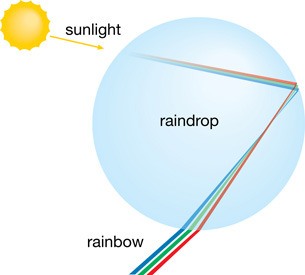
Light bending as it passes through a rain drop is an example of...
a)
Refraction
b)
Reflection
3.
The metric scale for measuring temperature is_____________.
a)
Fahrenheit
b)
Celsius
4.

A student placed a pencil in a cup of water. The pencil appears broken because light-
a)
always travels in a straight line
b)
bends when it passes through water
c)
makes the water in the glass evaporate
d)
reflects the pencil on the water's surface
5.

The force that pulls you to the ground
a)
Magnetism
b)
Acceleration
c)
Friction
d)
Gravity
6.
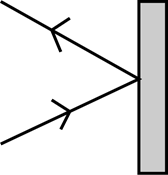
The illustration shows a light ray striking an object.
In the illustration, the light ray striking the object is-
In the illustration, the light ray striking the object is-
a)
absorbed
b)
stopped
c)
reflected
d)
refracted
7.
The form of energy that moves particles of matter is _________ __________.
a)
light energy
b)
thermal energy
c)
sun energy
d)
Tunazi's energy
8.
A metal rod, a plastic rod, and a wooden rod are all placed in boiling water. Which is going to conduct the most heat?
a)
The metal rod
b)
The plastic rod
c)
The wooden rod
d)
All will conduct heat equally
9.
If a material transfers heat easily, then the material is said to be a good ___________.
a)
Conductor
b)
Insulator
c)
Convector
d)
Metalloid
10.

The temperature where water turns from a liquid to a solid.
a)
melting point - 0 degrees Celsius
b)
freezing point - 0 degrees Celsius
c)
boiling point - 100 degrees Celsius
d)
freezing point - 100 degrees Celsius
11.
If the angle of incidence increases, the angle of refraction ________.
a)
Increases
b)
Decreases
12.

This type of material blocks thermal or electrical energy from passing through.
a)
circuit
b)
conductor
c)
insulator
d)
matter
13.

What kind of circuit is this?
a)
series
b)
parallel
14.

The temperature where a liquid boils and turns into a gas.
a)
Boiling Point - 212 degrees Celcius
b)
Freezing Point - 0 degrees Celcius
c)
Boiling Point - 100 degrees Celcius
d)
Melting Point - 0 degrees Celcius
15.

The temperature where water turns from a solid to a liquid.
a)
melting point - 0 degrees Celsius
b)
boiling point - 100 degrees Celsius
c)
freezing point - 0 degrees Celsius
d)
None of the above
16.
The energy of moving parts is called_____.
a)
Sound energy
b)
Light energy
c)
thermal energy
d)
Mechanical energy
17.
If 2 magnets push away from each other what is it called?
a)
Attract
b)
Iron
c)
Repel
d)
None of the above
18.
A lens is a transparent object that forms images by?
a)
Refracting Light
b)
Absorbing Light
c)
Transmitting light
d)
Scattering Light
19.

Which of the following does not conduct electricity?
a)
gloves
b)
penny
c)
paper clip
d)
key
20.

When heat is taken away from a liquid and it becomes a solid.
a)
freezing
b)
solid
c)
melting
d)
liquid
21.

True or False: This diagram shows the correct position of the mirrors so that the light hits the target
a)
True
b)
False
22.

In the schematic drawing what does the circle with the X in the middle represent?
a)
Wire
b)
Battery
c)
Bulb
d)
Switch
23.

What is this image an example of?
a)
Reflection
b)
Diffusion
c)
Refraction
24.

Will this circuit light the bulb?
a)
Yes
b)
No
25.
If the lights are on, the circuit is
a)
closed
b)
open
100 %

