
 Worksheets
October Benchmark Review 1
Total questions: 70
Worksheet time: 55mins
Name
Class
Date
1.
In the modern periodic table elements are arranged by:
a)
atomic mass
b)
atomic number
c)
valence electrons
d)
number of isotopes
2.
The atomic number tells you what?
a)
number of atoms
b)
number of protons
c)
number of neutrons
3.
Elements which are shiny, conduct electricity and heat are called
a)
metal
b)
nonmetal
c)
metalloid
d)
nonexistent
4.
Which element is not a metal?
a)
H
b)
Re
c)
Al
d)
Ni
5.

The atoms along the staircase are called
a)
metals
b)
nonmetals
c)
metalloids
d)
noble gases
6.

What does the 1.00794 stand for?
a)
Hydrogen
b)
atomic number
c)
atomic mass
d)
atomic explosion
7.
Which of the following is not a property of metals?
a)
brittle
b)
malleable
c)
lustrous
d)
conductive
8.
Good conductor of heat
a)
Metal
b)
Nonmetal
9.
If a material can easily be drawn into the shape of a wire, it is
a)
Ductile
b)
Magnetic
c)
Malleable
d)
Reactive
10.
All the elements on the right side of the periodic table are called..
a)
Metals
b)
Metalloid
c)
Nonmetals
11.
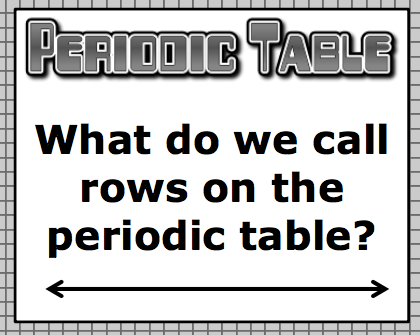
a)
Periods
b)
Groups
12.
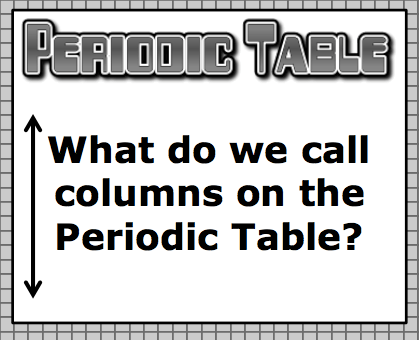
a)
Periods
b)
Groups
13.
How many different elements are in this chemical formula: C2H2ClK3
a)
6
b)
8
c)
2
d)
4
14.
Which of the following atomic symbols for bromine is written correctly?
a)
bR
b)
BR
c)
Br
d)
br
15.
Which of the following chemical formulas represents a compound?
a)
C3
b)
O2
c)
CH3CHO
d)
H2
16.
Can be found on the periodic table
a)
Element
b)
Compound
c)
MIxture
17.

What is gold?
a)
element
b)
compound
c)
mixture
18.

What is water?
a)
element
b)
compound
c)
mixture
19.

When two or more elements chemically combine
a)
element
b)
compound
c)
mixture
d)
solution
20.

a)
Element
b)
Compound
21.

a)
Element
b)
Compound
22.

a)
Element
b)
Compound
23.
Which of the following represents an element?
a)
H2O
b)
H2
c)
NaCl
d)
CaCO3
24.
Which of the following is not a compound?
a)
HCl
b)
Cl
c)
NaCl
d)
CO2
25.
Elements are made of
a)
Many types of atoms
b)
the Periodic Table
c)
One type of Atom
d)
Molecules
26.
What is the chemical formula for water?
a)
H2O
b)
H2O2
c)
KCl
d)
NaCl
27.
What kind of properties can only be observed when a substance changes into a different substance?
a)
physical properties
b)
chemical properties
c)
liquid properties
d)
real properties
28.
Which of the following is a sign that a chemical reaction has occurred?
a)
change in shape
b)
melting
c)
formation of a gas
d)
dissolving
29.
Is hammering wood together to build a house a chemical or physical change?
a)
chemical
b)
physical
30.
Is melting butter for popcorn a chemical or physical change?
a)
chemical
b)
physical
31.

Is burning wood a chemical or physical change?
a)
chemical
b)
physical
32.
Which of the following is NOT an example of a physical change?
a)
crumpled paper
b)
pencil sharpening
c)
shrunken clothing
d)
sour milk
33.
Kim puts an ice cube in a beaker and it melts. This is a good example of:
a)
a physical change.
b)
a chemical change.
c)
an experiment.
d)
an analysis.
34.
Which is a Chemical property?
a)
Thermal Conductivity
b)
Density
c)
Malleability
d)
Flammability
35.
Which is a chemical change?
a)
freezing fruit juice
b)
slicing a potato
c)
boiling water
d)
copper metal turning green
36.
what is the definition of chemical change?
a)
any change that results in the formation of new chemical substances.
b)
changing clothes
c)
matter cannot be created or destroyed, only change form
d)
changes affecting the form of a chemical substance, but not its chemical composition.
37.
One cup of water is left outside for two days when it was checked there was only half a cup left. What happened?
a)
evaporation; chemical change
b)
condensation; physical change
c)
evaporation; physical change
d)
condensation; chemical change
38.

Which box has a higher density?
a)
Box A
b)
Box B
c)
cannot be determined
d)
they are the same
39.
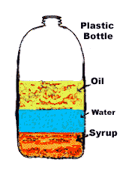
Which liquid is the least dense?
a)
oil
b)
water
c)
syrup
d)
plastic bottle
40.
Which of the following describes a precipitate?
a)
a liquid forms when a block of metal is heated
b)
a solid forms when one liquid is poured into another
c)
a gas forms when a solid is placed in a liquid
d)
bubbles form when an acid is poured on a rock
41.
Changes in which new substances are formed are called
a)
physical changes
b)
chemical changes
42.
KMnO4
How many total atoms are in this compound?
How many total atoms are in this compound?
a)
1
b)
3
c)
6
d)
8
43.
Fizzing, foaming, and burning are all examples of
a)
Chemical change
b)
Physical change
44.
Change in density is a physical change.
a)
True
b)
False
45.
The formation of solid particles in a substance is called:
a)
precipitate
b)
dissolving
c)
sugar
d)
koolaid
46.
Element or Compound? Fe2O3
a)
Element
b)
Compound
47.
Element or Compound? Au
a)
Element
b)
Compound
48.
What are the biochemical elements?
a)
Carbon, Nitrogen, Gold, and Silver
b)
Carbon, Oxygen, Phosphorus, Tin, Helium, and Titanium
c)
Carbon, Hydrogen, Nitrogen, Oxygen, Phosphorus, and Sulfur
d)
Carlos Has New Orange Puma Shoes
49.
All living and once living things on Earth contain this element.
a)
Carbon
b)
Gold
c)
Chlorine
d)
Potassium
50.
These things make elements
a)
Teachers
b)
Pure substance
c)
Atoms
d)
Gasses
51.
The C in CHNOPS stands for
a)
Calcium
b)
Chlorine
c)
Carbon
d)
Cesium
52.
The H in CHNOPS stands for
a)
Helium
b)
Happiness
c)
Hardness
d)
Hydrogen
53.
The N in CHNOPS stands for
a)
Nasty
b)
Nitrogen
c)
Neon
d)
Sodium
54.
The O in CHNOPS stands for
a)
Oxygen
b)
Opal
c)
Optional
d)
Ogre
55.
The P in CHNOPS stands for
a)
Lead
b)
Promethium
c)
Polonium
d)
Phosphorous
56.
The S in CHNOPS stands for
a)
Strontium
b)
Selenium
c)
Sulfur
d)
Silicon
57.
Which units of measurement are used for volume?
a)
grams
b)
centimeters
c)
grams/milliliter
d)
milliliter
58.
Which lab tool might you use to measure the volume of a liquid?
a)
electric scale
b)
bunsen burner
c)
test tube
d)
graduated cylinder
59.
Jack has a rock. The rock has a mass of 14g and a volume of 2cm3. What is the density of the rock?
a)
7 mL
b)
7 g/cm3
c)
28 g/cm3
d)
1/7 g/cm3
60.
True or False: The density of a specific type of material never changes.
a)
True
b)
False
61.
What is the formula for density?
a)
density = mass x volume
b)
density = mass / volume
c)
density = mass + volume
d)
density = mass - volume
62.
Frank has an eraser. It has a mass of 4g, and a volume of 2cm3. What is its density?
a)
8 g/cm3
b)
2 g/cm3
c)
1/2 g/cm3
d)
24 g/cm3
63.
Which property of matter is determined by dividing its mass by its volume?
a)
elasticity
b)
buoyancy
c)
density
d)
viscosity
64.

What is the volume of the fish?
a)
18.0 cm3
b)
6.0 cm3
c)
38.0 cm3
65.

The density of a crayon is 0.8 g/mL. What is the density of half of a crayon?
a)
0.8 g/mL
b)
0.4 g/mL
c)
0.5 g/mL
d)
1.6 g/mL
66.
In general what is the most dense form of matter?
a)
solid
b)
liquid
c)
gas
d)
plasmas
67.
Mass, relative density, solubility, color, texture, state of matter, conductivity, etc.
a)
Physical state
b)
Insulators
c)
Physical Properties
d)
Inferences
68.
ability for a solid to be hammered without shattering
a)
Density
b)
Conductivity
c)
Malleability
d)
Viscosity
69.
Mrs. Nordberg found an element that is not malleable, not ductile, and has no luster. What type of element can this be?
a)
Metalloid
b)
Nonmetal
c)
Metal
d)
Plasma
70.
A ________________ allows heat and electricity to travel through the material easily.
a)
conductor
b)
insulator
c)
rubber eraser
d)
solubility
100 %

