
NEW
Font size
S
M
L
XL
 Worksheets
Nuclear Reactions
Total questions: 40
Worksheet time: 58mins
Name
Class
Date
1.
Takes two small nuclei and combines them into a larger nucleus
a)
fission
b)
fusion
2.
The splitting of a nucleus into smaller nuclei is
a)
fusion
b)
fission
c)
half-life
d)
gamma radiation
3.
How do nuclear power-plants work?
a)
Fusion
b)
Half-life
c)
Fission
d)
Fusion or fission
4.
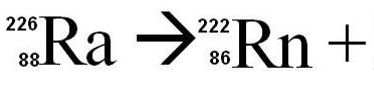
Complete the nuclear equation and determine the type of decay that is occurring in this reaction.
a)
alpha
b)
beta
c)
gamma
d)
none
5.
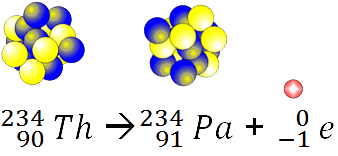
Which type of radioactive decay is occurring in this equation?
a)
Alpha decay
b)
beta decay
c)
gamma decay
d)
positron emission
6.
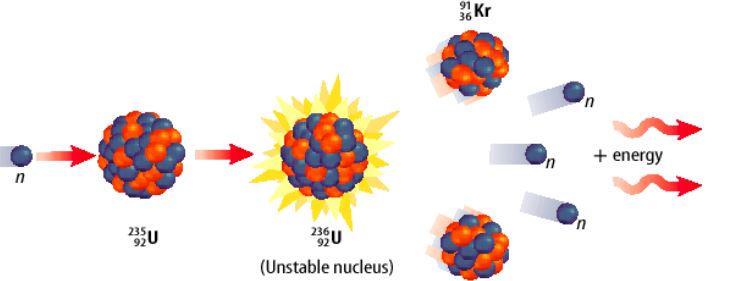
This is an example of...
a)
Fission reaction
b)
Fusion reaction
c)
Decomposition reaction
d)
Decay
7.
Where does fusion occur naturally?
a)
Underwater
b)
All around us
c)
In the radioactive waste
d)
On the sun
8.
Which atoms combine together during fusion reaction on the sun?
a)
Helium and Hydrogen atoms
b)
Hydrogen atoms
c)
Hydrogen and Lithium atoms
d)
Hydrogen and Carbon atoms
9.
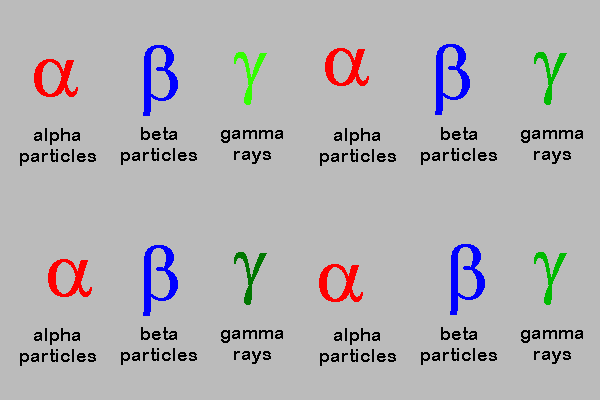
In order of most to least penetrating radiation we have
a)
Alpha , Beta, Gamma
b)
Beta , Gamma , Alpha
c)
Gamma, Beta, Alpha
d)
Gamma, Alpha, Beta
10.
What metal gives off radiation?
a)
carbon
b)
cobalt
c)
uranium
d)
titanium
11.

Which atoms combine together during fusion reactions in the sun?
a)
Helium and Hydrogen atoms
b)
Hydrogen atoms
c)
Hydrogen and Lithium atoms
d)
Hydrogen and Carbon atoms
12.

What is this process?
a)
Fission
b)
Fusion
c)
Combustion
d)
Oxidation
13.

What are the primary products of fusion in stars?
a)
Helium
b)
Energy
c)
Hydrogen
d)
Both Helium and Energy
14.
Hydrogen is the primary fuel for what?
a)
Fission
b)
Fusion
c)
Radioactive Decay
d)
Bombs
15.

A star begins to "die" when elements stop fusing in its core.
a)
True
b)
False
16.

A star that expands and cools once it runs out of hydrogen fuel and moves on to fusing heavier elements.
a)
neutron star
b)
black hole
c)
red giant
d)
supernova
17.

How is fusion different than other chemical reactions?
a)
atoms work together
b)
atoms merge to share a nucleus
c)
there is no difference
d)
atoms move independently but function together
18.
Areas of gas on the sun's surface that are cooler than gases around them are called:
a)
corona
b)
prominences
c)
sunspots
d)
solarspots
19.
The number of sunspots on the sun varies in a cycle that is about how long?
a)
6-8 years
b)
10-11 years
c)
12-15 years
d)
365 days
20.
Earths Magnetic field is created by
a)
the movement of metal in the earth core
b)
YOUR MOM!!!
c)
The movement of the earths crust
d)
Lava flowing out of the earth
21.
A glowing region in the atmosphere caused by charged particles from the sun
a)
Aurora
b)
Sun spots
c)
Magnetic Field
d)
Horizon
22.
A stream of electrically charged particles flowing at high speeds from the sun
a)
Solar Wind
b)
Lightning
c)
Electricity
d)
Aurora
23.
Nuclear power uses ____ for fuel.
a)
steel
b)
coal
c)
uranium
d)
hydrogen
24.
_________ happens naturally due to an unstable nucleus.
a)
fission
b)
fusion
c)
radioactive decay
d)
K-capture
25.
What is a chain reaction?
a)
When electrons are emitted causing electricity
b)
When a nuclear fission reaction occurs, the protons emitted can strike other nuclei in the sample, and cause them to split
c)
When a nuclear fission reaction occurs, the neutrons emitted can strike other nuclei in the sample, and cause them to split
d)
When a nuclear fission reaction occurs, the electrons emitted can strike other nuclei in the sample, and cause them to split
26.
One disadvantage of nuclear energy is ___.
a)
it is a fossil fuel
b)
it leaves behind radioactive waste
c)
it emits large amounts of pollution into the atmosphere
d)
there are no disadvantages
27.
Nuclear energy uses _____ to turn turbines to power a generator.
a)
wind
b)
water
c)
steam
d)
solar
28.
Isotopes of the same element have different ____________.
a)
numbers of protons
b)
numbers of electrons
c)
symbols
d)
numbers of neutrons
29.
Radioactive materials have unstable...
a)
electrons
b)
protons
c)
nuclei
d)
neutrons
30.
A helium nucleus with two protons and two neutrons is called a(n) ____.
a)
alpha particle
b)
electroscope
c)
beta particle
d)
gamma ray
31.
An atom's _________ is its number of protons.
a)
atomic number
b)
mass number
c)
weight number
d)
football number
32.
When nuclei decay, massive amounts of __________ is released.
a)
energy
b)
jello
c)
protons
d)
neutrons
33.
Solve this equation for alpha decay.
85209At = ___ + 24He
85209At = ___ + 24He
a)
83205Bi
b)
86209Rn
c)
81207Tl
d)
85208At
34.
Solve this equation for beta decay.
614C = ___ + -10e
614C = ___ + -10e
a)
410Be
b)
714N
c)
210He
d)
613C
35.
Barium-122 has a half-life of 2 minutes. A fresh sample weighing 80 g was obtained. If it takes 10 minutes to set up an experiment using barium-122, how much barium-122 will be left when the experiment begins?
a)
0.25g
b)
2.5g
c)
25g
d)
80g
36.
What is Half-life?
a)
The amount of time it takes for some of the nuclei in a sample of the isotope to decay
b)
The amount of time it takes for half the electrons in a sample of the isotope to decay
c)
The amount of time it takes for half the nuclei in a sample of the isotope to decay
d)
the amount of time it takes to double the nuclei in a sample of the isotope to decay
37.
The half-life of strontium-90 is 25 years. How much strontium-90 will remain after 100 years if the initial amount is 4.0 g?
a)
3.0g
b)
0.25mg
c)
0.3g
d)
0.25g
38.
The half-life of Zn-71 is 2.4 minutes. If one had 100.0 g at the beginning, how many grams would be left after 7.2 minutes has elapsed?
a)
100.0g
b)
50.0g
c)
12.5g
d)
8.5g
39.
Black holes are formed when stars lose gas to burn, form a red super giant, cool down, then become so dense...
a)
the star flattens like a pancake.
b)
the matter of the star collapses on itself.
c)
the star turns into a giant ice ball.
d)
the star explodes.
40.
What happens after the giant star stage (in order)?
a)
nebula, white dwarf, black dwarf
b)
supernova, white dwarf, black dwarf
c)
nebula, neutron star, black dwarf
d)
supernova, black hole, white dwarf
Reset

