
 Worksheets
Chapter 2 cell Division
Total questions: 42
Worksheet time: 1hrs 18mins
Name
Class
Date
1.
The longest phase of the cell cycle
a)
prophase
b)
interphase
c)
metaphase
d)
mitosis
2.
Which of the following is NOT a part of mitosis?
a)
prophase
b)
anaphase
c)
metaphase
d)
interphase
3.
Chromosomes are copied.
a)
Interphase
b)
Prophase
4.
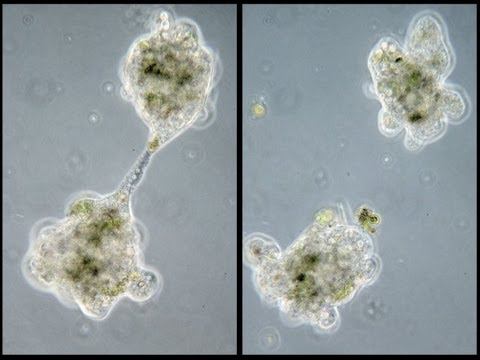
As we already know, animal like protists (the amoeba and paramecium) reproduce by asexual reproduction. Which of the following is an example of how the amoeba and paramecium reproduce using asexual reproduction?
a)
regeneration - amoebas and paramecium that are split in half will regenerate, and create more identical offspring
b)
sporulation - as amoebas and paramecium die, they release pores that reproduce other protists under certain environmental conditions.
c)
binary fission - amoebas and paramecium divide by binary fission, within which the cytoplasm and the nucleus divide equally under certain environmental conditions.
d)
budding - amoebas and paramecium reproduce by budding, within which the cytoplasm divides unequally, and the nucleus divides equally. The amoeba or paramecium can either create a colony, or split into two different protists.
5.
Which of the following is/are advantages of asexual reproduction?
a)
It allows the organisms to crowd out the other organisms that reproduce more slowly. As we have seen, bacteria can reproduce very rapidly in a short time!
b)
Asexual reproduction allows the organism to better fight off diseases, unlike organisms that reproduce sexually. Asexual reproduction allows for greater diversity, in turn, asexual reproducers have a greater life expectancy.
c)
Most asexual reproductive organisms live in ideal conditions, which allows them to reproduce rapidly.
d)
both b and c are correct
6.
As we already know, bacteria reproduce very rapidly under certain environmental conditions. What is the method within which bacteria undergo asexual reproduction?
a)
Budding - asexual reproduction in which a new organism develops as an outgrowth of the parent. The new organism, called the bud, is a tiny duplicate of the parent organism. In budding, the nucleus divides equally and the cytoplasm divides unequally.
b)
Regeneration by Fragmentation - type of asexual reproduction where the organism fragments a piece of itself off. In turn, the fragment reproduces an identical creature. Examples are flatworms and starfish
c)
Binary Fission - type of asexual reproduction where the parent organism divides equally in half reproducing identical offspring
d)
Sporulation - cells that contain a nucleus and a small amount of cytoplasm. Spores are surrounded by tough protective coats that enable them to survive unfavorable conditions, such as extreme heat or cold, for long periods of time. When environmental conditions become favorable, each spore can develop and produce by releasing spores.
7.
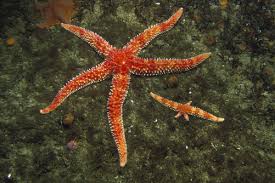
During the late 1800's, oyster fishermen were having a problem with starfish eating most of the oyster population. As a result, the fishermen "cut apart" the starfish. Why would this be a "bad" idea?
a)
Starfish reproduce by budding, within which the starfish grew back and wiped out most of the oyster population.
b)
Starfish reproduce by binary fission, within which the starfish grew back and wiped out most of the oyster population
c)
Starfish reproduce by sporulation, within which the starfish grew back and wiped out most of the oyster population
d)
Starfish reproduce by regeneration by fragmentation, within which the starfish grew back and wiped out most of the oyster population.
8.
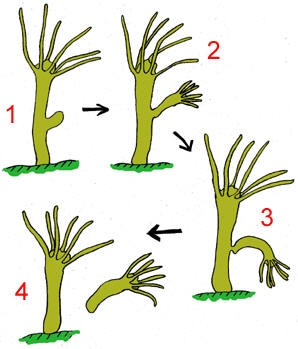
During this process of asexual reproduction, the organelle called "nucleus" divides evenly, while the organelle called "cytoplasm" divides unequally? Yeast and the hydra produce by this type of asexual reproduction?
a)
Budding
b)
Binary Fission
c)
sporulation
d)
Regenertaion
9.
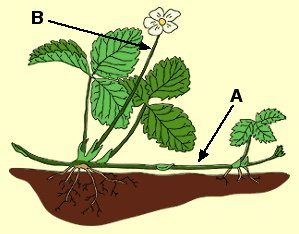
During this type of asexual reproduction, plants produce genetically identical offshoots (clones) of themselves, which then develop into independent plants?
a)
Binary Fission
b)
Sporulation
c)
Regeneration
d)
Vegetative Propagation
10.
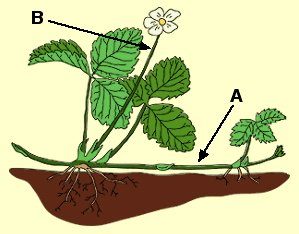
Which of the following asexual reproduction processes includes strawberries, within which strawberries reproduce when the parent organism sends out tendrils which can take root and grow into new organisms.
a)
Tuber
b)
Bulb
c)
Runner
d)
Binary Fission
11.
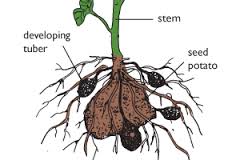
Tubers reproduce by asexual reproduction by sprouting off a new organisms from the original tuber's eye. Which of the following organisms reproduces in this fashion?
a)
Strawberries
b)
Potatoes
c)
Onions
d)
Hydra
12.
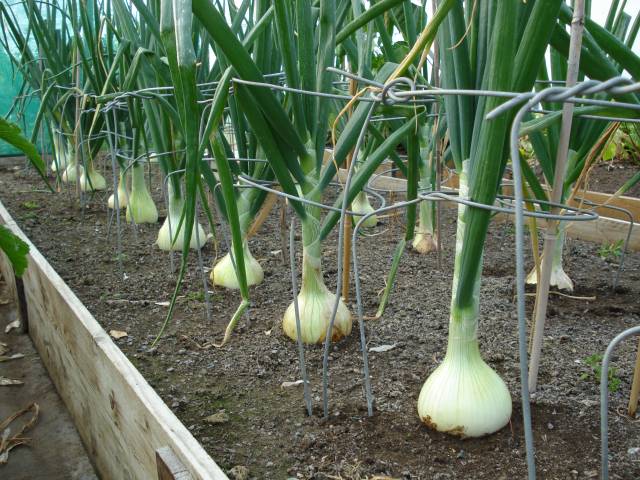
As we already know, onions reproduce asexually. How does an onion reproduce asexually?
a)
The parent onion sends out tendrils which can take root and grow into new organisms. This type of asexual reproduction can be called a runner.
b)
The onion has eyes, within which the eyes of an onion create a new organism by sprouting out from the original tuber.
c)
The parent onion is a bulb, within which the onion parent bulbs create lateral buds or shoots, which can grow into new bulbs and grow into separate organisms.
d)
Onions reproduce by splitting them in half, and planting them into the soil. This is an asexual process known as fragmentation by regeneration.
13.
Which of the following is/are disadvantages of asexual reproduction?
a)
It allows the organisms to crowd out the other organisms that reproduce more slowly. As we have seen, bacteria can reproduce very rapidly in a short time!
b)
Most organisms that reproduce by asexual reproduction do not live in ideal conditions. Most of the reproduction is kept in check by limited resources, predators, and their own waste.
c)
Organisms that tend to reproduce by asexual reproduction are not able to fend off diseases, unlike organisms that are able to reproduce sexually. Asexual reproduction involves 1 parent and one source of DNA, within which asexual organisms are not able to fend off diseases
d)
Both ideas are correct, within which most organisms that reproduce by asexual reproduction do not live in ideal conditions, and diseases can be passed on by the identical parent offspring.
14.
______________ is the type of reproduction that involves 1 parent, and performs exact DNA replication? During this type of reproduction, there is no fertilization. Also, cells undergo the cell division called mitosis during this type of reproduction.
a)
asexual reproduciton
b)
sexual reproduction
c)
binary fission
d)
sporulation
15.
Why does sexual reproduction result in more genetic diversity than asexual reproduction?
a)
Traits from two parents are combined.
b)
More organisms reproduce this way.
c)
Offspring grow in different environments.
d)
Offspring come from identical parents.
16.
Organisms that reproduce asexually generally have offspring that are
a)
unicellular.
b)
multicellular.
c)
genetically varied.
d)
genetically identical.
17.
A plant that has traits identical to the parent plant provides evidence that the plant
a)
resulted from sexual reproduction.
b)
resulted from asexual reproduction.
c)
will develop many seeds.
d)
will have large leaves.
18.
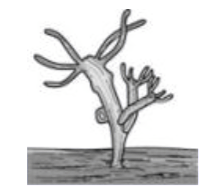
Many invertebrate animals, such as the hydra, reproduce asexually. What form of reproduction in this stage of the life cycle of the hydra is shown in the diagram?
a)
binary fission
b)
budding
c)
fragmentation
d)
vegetation propagation
19.
The muscle cells of an elephant contain 62 chromosomes. How many chromosomes are in an elephant egg cell?
a)
31
b)
62
c)
122
d)
244
20.
Which is the greatest benefit of sexual reproduction?
a)
capable of reproducing by meiosis
b)
ability to reproduce without a mate
c)
ability to produce genetically different offspring
d)
capable of producing offspring genetically identical to parent
21.
In order to grow two of the exact same plants, a person would reproduce them asexually because the
a)
genetic diversity is greater.
b)
offspring would be genetically identical.
c)
recessive traits would emerge.
d)
negative traits are suppressed.
22.
When an egg and sperm form an embryo, the offspring that is formed will have genetic traits that are
a)
inherited from only one parent.
b)
created by the environment.
c)
passed on from two parents.
d)
learned from siblings.
23.

When comparing the offspring of sexually and asexually reproducing organisms, we would expect the genetic material (DNA) of the sexually reproducing organism to -
a)
contain fewer mutations
b)
be lesser in quantity
c)
be simpler overall
d)
show more variation
24.

All of the offspring of an organism have the same genetic material, which is identical to the parent organism. From this, we can conclude that this organism -
a)
makes its own food
b)
is unicellular
c)
live in a marine habitat
d)
reproduces asexually
25.
In sexual reproduction the female produces ___ cells.
a)
Femalex
b)
Quack
c)
Egg
d)
Sperm
26.
In sexual reproduction the male produces ___ cells.
a)
Malex
b)
Quack
c)
Egg
d)
Sperm
27.
What are some of the facts about sexual reproduction?
a)
Takes two mates to reproduce and takes a longer time to reproduce
b)
Takes one mate to reproduce and takes a shorter amount of time to reproduce
c)
Takes two mates to reproduce and takes a shorter amount of time to reproduce
d)
Takes one mate to reproduce and takes a shorter amount of time to reproduce
28.
What are some of the facts about asexual reproduction?
a)
Takes only one mate to reproduce and takes a longer time to reproduce
b)
Takes a shorter amount of time to reproduce and it takes two mates to reproduce
c)
Reproduces diverse offspring and takes a longer time to reproduce
d)
Takes only one mate to reproduce and takes a shorter time to reproduce
29.
Which of the following is a disadvantage for sexual reproduction?
a)
a lot of time and energy is required for making gametes and finding mates
b)
offspring can be produced more quickly than by asexual means
c)
the genetic diversity makes organisms respond differently to environmental changes
d)
the offspring are genetically different
30.

What is official name for the shape of DNA?
a)
double helix
b)
twisted ladder
c)
twirl
d)
helicase
31.
If the original strand of DNA was AATTGGCC, what would the opposite strand be?
a)
AATTGGCC
b)
TTAACCGG
c)
ATGCATGC
d)
TTAATTAA
32.
Who is credited for building the model of DNA?
a)
Watson and Crick
b)
Franklin and Wilkins
c)
Chargaff and Mendel
d)
Schwann and Virchow
33.
The information in DNA is stored in the combinations of the...
a)
deoxyribose sugars
b)
phosphate-sugar backbone
c)
nitrogenous base pairs
d)
helix
34.
Replicate the following strand of DNA:
AATCATGGA
AATCATGGA
a)
AATCATGGA
b)
TTAGTACCT
c)
UUAGUACCU
d)
GGATAUCUA
35.
Where does DNA replication take place?
a)
Nucleus
b)
Ribosome
c)
Cytoplasm
d)
Golgi Body
36.
In DNA which is a correct base pairing?
a)
A with G
b)
G with T
c)
A with U
d)
A with T
37.
During which stage of the cell cycle does chromosome replication occur?
a)
Interphase
b)
Prophase
c)
Metaphase
d)
Anaphase
38.
A sugar, a phosphate group, and a nitrogen base form the building blocks of which organic compound?
a)
carbohydrates
b)
nucleic acids
c)
lipids
d)
proteins
39.
The genetic material of an organism is composed of
a)
lipids
b)
proteins
c)
deoxyribonucleic acids
d)
complex carbohydrates
40.
Changes in DNA sequences that affect genetic information are known as...
a)
Replication
b)
Mutations
c)
Transformation
d)
Translation
41.
what cells do meiosis produce
a)
sex cells (sperm and egg)
b)
everything over than sex cells
42.
why is mitosis important for life
a)
reproduction
b)
growth and repair
100 %

