
 Worksheets
Electricity Quiz 1
Total questions: 16
Worksheet time: 20mins
Name
Class
Date
1.
The accumulation of excess electric charge on an object is called
a)
Static electricity
b)
Electric discharge
c)
Resistance
d)
Circuit
2.
What types of charges attract?
a)
Positive and Positive
b)
Negative and Negative
c)
Neutral and Neutral
d)
Positive and Negative
3.
Electric charges that are alike _______ each other.
a)
Attract
b)
Repel
c)
do not interact
4.
What charge does an electron have?
a)
negative (-)
b)
positive (+)
c)
neutral or no charge (0)
d)
both positive and negative
5.
If a substance has a higher number of electrons than protons on its surface, what type of charge does it have?
a)
A positive charge.
b)
A negative charge.
c)
A neutral charge
d)
No charge at all
6.
Which of the following is caused by static electricity?
a)
a stove getting hot when it is turned on
b)
a magnet being attracted to a refrigerator
c)
a lightning strike during a storm
d)
a light bulb coming on when a switch is turned on
7.
Materials that easily loose or accept electrons are considered
a)
Good conductors
b)
Good insulators
c)
Good anti-static agents
d)
Good for storing charge
8.
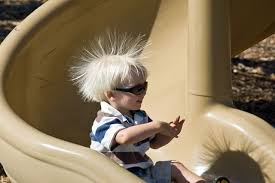
What method of static charging is shown in this picture
a)
Polarization
b)
Friction
c)
Induction
d)
Conduction
9.
Method of charging an object by allowing electric charge to flow by direct contact from one object to another object.
a)
friction
b)
conduction
c)
electric force
d)
induction
10.
If you rub a glass rod with a piece of silk, the rod becomes positively charged. This means that
a)
friction destroyed electrons in the rod.
b)
the silk has become negatively charged.
c)
protons have moved to the rod.
d)
glass attracts more protons.
11.

What kind of circuit is this?
a)
series
b)
parallel
c)
double circuit
d)
serious
12.

What type of circuit is show in the image?
a)
Series Circuit
b)
Parallel Circuit
c)
double circuit
d)
serious
13.
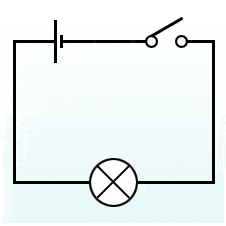
this circuit is .....?
a)
open, series
b)
open, parallel
c)
closed, series
d)
closed, parallel
14.
What is one benefit of using a parallel circuit?
a)
If one bulb goes out, all the rest also go out.
b)
It is very cheap to make due to the low number of parts used.
c)
If one item goes down, it does not affect the others.
d)
It is impossible to break.
15.

Which of the following statements is TRUE?
a)
all of the circuits will work properly.
b)
three of the four circuits will work properly.
c)
two of the four circuits will work properly.
d)
only one of the four circuits will work properly.
16.

Which statement is true?
a)
The light bulb will light up because the circuit is complete.
b)
The light bulb will light up because the circuit is broken.
c)
The light bulb will not light up because the circuit is complete.
d)
The light bulb will not light up because the circuit is broken.
100 %

