
 Worksheets
Atoms and Thermal energy
Total questions: 27
Worksheet time: 22mins
Name
Class
Date
1.
Heat transfer always goes from-
a)
Cold to Hot
b)
Hot to Cold
c)
Heat doesn't transfer
d)
Freezing to Cold
2.
What happens to particles as they cool down?
a)
They slow down
b)
Nothing
c)
They don't move
d)
They speed up
3.
Mittens help keep your hands warm in winter because:
a)
They are conductors of heat.
b)
They are fuzzy.
c)
They are conductors of electrical energy.
d)
They are insulators.
4.
Conductors are materials that...
a)
Allow heat to pass through
b)
Stop heat from passing through
c)
Allow cold to pass through
d)
Stop cold from passing through
5.
The Law of Conservation of Energy states:
a)
Energy can created or destroyed but not transformed
b)
Energy cannot be created or destroyed, it can only transformed
c)
Energy can't be created, destroyed or transformed
6.
Hot objects begin to cool as-
a)
cooler air is transferred to the hot object.
b)
thermal energy in the object is transferred to the surrounding air.
c)
atoms in the object react with the oxygen in the air.
d)
thermal energy in the object cancels out energy in the air
7.
As you touch a hot stove the heat transfers -
a)
from your hand to the stove
b)
from the stove to your hand
c)
It doesn't transfer
8.
Which sentence explains why a cold metal spoon placed in a pot of boiling water becomes hot?
a)
Thermal energy is transferred from the spoon to the water.
b)
Thermal energy is transferred from the water to the spoon.
c)
Thermal energy in the water is transformed into kinetic energy in the spoon.
d)
Thermal energy in the spoon is transformed into kinetic energy in the water.
9.
What happens to particles as they heat up?
a)
They slow down
b)
Nothing
c)
They don't move
d)
They speed up
10.
all matter is made of what
a)
energy
b)
atoms
c)
electrons
d)
compounds
11.
The positive particles of an atom are
a)
electrons
b)
positrons
c)
neutrons
d)
protons
12.
the central region of an atom where its neutrons and protons are is its
a)
nucleus
b)
electron cloud
c)
core
d)
center
13.
an atom with atomic number 6 would have how many protons
a)
6
b)
12
c)
3
d)
cannot be determined
14.
Particles in an atom that are neutral and have no charge are
a)
negatrons
b)
electrons
c)
neutrons
d)
protons
15.
What is the mass number?
a)
the number of protons
b)
the number of protons and neutrons
c)
the number of neutrons
d)
the number of protons and electrons
16.
What is the atomic number?
a)
the number of protons
b)
the number of protons and neutrons
c)
the number of neutrons
d)
the number of protons and electrons
17.
If the number of protons equal the number of _____, the atom will have no charge
a)
protons
b)
neutrons
c)
electrons
d)
nucleus
18.
What subatomic particle(s) would be found orbiting the nucleus?
a)
Neutrons only
b)
Electrons only
c)
Protons and Neutrons
d)
Protons and Electrons
19.
The subatomic particle with a negative charge is the
a)
electron
b)
proton
c)
neutron
d)
nucleus
20.
What is the atomic number for an element with three protons?
a)
2
b)
1
c)
3
d)
6
21.
A particle that moves around the nucleus is a(n)...
a)
Proton
b)
Neutron
c)
Electron
d)
Quark
22.
The particles that are found in the nucleus of an atom are
a)
neutrons and electrons
b)
electrons only
c)
protons and neutrons
d)
protons and electrons
23.
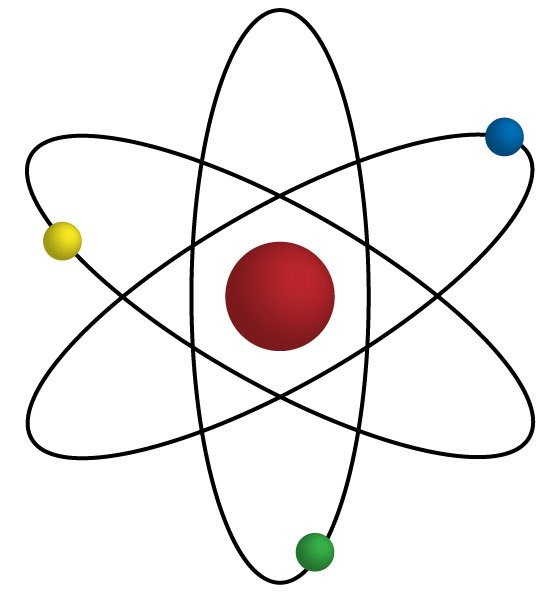
What are the 3 particles that make-up the atom?
a)
protons, neutrons, and isotopes
b)
neutrons, isotopes, and electrons
c)
positives, negatives, and electrons
d)
protons, neutrons, and electrons
24.
What is the purpose of the neutron?
a)
It has no purpose
b)
The neutron stabilizes the nucleus
c)
It gives the nucleus its positive charge
25.
Chalk, a ceramic similar to glass, has good __________________
a)
Tensile strength
b)
Compressive strength
c)
Toughness
d)
None of the above
26.
Steel, kevlar, and spider silk all have good _________________
a)
Compressive strength
b)
Toughness
c)
Tensile Strength
27.
Tensile strength is the measure of _____________________
a)
How well the material can be condensed or compressed
b)
How much energy the material can absorb while remaining intact
c)
The amount of pulling apart force a material can withstand
d)
None of the above
100 %

