
 Worksheets
Patterns in Our Solar System
Total questions: 52
Worksheet time: 36mins
Name
Class
Date
1.
What is a gibbous moon?
a)
Shows more than half of the bright side of the moon
b)
Shows less than half of the bright side of the moon
c)
Shows a quarter of the bright side of the moon
d)
Shows a full bright moon
2.
What is the crescent moon?
a)
Shows more than half of the bright side of the moon.
b)
Shows less than half of the bright side of the moon.
c)
Shows a full moon
3.
What is the difference between revolution and rotation of the earth and the moon?
a)
The earth revolves about its axis and the moon rotates around the earth
b)
The earth rotates about its axis and the moon revolves around the earth
c)
The earth rotates about the sun and the moon revolves around the earth.
d)
The earth revolves around the moon and the moon rotates around the sun.
4.
full of light
a)
new moon
b)
1st Quarter
c)
full moon
d)
3rd Quarter
5.
It takes the moon an average of _____ days to revolve around the Earth
a)
19.5
b)
19
c)
29
d)
29.5
6.

a)
New moon
b)
Full moon
c)
1st Quarter
d)
3rd Quarter
7.

a)
Waxing Crescent
b)
Waning Crescent
c)
Waxing Gibbous
d)
Waning Gibbous
8.

a)
New moon
b)
Full moon
c)
1st Quarter
d)
3rd Quarter
9.

a)
Waxing Crescent
b)
Waning Crescent
c)
Waxing Gibbous
d)
Waning Gibbous
10.

What is the reason for the seasons?
a)
tilt of earth
b)
closeness of earth to the sun
c)
the flowers begin to grow in spring
d)
the kangaroo told the buffalo but I can't remember
11.

Waning means to be...
a)
Going away
b)
Growing
c)
Gaining light
d)
Moving
12.

Waxing means...
a)
Growing
b)
Dying
c)
Losing light
d)
Moving
13.

The Earth rotates every...
a)
12 hours
b)
365 days
c)
24 hours
d)
366 days
14.

What Moon phase is this?
a)
Old Moon
b)
Far Side of the Moon
c)
New Moon
d)
Waxing Gibbous
15.
When does a lunar eclipse occur?
a)
At night
b)
When the moon's shadow is on the earth
c)
when the moon comes between the sun and earth
d)
During the day
16.
During a lunar eclipse, what color does the moon appear?
a)
Black
b)
Red-orange
c)
Yellow-green
d)
White
17.
A solar eclipse only happens during a ________ moon.
a)
New
b)
Cresent
c)
Gibbous
d)
Full
18.
A lunar eclipse only happens during a ________ moon.
a)
New
b)
Cresent
c)
Gibbous
d)
Full
19.
What do we call the sun's outer atmosphere that you see during a solar eclipse?
a)
an umbra
b)
a corona
c)
an orbit
d)
a shadow
20.
Which of the following is not true about a total solar eclipse?
a)
It can be viewed once a year from every spot on earth
b)
It is dangerous to look at without the proper device
c)
When it happens, the moon blocks all of the sun except the corona
d)
You must be within the moon's umbra to see it
21.

a)
A
b)
B
c)
C
d)
D
22.

What does number 1 in the image to the left represent?
a)
Umbra
b)
Penumbra
23.
What does number 2 in the image to the left represent?
a)
Umbra
b)
Penumbra
24.
During what phase of the moon can a lunar eclipse occur?
a)
3rd Quarter
b)
1st Quarter
c)
New Moon
d)
Full Moon
25.
For a solar eclipse to occur, what has to happen?
a)
The sun must be directly between Earth and the moon.
b)
The moon must be directly between Earth and the Sun.
c)
Earth must be directly between the Sun and the moon.
26.
When the Earth's shadow falls on the moon, the shadow causes what to happen?
a)
Lunar eclipse
b)
Solar eclipse
c)
Partial eclipse
27.
This type of eclipse occurs when the moon blocks the sunlight from reaching Earth?
a)
Solar eclipse
b)
Lunar eclipse
c)
Total eclipse
28.
What is the darkest inner part of the shadow cone called, where a total eclipse can be viewed.
a)
Total
b)
Umbra
c)
Penumbra
29.
What is the larger outer lighter part of the shadow cone called, where a partial eclipse can be viewed?
a)
Partial
b)
Umbra
c)
Penumbra
30.
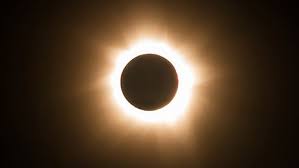
During a solar eclipse...
a)
The sun is blocked by the moon
b)
The Earth is blocked moon
c)
The moon is blocked by the sun
d)
You are blocked
31.

What must occur for an solar eclipse to occur?
a)
Sun-Earth-Moon in line
b)
Sun-Moon-Earth in line
32.
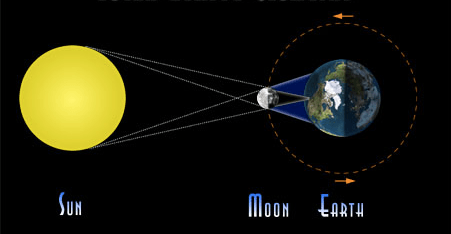
Which type of eclipse is shown in this picture?
a)
Solar Eclipse
b)
Orbit
c)
Lunar Eclipse
d)
Total Eclipse
33.
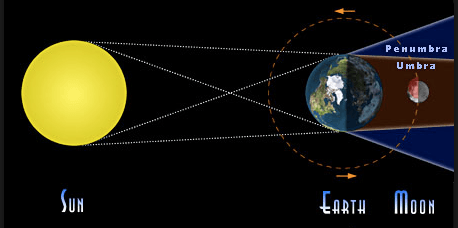
Which type of eclipse is shown in the diagram?
a)
Solar Eclipse
b)
Lunar Eclipse
c)
Total Eclipse
d)
Partial Eclipse
34.

We do NOT have a solar or lunar eclipse each month because...
a)
The tilt of the moon's orbit is at 5 degrees
b)
The moon is too small
c)
The moon's orbital distance changes
d)
All choices
35.

What causes the seasons to change?
a)
The warming and cooling of Earth's core.
b)
The distance from the sun.
c)
Earth's tilt in relation to the sun.
d)
Earth's rotation on its axis.
36.

What happens when the area in which you live tilts away from the sun?
a)
It is summer.
b)
It is spring.
c)
It is winter.
d)
It is fall.
37.

Which season is taking place in the Southern Hemisphere in Position 1?
a)
Winter
b)
Spring
c)
Summer
d)
Fall
38.
In the Northern Hemisphere, on which day will you receive the most daylight?
a)
September 21
b)
December 21
c)
March 21
d)
June 21
39.

Why does the area around the equator stay the same temperature all year?
a)
The equator rotates slower than the poles.
b)
The equator remains the same distance from the sun.
c)
The equator always receives direct sunlight.
d)
The equator has 18 hour days.
40.

Which season is taking place in the Northern Hemisphere in Position 2?
a)
Winter
b)
Spring
c)
Summer
d)
Fall
41.

Which season is taking place in the Northern Hemisphere in Position 3?
a)
Winter
b)
Spring
c)
Summer
d)
Fall
42.
One rotation of Earth is equal to
a)
a day.
b)
a year.
43.
If Earth rotated slower, we would have...
a)
shorter days.
b)
longer days.
c)
shorter years.
d)
longer years.
44.
When will the sun reach the highest altitude at noon?
a)
December
b)
March
c)
September
d)
June
45.
_____________ happens as we begin to turn towards the sun.
a)
Sunset
b)
Sunrise
46.
The Northern Hemisphere gets __________ sunlight in the winter, which leads to _________ temperatures.
a)
less direct, hotter
b)
less direct, colder
c)
more direct, hotter
d)
more direct, colder
47.
Which angle of sunlight produces the most heat?
a)
90 degrees
b)
60 degrees
c)
30 degrees
d)
0 degrees
48.
Which angle of sunlight represents the sunlight that reaches the poles?
a)
90 degrees
b)
60 degrees
c)
30 degrees
d)
0 degrees
49.

Which season is taking place in the Southern Hemisphere in Position 4?
a)
Winter
b)
Spring
c)
Summer
d)
Fall
50.
What is Earth's annual motion around the sun called?
a)
Rotation
b)
Revolution
51.

Why do globes lean sideways?
a)
To allow them to spin easier.
b)
To demonstrate the tilt of Earth's axis.
c)
To demonstrate the effects of gravity.
d)
To demonstrate day and night.
52.
Which season has the least amount of daylight in the Northern Hemisphere?
a)
Winter
b)
Spring
c)
Summer
d)
Fall
100 %

