
 Worksheets
Investigation 3 & 4
Total questions: 30
Worksheet time: 26mins
Name
Class
Date
1.
When the temperature of matter increases the particles...
a)
speed up and move closer
b)
speed up and move farther apart
c)
slow down and move closer together
d)
slow down and move farther apart
2.
The theory that states that all particles in matter are constantly moving; helps to describe the phases of matter
a)
behavior of gases
b)
kinetic theory
c)
matter matters
d)
temperature
3.
Solids are described as having a
a)
definite shape and indefinite volume
b)
indefinite shape and indefinite volume
c)
definite shape and definite volume
d)
indefinite shape and definite volume
4.
Gas particles have the ________ kinetic energy because they move the fastest.
a)
least
b)
most
5.
When a liquid changes its phase and turns into a solid it is known as
a)
condensation.
b)
melting.
c)
vaporization.
d)
freezing or solidification.
6.
Something that takes up space and has mass.
a)
volume
b)
matter
c)
mass
d)
density
7.
What is one way matter change states?
a)
matter loses mass
b)
heat is added
c)
it doesn't change
d)
by doing nothing
8.
The amount of matter something contains is its ______________.
a)
gas
b)
solid
c)
weight
d)
mass
9.
Adding HEAT to matter causes its particles to:
a)
move faster and farther apart
b)
Move slower and farther apart
c)
Move faster and closer together
d)
Move slower and closer together
10.

Substance with a DEFINITE volume, but NO definite shape...
a)
solid
b)
liquid
c)
gas
11.

Substance with a DEFINITE shape and DEFINITE volume...
a)
solid
b)
liquid
c)
gas
12.

Which is true?
a)
Material A is a liquid
b)
Material C is a solid
c)
Material B is a gas
d)
Material B is a liquid
13.
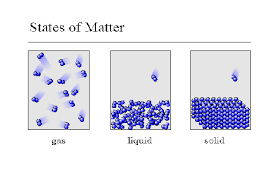
At higher temperatures
a)
particles in an object have less energy
b)
particles in an object move faster
c)
a gas contracts
d)
particles are bigger
14.
Which best describes the characteristics of particles of a liquid?
a)
tightly packed together in a fixed position
b)
have no viscosity
c)
decrease in volume with increasing temperature
d)
free to move around one another but still touch
15.
In which state of matter do the particles spread apart and fill the space available to them?
a)
gas
b)
liquid
c)
solid
16.
The force of a gas's outward push divided by the area of the walls containers is the gas's
a)
volume
b)
pressure
c)
temperature
d)
density
17.
When an inflated balloon is exposed to cold air,
a)
the volume of the balloon decreases
b)
the volume of the balloon increases
18.
___________________ is caused by the ________ of the particles in a substance without having it change its state of matter.
a)
Expansion, heating up
b)
Mixture, melting
c)
Small particles, millions
d)
State of matter, mixture
19.
What happens to a substance when decrease its temperature?
a)
expands
b)
breaks down
c)
dissolves
d)
contracts
20.
What happens to the particles when you “cool off” a substance?
a)
speed up
b)
sink
c)
slow down
d)
run over each other
21.
What do scientists believe all matter is made up of?
a)
dust
b)
particles
c)
water
d)
grains
22.

What is the independent variable in this experiment?
a)
Material
b)
Density
c)
Sound waves
d)
Tuning fork
23.

What statement is a correct conclusion about this experiment?
a)
Over time, the raisins began to rise in the soda when carbon dioxide bubbles attach to the raisins.
b)
If raisins are added to a colorless soda, then they will sink and remain at the bottom of the glass.
c)
Twelve raisins were added to a 250 ml glass container holding 240 ml of colorless soda.
d)
What will happen over time if raisins are added to colorless soda?
24.
What is the correct scientific definition of compression?
a)
Reduction in volume as a result of applied pressure.
b)
To express in shorter form
c)
Expansion in volume as a result of applied pressure.
d)
Reduction in volume as a result of cooling.
25.
What is the correct scientific definition of contraction?
a)
The reduction of volume of a sample of matter as a result of cooling.
b)
Reduction in volume as a result of outside pressure.
c)
Expansion of volume as a result of cooling.
d)
Expansion of volume as a result of outside force.
26.
Compare the particles in a sample of liquid water and the particles in a sample of solid water (ice). Choose the correct answer.
a)
Particles in the liquid are smaller than the particles in the solid.
b)
Particles in the liquid move past each other, and particles in the solid cannot.
c)
Particles in the liquid are less firm than particles in the solid.
d)
Particles in the liquid are moving, and the particles in the solid are not moving.
27.

How could you prove that air is matter?
a)
Weigh a balloon after filling it with water
b)
Weigh a balloon before and after filling it with air and calculate the difference
c)
Try to get some air to burn with a lighted match
d)
Look at air under a hand lens
28.

All types of matter:
a)
do not have weight and do not take up space (volume)
b)
take up space (volume)
c)
have weight
d)
have weight and take up space (have volume)
29.
As ice cream melts, its molecules ___________.
a)
absorb heat energy and move farther apart
b)
absorb heat energy and move closer together
c)
release heat energy and move farther apart
d)
release heat energy and move closer together
30.
Compared to gases, liquids are not easily compressed because particles of a liquid ___________.
a)
are closer together
b)
are moving faster
c)
have more kinetic energy
d)
have a crystal structure
100 %

