
 Worksheets
Manifest Destiny review
Total questions: 174
Worksheet time: 2hrs 29mins
Name
Class
Date
1.
What is Manifest Destiny?
a)
The belief that it was America's destiny to control and civilize all of North America
b)
The belief that their destiny was to manifest
c)
A religious term used to explain how to be saved
2.
As Americans took over more and more land, what happened to Native Americans?
a)
They agreed to give up their land.
b)
They were given their choice of where to live.
c)
They were forced to live in reservations.
d)
They voluntarily moved to Canada and Mexico.
3.
What states were part of the Mexican Cession?
a)
Massachusetts, Rhode Island, Pennsylvania
b)
Louisiana, Arkansas, Alabama, Mississippi
c)
Oregon, Washington, Idaho
d)
California, New Mexico, Utah, Nevada
4.
Which part of the country was the Mexican Cession in?
a)
Northeastern U.S.
b)
Southeastern U.S.
c)
Northwestern U.S.
d)
Southwestern U.S.
5.
The war with Mexico BEGAN with
a)
California's rebellion
b)
a border dispute in Texas
c)
the Battle of Buena Vista
d)
a US invasion of Mexico City
6.
Which of the following presidents purchased Louisiana?
a)
Washington
b)
Adams
c)
Jefferson
d)
Jackson
7.
The purchase of Louisiana
a)
was a costly mistake
b)
was opposed by western farmers
c)
doubled the size of the United States
d)
led to war with Great Britain
8.
What is the name of the piece of land the U.S. gained after the Mexican-American War?
a)
Oregon Country
b)
Given Mexican Land
c)
Louisiana Purchase
d)
Mexican Cession
9.
How did the U.S. acquire Oregon?
a)
treaty with the British
b)
war with England
c)
purchased from the British
d)
war with Mexico
10.
Why was the Gadsden Purchase added to the U.S. in 1853?
a)
it was needed for the building of a railroad
b)
it was a gift from Mexico
c)
it was part of the treaty with Mexico
d)
gold was discovered in that area
11.
The discovery of gold led to
a)
California statehood
b)
Polk becoming president
c)
a war with Mexico
d)
Texas statehood
12.
In what year did the United States purchase the Louisiana Territory?
a)
1803
b)
1819
c)
1845
13.
During which time period did most territorial expansion of the United States take place?
a)
Early 1700s
b)
Early 1800s
c)
Late 1700s
14.
How did the Northwest Ordinance of 1787 provide for the orderly expansion of the United States?
a)
It provided the president with the power to sign treaties with foreign powers to buy additional territory
b)
It provided a review process for laws in new territories and states.
c)
It provided procedures for establishing territories and creating states.
15.
Where was most of the territory the United States acquired during the era of Westward Expansion?
a)
West of the Appalachian Mountains and east of the Mississippi River
b)
West of the Mississippi River
c)
Along the Canadian border with the United States
16.
Which of these is required of a U.S. territory in order for it to become a U.S. state?
a)
Election of a state governor
b)
A population of 60,000 people
c)
Appointment of the first postmaster
17.

Which of the following contributed to the westward expansion of the United States?
a)
European warships attacked the eastern seaboard, forcing citizens to move westward for safety.
b)
Most of the land east of the Mississippi River was not suitable for farming.
c)
Many Americans felt it was their right and duty to move westward.
d)
The standard of living on the Pacific Coast was very high, so many people wanted to move there.
18.
The philosophy of "Manifest Destiny" stated that American should expand from the Atlantic Ocean to the __________
a)
Mississippi River
b)
Pacific Ocean
c)
Rocky Mountains
d)
Great Lakes
19.
Belief that the U.S. would control North America?
a)
Manifest Destiny
b)
Manifest Determination
c)
Mandate of Heaven
d)
Imperialism
20.

Which area on the map was acquired by the United States as a result of the Mexican War?
a)
Texas Annexation
b)
Gadsden Purchase
c)
Mexican Cession
d)
Oregon Territory
21.

Name the piece of Land.
a)
Texas Annexation
b)
Mexican Cession
c)
Louisiana Purchase
d)
Florida Cession
22.

Name the piece of land.
a)
Mexican Cession
b)
Northwest Territory
c)
Trans-Appalachian West
d)
Oregon Country
23.
What was the name of the treaty where Mexico ceded half of its land to the United States?
a)
Treaty of Guadalupe Hidalgo
b)
Treaty of San Jacinto
c)
Treaty of Mesa Verde
d)
Treaty of Alama Gordo
24.

Which of these would be the best title for the illustration above?
a)
Divine Nature
b)
Survival of the Fittest
c)
Universal Expansion
d)
Manifest Destiny
25.
Why were the Northwest Ordinances so important to the new nation?
a)
It led to the admission of new states to our country.
b)
It made Halloween a National Holiday! (don't pick this one!)
c)
It limited the number of voters in national election.
d)
It was so weak that it was replaced with the Constitution.
26.

The President most associated with Manifest Destiny was ---.
a)
Andrew Jackson
b)
Thomas Jefferson
c)
Abraham Lincoln
d)
James K. Polk
27.

What did the Louisiana Purchase of 1803, the annexation of Texas in 1845, and the Mexican War of 1846 have in common?
a)
They brought about a war with Spain.
b)
They increased the territory of the United States.
c)
Each resulted in territory annexed by the United States.
d)
Each involved land forcibly taken from Mexico.
28.
What year did the most miners rush to California?
a)
1848
b)
1849
c)
1852
d)
1853
29.

What is the name given to the belief that the United States had the right and duty to expand across the North American continent?
a)
Manifest destiny
b)
Monroe Doctrine
c)
Great Awakening
d)
Louisiana Purchase
30.
What piece of land was purchased in order to build something in the South? What did they want to build?
a)
Mexican Cession/Trails
b)
Louisiana Territory/Canals
c)
transcontinental/Oregon Country
d)
Gadsden Purchase/Railroad
31.
Who were the Mormons?
a)
1848 when gold was found in California
b)
name given to members of Church of Jesus Christ of Latter day Saints
c)
Mexican General
d)
created by Congress in 1848 as an area that included present day Oregon
32.

Oregon Trail
a)
a route used during the US migration westward
b)
a person who went to California for the gold rush
c)
a giving up ( as in territory or rights ) to another
d)
a government in which citizens rule through elected representatives
33.

Mormons moved from New York to the West in the early 1830s in order to
a)
obey the Book of Mormon
b)
prosper in the fur trade
c)
seek out religious freedom
d)
gold
34.

President Jackson refused to annex Texas at first because doing so would have
a)
upset the balance between free and slave states.
b)
admitted to the British that western expansion had ended.
c)
gone against the wishes of Congress.
35.
Texans fought for independence against what country?
a)
United States
b)
Mexico
c)
France
d)
Great Britain
36.
Utah was mostly settled by what group of people?
a)
Mormons
b)
Christians
c)
Native Americans
d)
Mountain men and fur trappers
37.
The primary goal of manifest destiny was
a)
End slavery in the new territories
b)
removal of European influence from South America
c)
expansion westward to the Pacific Ocean
d)
secession of southern states from the nation
38.
California Gold Rush, the Homestead Act (giving people land), and the completion of the Transcontinental all...
a)
encouraged westward settlement.
b)
are examples of government sponsored transportation programs.
c)
recognized Native American Indian land rights.
d)
promoted the conservation of natural resources.
39.
What did California and Texas have in common?
a)
Both would enter the Union as slave states.
b)
Both would enter the Union as free states.
c)
Both were former Mexican territories.
d)
Both were jointly occupied by the United States and Great Britain.
40.
Who led the Mormons to Utah after the church's founder, Joseph Smith, was killed by an angry mob?
a)
William Penn
b)
John C. Fremont
c)
Brigham Young
d)
Stephen Kearney
41.
Where did many Asian immigrants during the 1800s arrive to in the United States?
a)
Alaska along the Bering Sea
b)
California along the Pacific Ocean
c)
Texas along the Rio Grande River
42.
Which of these is required of a U.S. territory in order for it to become a U.S. state?
a)
Election of a state governor
b)
A population of 60,000 people
c)
Appointment of the first postmaster
43.
One reason California achieved statehood earlier than other territories in the American Southwest was —
a)
a transcontinental railroad linking the East with the West
b)
a series of terrible winters across the Rocky Mountains
c)
a population boom related to the California gold rush
44.
Which modern-day states can be found in the Louisiana Purchase?
a)
Kansas and Nebraska
b)
Louisiana and New Mexico
c)
Nebraska and Illinois
45.
How did President Polk's placement of soldiers along the Rio Grande contribute to the outbreak of war with Mexico?
a)
Texas residents encouraged U.S. soldiers to conduct cross-border raids against Mexican outposts.
b)
U.S. soldiers patrolled a disputed region that Mexico considered its own territory.
c)
The Mexican army desired to show it was superior to the military strength of the United States.
46.

The present-day states of California, Nevada, and Utah were acquired in 1848 from —
a)
Spain
b)
Mexico
c)
Great Britain
d)
Russia
47.

Belief in the idea of Manifest Destiny was one reason that —
a)
the United States went to war with Mexico
b)
transcendentalists established utopian societies
c)
the Bank of the United States was established
d)
women organized the Seneca Falls Convention
48.

Northern opposition to the U.S. annexation of Texas was mainly caused by ---.
a)
fears that the executive branch was controlling Congress
b)
resistance to the expansion of slavery and Southern political power
c)
opposition to expansionism and the use of American troops abroad
d)
demands from Mexicans that their army be deployed north of the Rio Grande
49.

In this statement, Washington advised Americans to adopt a policy of ---.
a)
territorial expansion
b)
nationalism
c)
Mercantilism
d)
Neutrality
50.

In declaring that the nation would avoid entanglement in European wars, the Monroe Doctrine shows the influence of ---.
a)
New England’s merchants
b)
the commerce clause of the U.S. Constitution
c)
the foreign policy of the Democratic-Republican Party
d)
Washington’s Farewell Address
51.

Based on the cartoon, which of the following best explains the impact of the Monroe Doctrine?
a)
The United States would not allow foreign nations to form alliances.
b)
The United States would not allow further European colonization in the Western Hemisphere.
c)
The United States would serve as a negotiator between European nations.
d)
The United States would protect the economic interests of Europe.
52.

What geographic advantage did the United States obtain from the purchase of the Louisiana Territory in 1803?
a)
warm water ports on the Atlantic coast
b)
rich fishing areas in the Great Lakes
c)
control of the Mississippi River
d)
valuable coal reserves in western Pennsylvania
53.

Many Americans supported the Indian Removal Act of 1830 because it —
a)
punished Native Americans for attacks on Washington, D.C.
b)
opened Native American lands to settlement by white citizens
c)
forced U.S. citizenship on Native Americans
d)
forced Native American leaders out of the U.S. Congress
54.

The Trail of Tears was the consequence of ---.
a)
arresting Native Americans for their attacks on whites
b)
opening up Native American land for settlement by whites
c)
creating the Trail of Tears
d)
forcing Native Americans to convert to Christianity
55.

In Worcester v. Georgia the U.S. Supreme Court ruled in favor of the Cherokee nation. However, President Andrew Jackson refused to enforce the ruling, and the result was the —
a)
Trail of Tears
b)
Missouri Compromise
c)
Bleeding Kansas conflict
d)
Texas Revolution
56.
Utah is mostly settled by what people?
a)
Mormons
b)
Christians
c)
Native Americans
d)
Mountain men and fur trappers
57.

a)
13 Colonies
b)
Louisiana Purchase 1803
c)
Texas 1845
d)
Oregon 1846
58.

a)
Northwest Territory
b)
Florida/Louisiana ceded by Spain 1819
c)
Mexican Cession 1848
d)
Mississippi ceded by Spain 1810
59.

a)
Oregon 1846
b)
Spanish Cession 1819
c)
Gadsden Purchase 1853
d)
Mexican Cession 1848
60.

a)
Mexican Cession 1848
b)
Great Britain Cession 1816
c)
Louisiana Purchase 1803
d)
Oregon 1846
61.

a)
Gadsden Purchase 1853
b)
13 Colonies
c)
Texas 1845
d)
Louisiana Purchase 1803
62.
Which territory was gained as a result of the Treaty of Guadalupe-Hidalgo?
a)
Mexican Cession
b)
Texas
c)
Northwest Territory
d)
Florida
63.
This term means to give up territory.
a)
Cede
b)
Annex
c)
Border
d)
Cannibalism
64.
As the country expanded west...
a)
The Native Americans were pushed further and further off their land.
b)
The American west became more populated with people seeking cheap land and riches.
c)
More divisions over slavery developed that would ultimately lead to the Civil War.
d)
All answers are correct.
65.
Several years after gaining its independence from Mexico, this area was admitted into the US.
a)
Florida
b)
Texas
c)
Oregon Country
d)
Louisiana Territory
66.
This is the official document that helps territories become a state.
a)
Northwest Ordinance
b)
Webster-Ashburton Treaty
c)
Monroe Doctrine
d)
Treaty of Guadalupe Hidalgo
67.
What was one outcome of the US-Mexican War?
a)
The United States gained control of the Oregon Country.
b)
Mexico gave up all claims to Texas.
c)
Texas and the new territories had to give up slavery.
d)
Mexicans living in the new territories had to move to Mexico.
68.
Which war happened because of Texas Annexation?
a)
Texas Revolution
b)
American Revolution
c)
US Mexican War
d)
Civil War
69.
What year was Texas annexed to the United States?
a)
1819
b)
1836
c)
1845
d)
1861
70.
Which of the following might have been a motive for moving West to Oregon?
a)
Escaping Debt
b)
Religion
c)
Manifest Destiny
d)
All of the above
71.
What were the difficulties of the Oregon Trail?
a)
Length of the journey
b)
Disease
c)
Weather
d)
All of the above
72.
Which President asked Lewis and Clark to go exploring?
a)
George Washington
b)
Barak Obama
c)
Thomas Jefferson
d)
Abraham Lincoln
73.
What groups were treated poorly during the Gold Rush?
a)
Japanese, Chinese, and Mexican
b)
Mexican, Russian, and African-American
c)
Mexican, Native American, and Chinese
d)
African-American, Spanish, and British
74.
Why was the Battle of the Alamo important?
a)
We won and forced the Mexicans to retreat
b)
We lost and had to give up Texas
c)
We won and claimed all of California
d)
We lost but gained a reason to fight harder
75.
As Americans took over more and more land, what happened to Native Americans?
a)
They agreed to give up their land.
b)
They were given their choice of where to live.
c)
They were forced to live in reservations.
d)
They voluntarily moved to Canada and Mexico.
76.
The war with Mexico BEGAN with
a)
California's rebellion
b)
a border dispute in Texas
c)
the Battle of Buena Vista
d)
a US invasion of Mexico City
77.
What had the Cherokee done before they were forced to move off their land?
a)
moved to Canada
b)
fought many violent battles
c)
assimilated to white settlers' culture
78.
Which Political party did Andrew Jackson belong to?
a)
Republican
b)
Whig
c)
Democratic
d)
Federalist
79.
The cherokee nation responded to the Native American removal act was?
a)
taking the government to court
b)
fighting the army
c)
Peacefully
80.
What did Andrew Jackson do to the Native Americans?
a)
Forced whites to leave them alone
b)
Forced them to vacate their lands
c)
Did nothing either way
81.
Did Andrew Jackson listen to the supreme court decision to give the land to the Native Americans?
a)
Listened
b)
Ignored it
c)
Vetoed the decision
82.
What was the main state invovled in the Nullification Crisis?
a)
New York
b)
Massachussets
c)
Kentucky
d)
South Carolina
83.
Why did Andrew Jackson dislike the National Bank?
a)
The bank did not allow Jackson to raise tariffs
b)
He feared the bank favored the wealthy
c)
The bank was lead by corrupt leaders
d)
The bank did not allow for gold or silver used as currency
84.
Over time the number of slaves in the United states did what?
a)
Stayed the same
b)
kept rising
c)
lowered
85.
Southern states believed the issue of slavery was what?
a)
A states rights issue
b)
the right of each individual person
c)
a national issue
d)
a global issue
86.
Suffrage deals with?
a)
cancelling laws
b)
ending slavery
c)
Voting Rights
87.
Nullification is the right of
a)
people to vote
b)
States to cancel a law
c)
the government to control states
88.
Sectionalism is a sense of pride in what?
a)
Country
b)
Planet
c)
Area or region
89.
Nationalism is a a sense of pride in?
a)
Nation
b)
state
c)
area
d)
region
90.

What political party today traces its roots to Andrew Jackson?
a)
Whigs
b)
Democrats
91.

Who were a big supporters of Andrew Jackson?
a)
wealthy business owners
b)
farmers & factory workers
92.

When Andrew Jackson gave government jobs to people who voted for him it was called:
a)
support system
b)
the spoils system
93.
Andrew Jackson calls the election of 1824 a “corrupt bargain” because of an alliance between which two men?
a)
John Q. Adams & John C. Calhoun
b)
John Q. Adams & Henry Clay
94.
What document said the US would take action against any people from Europe if they interfered in the Western Hemisphere
a)
monroe doctrine
b)
treaty of Ghent
c)
missouri compromise
95.
During this crisis, South Carolina nullified the federal tariff believing that due to states' rights, federal taxes on imports cannot be imposed if the state considers the actions unconstitutional.
a)
Nullification Crisis
b)
Bank Crisis
c)
Indian Removal Crisis
d)
Corrupt Bargain
96.
What was the main state involved in the Nullification Crisis?
a)
South Carolina
b)
Massachussets
c)
Kentucky
97.
A term used by political opponents of President of the United States Andrew Jackson to describe his collection of unofficial advisers
a)
Trail of Tears
b)
Democrats
c)
Kitchen Cabinet
98.
A protective tariff passed in 1828 designed to protect northern manufactured products from foreign competition. The tariff caused a constitutional crisis when South Carolina threatened to nullify the power of the federal government by refusing to collect the tariff.
a)
Spoils System
b)
Nullification
c)
Tariff of Abominations
d)
Veto
99.
The political struggle that developed over the issue of rechartering the Second Bank of the United States (BUS) during the Andrew Jackson administration
a)
Nullification Crisis
b)
Compromise of 1833
c)
The Bank War
d)
Pet Banks
100.
What requirement was eliminated in order to allow more people to vote?
a)
Be a male
b)
Own property
c)
Be 18 years of age
d)
Pay taxes
101.

What did Jackson do that ended the nullification crisis?
a)
passed a higher tariff
b)
fired his Vice President
c)
burned down every home in South Carolina
d)
threatened to use Army to enforce the law
102.
What party forms because they opposed Jackson's ideas?
a)
Whigs
b)
Republicans
103.

Who is the inventor of this machine?
a)
Samuel Morse
b)
Lowell Girls
c)
Samuel Slater
d)
Eli Whitney
104.
Which section of the country was opposed to high tariffs?
a)
the South
b)
the North
c)
the West
105.
Which of the following groups thought of Andrew Jackson as their champion?
a)
Merchants in New England
b)
Native Americans in the North
c)
Common men across the country
d)
Wealthy planters in the South
106.
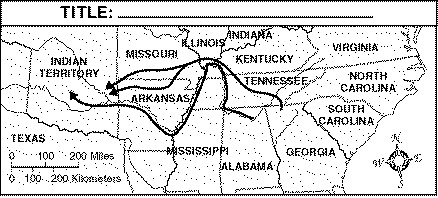
What event of the 1830s is shown by the heavy black lines on the map?
a)
The expansion of suffrage
b)
The spoils system
c)
The Trail of Tears
d)
Battles of the Seminole War
107.
The spoils system refers to
a)
the informal advisers to President Jackson.
b)
the removal of the Cherokee from their lands.
c)
giving jobs to one's political supporters.
d)
the banks owned by Jackson's supporters where the administration put money after closing down the National Bank.
108.
One limitation to democracy during the Jackson era was that
a)
there were only two political parties.
b)
the number of voters was decreasing.
c)
Native Americans could not appeal to the Supreme Court.
d)
women, Native Americans, and most African Americans could not vote.
109.
Jackson's victory in the election of 1828 was significant because
a)
many more people took part in the voting process than in previous elections.
b)
he was the first president to come from a poor background.
c)
it indicated the growing influence of the western section of the country in national politics.
d)
all of the above
110.
Andrew Jackson was a member of which political party?
a)
Whigs
b)
National Republicans
c)
Democrats
d)
Anti-Federalists
111.

To nullify a law means …
a)
to agree to the law
b)
to secede.
c)
to void or cancel the law.
d)
to vote on the law.
112.
Who won the election of 1824?
a)
Andrew Jackson
b)
John Quincy Adams
c)
Henry Clay
d)
William Crawford
113.
What party formed because they opposed Jackson's ideas?
a)
Whigs
b)
Republicans
c)
Federalists
d)
Democrats
114.
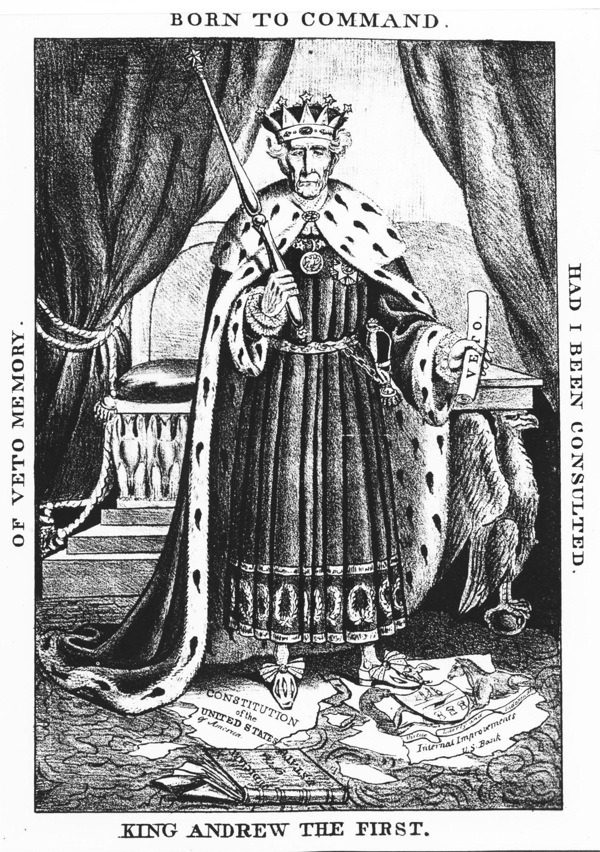
What led President Andrew Jackson’s opponents to call him “King Andrew”?
a)
his experience as a lawyer
b)
his wealthy family
c)
his intention to expand presidential powers
d)
his achievements in the War of 1812
115.
What symbol did the Whigs use for the election of 1840?
a)
log cabin
b)
eagle
c)
a bank
d)
donkey
116.
What helped Martin Van Buren win the election of 1836?
a)
the Whig Party wasn't unified
b)
he was war hero
c)
he fixed the country's economic problems
d)
his belief in the "common man"
117.
Why did W.H. Harrison win the election of 1840?
a)
his opponent was blamed for the depression
b)
he ran unopposed
c)
he supported Jackson's policies
d)
his opponent "killed the bank"
118.
What led to the Panic of 1837?
a)
Jackson's economic policies
b)
a lack of government control over big business
c)
too many common people were not paying taxes
d)
Clay's American System failed
119.
Why were Southerners opposed to high tariffs?
a)
The tariffs made imported goods more expensive
b)
The tariffs decreased the price of the goods they needed
c)
The tariffs were higher in the South than in the North and West
d)
The tariffs benefited only northern merchants
120.
Why did Jackson veto the Maysville Road Bill?
a)
he thought it was unconstitutional
b)
he was mad at John Calhoun
c)
he thought it was a waste of money
d)
he was against all tariffs
121.
These allowed party members, not just leaders, to select candidates.
a)
nominating conventions
b)
spoils system
c)
kitchen cabinet
122.
Vice president under Jackson. He resigned during the nullification crisis. Author of the States' Rights Doctrine.
a)
Martin Van Buren
b)
Sequoya
c)
John C. Calhoun
d)
Daniel Webster
123.
Andrew Jackson's Vice President after John C. Calhoun. Becomes President after the election of 1838.
a)
Martin Van Buren
b)
Daniel Webster
c)
Sequoya
124.
Under the Missouri Compromise, Maine entered the Union as a:
a)
free state
b)
slave state
125.
Under the Missouri Compromise, Missouri entered the Union as a:
a)
free state
b)
slave state
126.
Which issue is most closely associated with abolitionists?
a)
Women's Rights
b)
Religious Freedom
c)
Slavery
d)
Temperence
127.
Which of the following individuals created the Steamboat?
a)
Samuel Slater
b)
Cyrus McCormick
c)
Samuel Morse
d)
Robert Fulton
128.
Which of the following individuals brought factory plans to the U.S. after sneaking them out of Britain?
a)
Cyrus McCormick
b)
Samuel Slater
c)
Samuel Morse
d)
Robert Fulton
129.
Which individual is most closely linked to the abolitionist movement?
a)
Horace Mann
b)
Ralph Waldo Emerson
c)
Fredrick Douglas
d)
Susan B. Anthony
130.
Which of the following individuals developed the telegraph?
a)
Samuel Slater
b)
Cyrus McCormick
c)
Robert Fulton
d)
Samuel Morse
131.
Which of the following was a result of the Industrial Revolution:
a)
The lower class revolted in efforts to gain more power in industrialized states
b)
We see a plumit in our economy because promise notes are passed out without hard money to support it
c)
U.S. economy expanded quickly through entrepreneurs and free enterprise
132.
What conceptual breakthrough, used by Eli Whitney to produce rifles and the cotton gin, was vital to the 1st Industrial Revolution in the United States?
a)
The Factory System
b)
The Bessemer Process
c)
Interchangeable Parts
d)
Hydroelectric Power
133.
The market revolution can best be summed up by which of the following:
a)
The economic change to an industrial north and an agricultural south
b)
The government was overthrown through rebellion because of market taxes
c)
The revolution that changed out country to incorporate free enterprise
d)
People bought what they needed instead of made everything
134.
Which of the following is a hatred towards immigrants, happens in our country at this time.
a)
Patriotism
b)
Nationalism
c)
Nativism
d)
Racism
135.
What was the first women’s rights convention called?
a)
First Continental Congress
b)
Second Continental Congress
c)
Seneca Falls Convention
d)
Women's Suffrage Convention
136.
Which of the following did William Lloyd Garrison create as an abolitionist paper:
a)
North Star
b)
Social Contract Gazette
c)
Time Magizine
d)
The Liberator
137.
What movement inspired people to become more religious and increased church attendance?
a)
Abolitionism
b)
Feminism
c)
The Second Great Awakening
d)
Manifest Destiny
138.
Which of the following was a rebellion which displayed up to 50 African Americans killing 60 Caucasian individuals over the course of 4 plantations in an uprising of sorts:
a)
Shay's Rebellion
b)
Whiskey Rebellion
c)
Turner's Rebellion
139.
Which of the following led the Seneca Falls women's convention?
a)
Helen Bamber
b)
Susan B. Anthony
c)
Franny Armstrong
d)
Sojourner Truth
140.
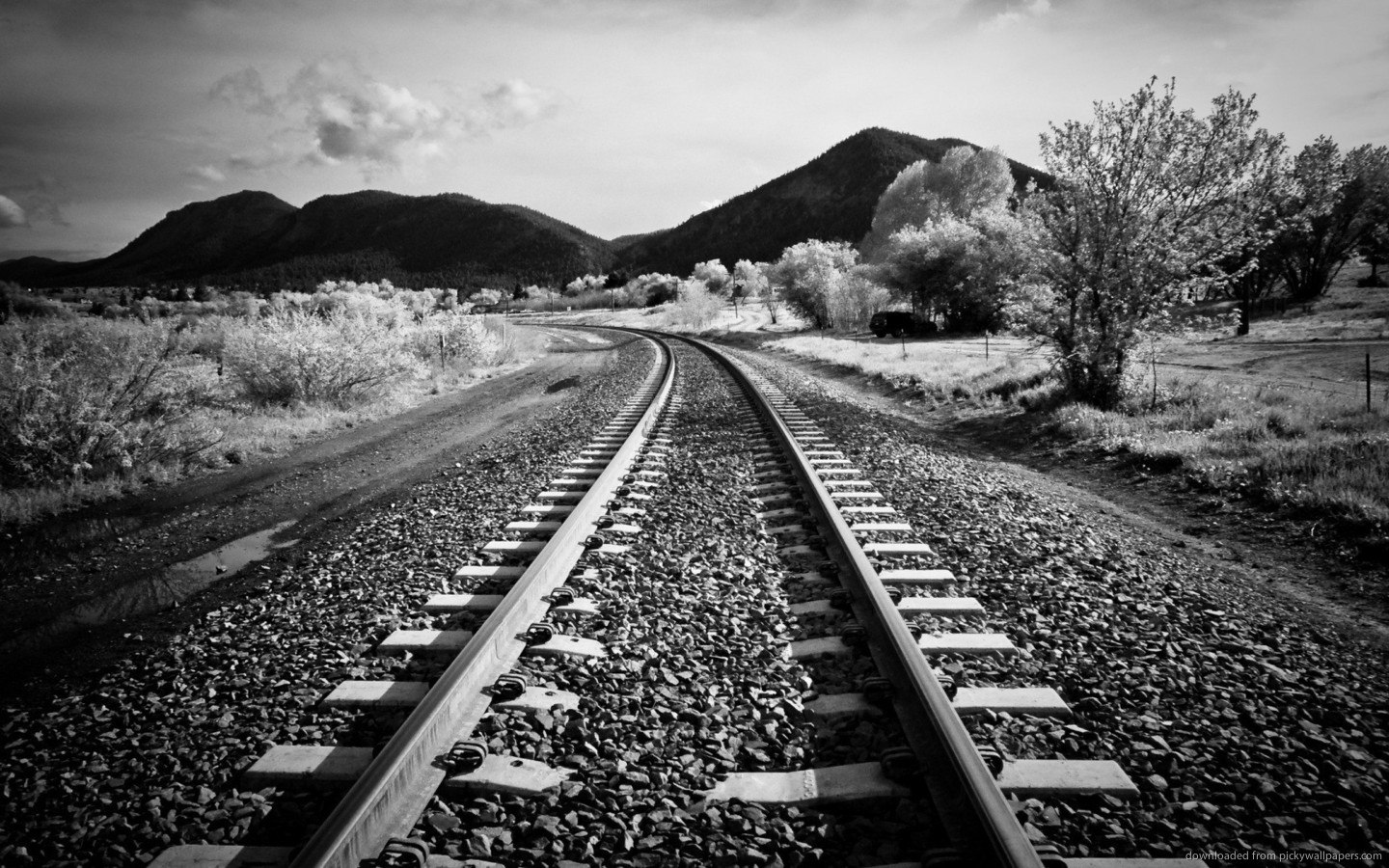
Why were railroads so important during this time?
a)
they moved goods more quickly and less expensively over greater distances
b)
they were fun to ride on to go visit family in other states
c)
people could ride on railroads to get to their jobs in another city
141.

If factories make mass quantity of one item that item becomes....
a)
Less expensive to buy
b)
More expensive to buy
c)
More expensive to make
d)
Less valuable to customers
142.
Why was the steamboat important in the United States?
a)
Made transportation harder on the waterways.
b)
Slowed down the process of transporting goods.
c)
Made transportation easier on the waterways.
d)
Made it difficult for travel.
143.
The expansion of this transportation helped open up the national market.
a)
boats
b)
railroads
c)
automobiles
d)
horse drawn carriages
144.
Which of these is the best definition of the Industrial Revolution?
a)
a change from making things by machines to making them by hand
b)
a change from making things by hand to making them by machines in factories
c)
a shift from a monarchy to a democracy
d)
a shift from old order to new order
145.
Capitalism is
a)
an economic policy that favors free market economy
b)
an economic system that has full government control
c)
an economic system where all people have equal share of wealth
d)
an economic policy where foreign investors control the market
146.
What industry was the first to industrialize?
a)
Banking
b)
Masonry
c)
Textile
d)
Farming/Agriculture
147.
What is a textile?
a)
A multi-spindle spinning wheel
b)
An automatic machine loom
c)
cloth or fabric
d)
goods that help create a text in type or print
148.

When was the Erie Canal made and how long was it?
a)
1825, 28 miles
b)
1826, 28 miles
c)
1820, 30 miles
d)
1828, 20 miles
149.

I worked to reform the prison system and the treatment of the mentally ill, who am I?
a)
Horace Mann
b)
Dorothea Dix
c)
Harriet Tubman
d)
Henry David Thoreau
150.

The network of escape routes from the south to the north to help runaway slaves is called?
a)
Temperance Movement
b)
William Lloyd Garrison
c)
Underground Railroad
d)
Second Great Awakening
151.

What was the Temperance Movement?
a)
Movement to reform prisons
b)
Movement to reform schools
c)
Movement stop slavery
d)
Movement to ban alcohol
152.

I was a runaway slave who became a conductor on the Underground Railroad, and helped over three hundred slaves to freedom, who am I?
a)
The Grimke Sisters
b)
Abigail Adams
c)
Sojourner Truth
d)
Harriet Tubman
153.

I was born a slave but escaped. I became an abolitionist and also worked toward women’s rights, who am I?
a)
Harriet Tubman
b)
Susan B. Anthony
c)
Sojourner Truth
d)
Frederick Douglass
154.

The wave of religious fervor in the early 1800s was called?
a)
Second Great Awakening
b)
Great Awakening
c)
Temperance Movement
d)
Church Reform Movement
155.

I was born in the north where I worked for Women's Suffrage and I was an Agent for the American Anti-Slavery Society, who am I?
a)
Lucretia Mott
b)
Harriet Tubman
c)
Elizabeth Cady Stanton
d)
Susan B. Anthony
156.
What is an abolitionist?
a)
Someone against the sale of alcohol
b)
Someone against prison reform
c)
Someone against slavery
d)
Someone against women's rights
157.
What is "suffrage"?
a)
The right to bear arms
b)
The right to drink alcohol
c)
The right to end suffering
d)
The right to vote
158.

I worked with Lucretia Mott in the women’s rights movement. She helped write The Declaration of Sentiments.
a)
Sojourner Truth
b)
Dorothea Dix
c)
Elizabeth Cady Stanton
d)
Susan B. Anthony
159.

I worked for education reform. I wanted less crowded classrooms and better trained teachers, who am I?
a)
Horace Mann
b)
William Lloyd Garrison
c)
Frederick Douglass
d)
Dorothea Dix
160.
held in NY to launch the women's Rights Movement
a)
Women's Rights Movement
b)
Seneca Falls Convention
c)
Underground Railroad
d)
Prohibition
161.
Quaker, spent years working for anti-slavery
movement and women's rights
movement and women's rights
a)
Harriet Tubman
b)
Dorthea Dix
c)
Lucretia Mott
d)
Horace Mann
162.
known for education reform
a)
Lucretia Mott
b)
Dorthea Dix
c)
Horace Mann
d)
Frederick Douglas
163.
Which state wanted to join the Union as a free state?
a)
California
b)
Michigan
c)
Washington
d)
Georgia
164.
What law compelled the North to return runaway slaves back to the South?
a)
Fugitive Dog Acts
b)
Fugitive Slave Act
c)
Abolition Act of 1850
d)
I refuse to answer this question based on the fact I have not studied!
165.
As part of the agreement in the Compromise of 1850, how would the remaining territory from the Mexican Cession be decided?
a)
The Senate would vote
b)
The House of Representatives would vote
c)
The President would vote
d)
Popular sovereignty
166.
What part of the Compromise of 1850 upset the North the most?
a)
Allowing California in as a free state
b)
Ending the slave trade in Washington DC
c)
using popular sovereignty to decide Utah and New Mexico
d)
the stricter Fugitive Slave Act
167.

Who was known as the Great Compromiser?
a)
John C Calhoun
b)
Daniel Webster
c)
Henry Clay
d)
George Washington
168.
Who proposed the compromise of 1850?
a)
Henry Clay
b)
Abraham Lincoln
c)
Frederick Douglass
d)
Harriet Beecher Stowe
169.
How did the Kansas- Nebraska Act nullify the Missouri Compromise?
a)
It changed the borders of Missouri
b)
It required that all Missouri be free.
c)
It allowed slavery in Kansas and Nebraska Territories
d)
It established new interstate trade rules.
170.
What was the impact of the publication of Uncle Tom's Cabin?
a)
It created a slave revolt in Kentucky.
b)
It turned many more people against slavery.
c)
Congress agreed that slavery should be abolished.
d)
The Fugitive slave law was cancelled.
171.
Who was John Brown and what did he hope to start with his newly formed plan?
a)
John brown, The Kansas abolitionist, formed a plan to provide weapons to slaves to fight a war for freedom.
b)
He wanted power from the war
c)
he wanted to unite with the north
d)
He wanted to be the new Governor of the south
172.
What was John Brown's plan and how did he go about following it?
a)
He planned to blow up the arsenal
b)
Brown and a small band of blacks and whites gathered at Harpers ferry in what is now West Virginia. There, they attacked the federal arsenal, a place where weapons were kept.
c)
He planned to capture the troops and force the south to surrender to him
173.
Who captured John Brown and what happened to him afterwards?
a)
Robert E Lee captured Brown and his followers after two days of battle, Brown and four others were hanged
b)
Winston Churchill captured him and sent him to life in jail
c)
Abrahim Lincoln captured him and saved him
174.

What state is this?
a)
Kentucky
b)
Alabama
c)
North Carolina
d)
Tennessee
100 %

