
 Worksheets
Quarter 1 Review
Total questions: 50
Worksheet time: 2hrs 28mins
Name
Class
Date
1.
What happens when two north poles of a magnet are placed together?
a)
they repel
b)
they attract
c)
they cancel each other out
d)
the strength of the magnet is doubled
2.
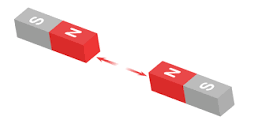
What will happen when these magnets are brought close together?
a)
They will attract each other.
b)
They will repel each other.
c)
Both magnets will turn to the left
d)
Both magnets will turn to the right
3.
True or False: All metals stick to magnets.
a)
True
b)
False
4.
What are the north and south ends of a magnet called?
a)
borders
b)
tips
c)
caps
d)
poles
5.
Ms Jo Jo rubbed two balloons with a piece of wool. What will happen when the balloons are brought near each other?
a)
The balloons will repel each other.
b)
The balloons will attract each other.
c)
The balloons will become positively (+) charged.
d)
The balloons will pop.
6.
Which of the following is caused by static electricity?
a)
a stove getting hot when it is turned on
b)
a magnet being attracted to a refrigerator
c)
a lightning strike during a storm
d)
a light bulb coming on when a switch is turned on
7.
What charge does an electron have?
a)
negative (-)
b)
positive (+)
c)
neutral or no charge (0)
8.
Objects that conduct electricity can easily carry an electrical charge. Which of the following materials best conducts electricity?
a)
copper wire
b)
cotton string
c)
rubber sheets
d)
plastic tubing
9.
Plastic is an example of _______.
a)
an insulator
b)
a conductor
10.
What is the difference between a conductor and an insulator?
a)
An insulator allows electricity to flow through it easily and a conductor does not
b)
A conductor allows electricity to flow through it easily and an insulator does not.
c)
An insulator is magnetic and a conductor is not
d)
A conductor is magnetic and an insulator is not
11.
What happens when you touch a metal doorknob after rubbing your shoes on the carpet?
a)
The doorknob sends a burst of electric current into your body
b)
Millions of electrons go from your finger into the doorknob
c)
The doorknob sends millions of electrons into your finger
d)
our finger becomes negatively charged
12.
A material in which electrons are not able to move easily
a)
Circuit
b)
Insulator
c)
Resistance
d)
Conductor
13.
This circuit has more than one loop. When one light goes out, the others stay on.
a)
closed circuit
b)
series circuit
c)
parallel circuit
d)
open circuit
14.
When there is only one path for electrons to move through it is called a _____. When one light goes out, they all go out.
a)
closed circuit
b)
parallel circuit
c)
series circuit
d)
open circuit
15.

What kind of circuit is this?
a)
series
b)
parallel
16.
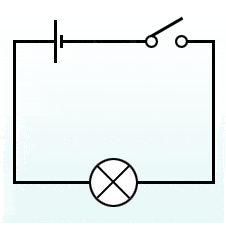
this circuit is .....?
a)
open
b)
parallel
c)
closed
d)
The cutest little circuit evah!
17.
When all parts of the circuit are connected it is a ______ circuit.
a)
open
b)
closed
18.
In a parallel circuit if one light bulb goes OUT; then they ALL go out. TRUE OR FALSE?
a)
TRUE
b)
FALSE
19.
What is a switch's function in a circuit?
a)
to make the current hotter or colder
b)
turn on and off the flow of current
c)
the pathway that current flows
d)
to add more power to the circuit
20.
The loads in a series circuit do not share the available voltage.
a)
True
b)
False
21.
Levi is wanting to light a bulb. What does he need to get the bulb to light?
a)
A battery and a paper clip
b)
A battery and a wire
c)
A paper clip and a wire
d)
A switch and a wire
22.
Electricity is the flow of _________.
a)
Protons
b)
Neutrons
c)
Electrons
23.

If you replace the paper clip with a plastic spoon, what happens?
a)
The bulb doesn't light
b)
The bulb is dimmer
c)
The wires get hot
d)
There is no change
24.

Which statement is true?
a)
The light bulb will light up because the circuit is complete.
b)
The light bulb will light up because the circuit is broken.
c)
The light bulb will not light up because the circuit is complete.
d)
The light bulb will not light up because the circuit is broken.
25.
Which of the following uses electricity for energy?
a)
a windmill
b)
a street light
c)
a solar cooker
d)
a wind-up toy
26.
What is the difference between refraction and reflection?
a)
light bends when it is reflected and bounces off when it is refreacted
b)
light bounces off when it is reflected and bends when it is refracted
c)
light travels in curved lines when it is reflected and straight lines when it is refreacted
d)
when light is refracted it no longer travels
27.
Which of the following best uses mechanical energy to perform a useful task?
a)
flashlight
b)
pencil sharpener
c)
candle
d)
solar calculator
28.
Energy produced from burning coal.
a)
sound
b)
mechanical
c)
electrical
d)
thermal
29.
Daniel has chores to do around the house. I which of his chores does he use thermal energy?
a)
Cook eggs for breakfast
b)
oil a squeaky door hinge
c)
sweep the back porch
d)
dig weeds in the garden
30.

Which statement correctly explains why you see the bear upside sown in the picture?
a)
light is refracted by the water, creating an image of the bear
b)
light is absorbed by the mirror, creating the image of the bear
c)
light is being reflected by the water, creating and image of the bear
d)
light is conducted by the water creating an image of the bear
31.
Energy of motion.
a)
sound
b)
light
c)
mechanical
d)
electrical
32.
Energy that travels in a straight line.
a)
thermal
b)
light
c)
sound
d)
mechanical
33.
Why is it appropriate to use plastic or rubber as materials to cover electric plugs ans outlets?
a)
these forms of matter conduct electrical energy
b)
these forms of matter insulate electrical energy
c)
these forms of matter produce electrical energy
d)
these forms of matter produce light and heat energy
34.
What do a camera, magnifying glass, and a glasses have in common?
a)
they reflect light
b)
they refract light
c)
they are conductors
d)
they make things smaller
35.
What type of energy is generated when a doorbell rings?
a)
Light
b)
Thermal
c)
Sound
d)
Solar
36.

Why dose the straw look bent?
a)
the light is traslucent
b)
the light is being reflected
c)
the light is being refracted
d)
the straw is opaque
37.
Energy produced by vibrations.
a)
mechanical
b)
sound
c)
light
d)
thermal
38.
Brianna strikes a match to light a fire. Which of the following is true about the flames of the fire?
a)
The flames of the fire use the Sun's light energy to produce heat.
b)
The flames of the fire produce light energy.
c)
The flames of the fire produce electric energy.
d)
The flames of the fire do not produce any energy at all.
39.

A car is driving in the middle of the night, and it is very dark. Light from the headlights of the car.....
a)
travels in a curved line.
b)
travels in a circle.
c)
travels in a straight line.
d)
travels only to objects that are shiny.
40.
Which of the following is not a source of light?
a)
the Moon
b)
a car head lamp
c)
a glow-worm
d)
a star
41.

The picture shows a jar of grape jelly. If you were to shine a bright light through the jar, what would happen to most of the light?
a)
The jelly would allow most of it to pass through.
b)
The jelly would reflect it.
c)
The jelly would cause it to curve.
d)
The jelly would absorb it.
42.
Select the surface that would most reflect the most light.
a)
firewood
b)
dark fabric
c)
construction paper
d)
flat aluminum foil
43.

In the picture below, a ray of light hits a surface and changes direction. What is this action called?
a)
incidence
b)
transmission
c)
reflection
d)
refraction
44.

_____?______ materials do not allow light waves to pass through.
a)
Opaque
b)
Transparent
c)
Translucent
45.

_____?_____ materials allow some light to partially pass through, but not in a straight path.
a)
Opaque
b)
Transparent
c)
Translucent
46.

_____?_____ materials allow light waves to pass through easily.
a)
Opaque
b)
Transparent
c)
Translucent
47.

Which objects on the table are "Opaque"?
a)
Pitcher; Supply Box; Pencil
b)
Book; Pencil; Rock
c)
Pencil; Book; Goggles
48.

A student picked two objects from the table. One object was "transparent", and the other object was "translucent". Which of these could be the objects the student picked up?
a)
Rock; Supply Box
b)
Pencil; Cup
c)
Pitcher; Book
d)
Goggles; Fish Bowl
49.

Which of these objects is "translucent"?
a)
A Brick Wall
b)
Sunglasses
c)
Mirror
50.

Which of these objects is "Opaque"?
a)
A Brick Wall
b)
Eye Glass Lenses
c)
Stained Glass Windows
100 %

