
 Worksheets
Mid Term Endless Quizizz
Total questions: 106
Worksheet time: 2hrs 59mins
Name
Class
Date
1.
The moon seems to change shape from day to day in a cycle that lasts about a month as it goes through _.
a)
revolutions
b)
phases
c)
rotations
d)
eclipses
2.
As the moon's shape appears to get smaller, we say that the moon is _.
a)
swelling
b)
waxing
c)
waning
d)
disappearing
3.
About how long does it take the moon to make one complete cycle around the earth?
a)
65 days
b)
8 days
c)
365 days
d)
28 days
4.
Which moon phase is when you can't see the moon at all?
a)
Waning crescent
b)
Full moon
c)
Waxing gibbous
d)
New moon
5.
One complete revolution of the Earth around the sun takes about
a)
one rotation
b)
half a year
c)
one year
d)
one season
6.
The Earth takes about __________________ hours to complete one rotation of its axis.
a)
12
b)
24
c)
14
d)
28
7.
The spinning of an object on its axis is called______
a)
orbit
b)
rotation
c)
revolution
d)
tide
8.
Day and night is caused by the _____________ of earth on its axis.
a)
revolution
b)
orbit
c)
rotation
9.

A large cloud of gas and dust is called a...
a)
Supernova
b)
High-mass star
c)
White dwarf
d)
Nebula
10.

This planet is known for having the greatest temperature extremes.
a)
Mercury
b)
Venus
c)
Earth
d)
Mars
11.

This planet is known for having frequent dust storms and being red in color due to iron oxide.
a)
Mercury
b)
Venus
c)
Earth
d)
Mars
12.

This planet is known for its unique system of rings.
a)
Jupiter
b)
Saturn
c)
Uranus
d)
Neptune
13.

This planet is known for being the largest planet in the solar system and its Great Red Spot.
a)
Jupiter
b)
Saturn
c)
Uranus
d)
Neptune
14.

This planet is known for having its axis of rotation on its side.
a)
Jupiter
b)
Saturn
c)
Uranus
d)
Neptune
15.

The asteroid belt is located...
a)
Between the sun and Mercury
b)
Between the Mars and Jupiter
c)
Past Pluto
16.
The Kuiper Belt is located...
a)
Between the sun and Mercury
b)
Between the Mars and Jupiter
c)
Past Pluto
17.
The energy from the sun is created by a process called:
a)
nuclear fission
b)
nuclear fusion
c)
nuclear reaction
d)
nuclear core
18.
When we look at the sun, what layer are we viewing?
a)
photosphere
b)
chromosphere
c)
corona
d)
convection zone
19.

What layer can be seen here?
a)
chromosphere
b)
corona
c)
photosphere
d)
core
20.

Which sun features are shown here?
a)
solar flares
b)
solar prominences
c)
sun spots
d)
aurora
21.
The sun is made up mostly of _____.
a)
helium
b)
hydrogen
c)
nitrogen
d)
oxygen
22.
The 0 degree line of latitude is the ___________.
a)
Equator
b)
Prime Meridian
c)
International Date Line
d)
Contour line
23.
The 0 degree mark of longitude is known as the ___________ ______________ measure from Greenwich England.
a)
Equator
b)
Prime Meridian
c)
International Date Line
d)
Contour Line
24.
Which type of rock results from melting and cooling of magma?
a)
Igneous
b)
Metamorphic
c)
Sedimentary
d)
Extrusive
25.
Which type of rock forms from extreme heat and pressure?
a)
Igneous
b)
Sedimentary
c)
Organic
d)
Metamorphic
26.
Which type of igneous rock forms above ground?
a)
Intrusive
b)
Organic
c)
Extrusive
d)
Foliated
27.
Coal is an example of a _______ sedimentary rock.
a)
Chemical
b)
Organic
c)
Clastic
d)
Intrusive
28.
Lava which cools on Earth's surface forms an
a)
metamorphic rock
b)
intrusive igneous rock
c)
extrusive igneous rock
d)
foliated metamorphic rock
29.
True/False: Igneous rocks can only turn into metamorphic rocks.
a)
True
b)
False
30.
Sediment being moved from one area to another is called
a)
erosion
b)
deposition
c)
weathering
d)
compaction
31.
The chemical makeup of a rock
a)
Composition
b)
Texture
c)
Minerals
d)
Organic matter
32.
Sediment being dropped off and laid to rest
a)
Deposition
b)
Erosion
c)
Weathering
d)
Lithification
33.
Which of the following are nonrenewable resources?
a)
Plants and animals
b)
Wind and water
c)
Sunlight and water
d)
Coal and petroleum
34.
Which is not a characteristic of a mineral?
a)
Organic
b)
Naturally Formed
c)
Inorganic
d)
Definite crystalline structure
35.
Earthquakes occur at all types of plate boundaries.
a)
True
b)
False
36.
Which layer of Earth is solid metal?
a)
crust
b)
mantle
c)
outer core
d)
inner core
37.
Which layer of Earth causes the magnetic field?
a)
crust
b)
mantle
c)
outer core
d)
inner core
38.
Which layer of Earth do you walk on?
a)
crust
b)
mantle
c)
outer core
d)
inner core
39.
In convection currents, hot things _________.
a)
rise
b)
sink
c)
stop moving
d)
jiggle
40.
Which type of crust is the thickest?
a)
Oceanic
b)
Continental
c)
Bread
d)
Pizza
41.
Which type of crust is the most dense?
a)
Oceanic
b)
Continental
42.
The idea of Continental Drift was introduced and explained by ______________.
a)
Harry Hess
b)
Alfred Wegener
c)
Abraham Ortelius
43.
The youngest rocks on the ocean floor are located ______________.
a)
near continents
b)
at mid-ocean ridges
c)
far from mid-ocean ridges
d)
near Asia
44.
Plates move apart at _________ boundaries.
a)
convergent
b)
stable
c)
divergent
d)
transform
45.
Plates slide past each other at ____________.
a)
subduction zones
b)
transform boundaries
c)
convection currents
d)
divergent boundaries
46.
Two plates moving towards each other create a ___________ boundary.
a)
convergent
b)
transform
c)
divergent
d)
lithospheric
47.
The ___________ is/are an example of a transform boundary.
a)
San Andreas Fault
b)
Mid-Atlantic Ridge
c)
Appalachian Mountains
d)
Himalayas
48.
A majority of the world's Earthquakes and volcanoes are located around this body of water.
a)
Ohio River
b)
Atlantic Ocean
c)
Pacific Ocean
d)
Lake Michigan
49.
Which wave can travel through solids, liquids, and gases?
a)
P
b)
S
c)
Surface
d)
Seismic
50.

What type of fault is this?
a)
Normal
b)
Reverse
c)
Strike-slip
51.
The most destructive type of wave is a
a)
P-wave
b)
S-wave
c)
Surface wave
d)
transverse wave
52.
The Richter scale measures:
a)
the amount of radon gas released
b)
the movement of plates
c)
the strength of an earthquake
d)
the weight of tectonic plates
53.
How much bigger is a magnitude 8 earthquake compared to magnitude 7 one on the Richter Scale?
a)
1 time bigger
b)
10 times bigger
c)
100 times bigger
d)
1000 times bigger
54.
The focus of an earthquake is...
a)
above ground
b)
along the edge of the ocean
c)
next to the nearest mountain range
d)
below ground
55.

The word tsunami comes from
______
______
a)
Japan
b)
Australia
c)
Africa
d)
Gurgens off Route 109!
56.

What starts a Tsunami?
a)
When everyone flushes their toilets at once
b)
when rock underground suddenly breaks along a fault.
c)
An underwater Earthquake
d)
Water Benders
57.

What is an example of a renewable resource?
a)
hydroelectric
b)
oil
c)
coal
d)
fossil fuel
58.

Do Renewable energy sources run out?
a)
Yes
b)
No
59.
Where does most of earth`s energy come from?
a)
The sun
b)
Mars
c)
Wind
d)
Water
60.
what is a fossil fuel
a)
oil
b)
biomass
c)
wind
d)
hydro
61.
Which renewable resource gets its direct energy from the sun?
a)
Geothermal
b)
Solar
c)
Wind
d)
Hydrogen
62.
Why do we use non-renewable resources instead of renewable resources?
a)
Less Expensive
b)
More Energy
c)
All of the above
63.
How much of Earth's water is unavailable for humans to consume due to its high salinity?
a)
3%
b)
23%
c)
77%
d)
97%
64.
What is the % of fresh water in the world
a)
50%
b)
30%
c)
5%
d)
3%
65.
You should never ______ chemicals in the lab.
a)
taste
b)
touch
c)
smell
d)
all of the above
66.
If you are not sure what to do during a lab activity:
a)
guess
b)
change lab partners
c)
ask a teacher
d)
just sit quietly and do nothing
67.
Keeping your work area neat and clean is important because:
a)
My teacher is a neat-freak
b)
I won't lose my supplies in the clutter.
c)
It keeps the room from looking messy.
d)
It helps prevent accidents.
68.
What is the CORRECT procedure for students to follow if a chemical is spilled?
a)
Stand back and advise the teacher of the spill.
b)
Run madly out of the room.
c)
Splash large amounts of water onto the spill.
d)
Immediately ask to go to the restroom.
69.
Helping to clean up the lab or classroom is the job of
a)
old students.
b)
transfer students.
c)
each and every student.
d)
only the teacher.
70.
At the end of the lab you see some leftover chemical that looks just like the stuff you were using. You should:
a)
put the chemical back in the jar it came from.
b)
sweep it into your hand and throw it out.
c)
tell the teacher so you can dispose of it properly.
d)
tell your classmates that your lab partner is really messy.
71.
When in the lab you should wear...
a)
open-toed shoes.
b)
sandals.
c)
closed-toes shoes.
d)
no shoes.
72.
You should report accidents to the teacher __.
a)
after the class is over
b)
immediately
c)
the following day
d)
never
73.
Which of the following are examples of dressing appropriately in the lab?
a)
Pulling long hair back
b)
Leaving long hair down to get in the chemicals.
c)
Wearing sandals
74.
True or False: Your hypothesis can never be wrong.
a)
True
b)
False
75.
If plants are exposed to sunlight, then they will grow taller.
What part of the scientific method is this an example of?
What part of the scientific method is this an example of?
a)
Procedure
b)
Hypothesis
c)
Question
d)
Results
76.
What step does every scientific experiment begin with?
a)
hypothesis
b)
question/problem
c)
procedures
d)
conclusion
77.
This part of the experiment serves as a basis of comparison; the one variable being tested has been omitted.
a)
experimental group
b)
control group
c)
data
d)
variables
78.
This variable in an experiment is the one being deliberately changed by the scientist.
a)
dependent variable
b)
independent variable
c)
data
d)
control group
79.
From the center of the Earth outward, what are the three layers of Earth?
a)
crust - mantle - core
b)
mantle - crust - core
c)
core - crust - mantle
d)
core - mantle – crust
80.
Which of the following is the thinnest layer of the Earth?
a)
Crust
b)
Mantle
c)
Outer core
d)
Inner core
81.
The inner core is thought to be made up of?
a)
Diamonds
b)
Liquid
c)
Solid iron and nickel
d)
Special world filled with magical creatures
82.
What does plate tectonics cause?
a)
Mountains
b)
Volcanoes
c)
Earthquakes
d)
All of the answer choices.
83.
What is the name given by Wegener to the supercontinent he proposed existed before the current continents?
a)
Euroamerica
b)
Pangaea
c)
Gwonondoaland
d)
Laursia
84.
What feature is formed when two continental plates collide?
a)
Volcanoes
b)
Islands
c)
Mountains
d)
New crust
85.
Which of the following are produced at oceanic-oceanic convergent boundaries?
a)
Volcanic island arcs
b)
Ocean Ridges
c)
Transform faults
d)
Continental volcanic arcs
86.
The Himalayan mountains were formed from this type of collision...
a)
Oceanic-oceanic
b)
Continental-continental
c)
Continental-oceanic
d)
Oceanic-volcanic
87.
Metamorphic rocks are formed as a result of...
a)
the cooling of magma
b)
heat and pressure
c)
cooling of lava
d)
compaction of sediments
88.

Circular currents in the mantle caused by the magma being heated by the core off the earth
a)
Lithosphere
b)
Plate Tectonics
c)
Convection Currents
d)
Dynamo Effect
89.

What kind of plate boundary is shown here?
a)
divergent
b)
convergent
c)
transform
d)
strike slip
90.
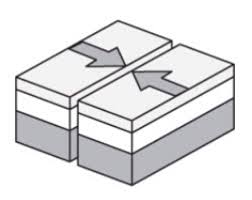
Name the boundary
a)
convergent boundary
b)
divergent boundary
c)
transform boundary
d)
sergent boundary
91.
A subduction zone is formed...
a)
when an ocean plate sinks below a continental plate creating a trench and usually volcanoes
b)
when an ocean plate sinks below a continental plate creating a mid-ocean ridge and rift valley
c)
when an ocean plate sinks below a continental plate creating a mountain range
d)
at transform boundaries
92.

In the diagram, letter "A" is labeling the _____
a)
Hanging Wall
b)
Foot Wall
c)
Gallery Wall
d)
Accent Wall
93.
In the diagram, letter "B" is labeling the _____
a)
Hanging Wall
b)
Foot Wall
c)
Gallery Wall
d)
Accent Wall
94.

a)
normal fault
b)
reverse fault
c)
strike-slip fault
95.
Earth's orbit follows an elliptical path.
a)
Kepler's 1st law
b)
Kepler's 2nd law
c)
Kepler's 3rd law
d)
Nutation
96.
When Earth orbits around the sun, it slows down when it is close to the sun. It speeds up its orbit when it is further from the sun. This is because the sun's gravity is stronger when you are closer to it.
a)
Kepler's 1st law
b)
Kepler's 2nd law
c)
Kepler's 3rd law
d)
Nutation
97.
Planets further from the sun have an orbit that lasts MUCH longer than planets that are close to the sun.
Pluto's orbit lasts over over 90,000 days.
Mercury's orbit lasts 88 days.
Pluto's orbit lasts over over 90,000 days.
Mercury's orbit lasts 88 days.
a)
Kepler's 1st law
b)
Kepler's 2nd law
c)
Kepler's 3rd law
d)
Nutation
98.
When the moon revolves around the Earth, the Earth wobbles a little because the moon's gravity is tugging on it.
a)
Nutation
b)
Precession
c)
Barycenter
d)
Revolution
99.
The Earth's axis changes direction (but the angle does NOT change).
a)
Nutation
b)
Precession
c)
Barycenter
d)
Revolution
100.
During precession, the Earth wobbles a little. This DOES change the angle of the axis.
a)
Nutation
b)
Precession
c)
Barycenter
d)
Revolution
101.
About how long ago do scientists believe the
universe began?
a)
13-14 billion years ago
b)
13-14 million years ago
c)
12-13 billion years ago
d)
12-13 million years ago
102.

What does the Big Bang theory suggest?
a)
The universe was just there
b)
The Milky Way is the only solar system
c)
The universe is continually expanding
d)
The universe started as a point and is moving towards each other
103.
A[n] ______________ tide occurs when the sun is at right angles to the line between Earth and the moon.
a)
high
b)
neap
c)
low
d)
spring
104.
How long does it take light to get from the sun to earth?
a)
8 hours
b)
2 years
c)
8 minutes
d)
12.5 seconds
105.
In what way does the Sun warm Earth?
a)
radiation
b)
convection
c)
conduction
d)
condensation
106.
Planets orbit the Sun in a shape called a(n)
a)
circle
b)
ellipse
c)
focus
d)
perihelion
100 %

