
 Worksheets
States of Matter and Phase Change
Total questions: 29
Worksheet time: 11mins
Name
Class
Date
1.

At higher temperatures
a)
particles in an object have less energy
b)
particles in an object move faster
c)
a gas contracts
d)
plasma
2.
Define a liquid.
a)
Indefinite shape, no definite volume
b)
Definite shape, definite volume
c)
Found in stars
d)
Definite volume, no definite shape
3.
The state of matter that has no definite size or shape is
a)
Solid
b)
Liquid
c)
Gas
d)
plasma
4.
Particles of a liquid
a)
are tightly packed together and stay in a fixed position.
b)
have no viscosity.
c)
decrease in volume with increasing temperature.
d)
are free to move around one another but still touch.
5.
What term describes a solid changing to a gas?
a)
Freezing
b)
Sublimation
c)
Evaporation
d)
Freezing
6.
What is condensation?
a)
gas to solid
b)
gas to liquid
c)
liquid to solid
d)
solid to liquid
7.
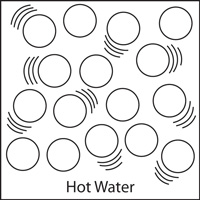
The speed of the molecules determines the _____ of the substance.
a)
volume
b)
density
c)
pressure
d)
temperature
8.
The slower the particles in a substance move,
a)
the colder it is.
b)
the warmer it is.
c)
the more energy it has.
d)
the less energy it has.
9.
Thermal energy is...
a)
heat energy.
b)
the energy of motion
c)
energy of nuclear processes.
d)
an indication of physical change.
10.
Freezing
a)
Solid to gas
b)
Liquid to solid
c)
Gas to solid
d)
Liquid to gas
11.

Which state of matter has particles arranged like this?
a)
solid
b)
liquid
c)
gas
12.

Which state of matter has particles arranged like this?
a)
solid
b)
liquid
c)
gas
d)
plasma
13.

Which state of matter has particles arranged like this?
a)
solid
b)
liquid
c)
gas
d)
plasma
14.
Which state of matter has particles that are stuck in one spot but vibrate?
a)
solid
b)
liquid
c)
gas
d)
plasma
15.
Which state of matter has particles that are still close together, but can move around each other?
a)
solid
b)
liquid
c)
gas
16.
The most common state of matter in the universe is _________.
a)
Plasma
b)
Solid
c)
Liquid
d)
Gas
17.
Air is an example of a
a)
solid
b)
liquid
c)
gas
d)
plasma
18.
Oil is an example of a
a)
solid
b)
liquid
c)
gas
d)
plasma
19.
What happens to the particles when heat is added?
a)
The particles get bigger
b)
The particles get smaller
c)
The particles get slower
d)
The particles get faster
20.
State of matter in which materials have a definite shape and a definite volume
a)
Solid
b)
Liquid
c)
Gas
d)
Plasma
21.
The kinetic theory of matter states that all particles of matter are in constant motion.
a)
True
b)
False
22.

What phase of matter is illustrated in "C"
a)
solid
b)
liquid
c)
gas
d)
melting
23.

What is labelled "B" on the graph?
a)
solids
b)
liquids
c)
evaporation
d)
melting\
24.
Water droplets forming on your mirror in your bathroom after you shower.
a)
vaporization
b)
sublimation
c)
condensation
d)
freezing
25.
High energy state of matter that is made of positive and negative charges.
a)
Gas
b)
Liquid
c)
Solid
d)
Plasma
26.
Flashback question:
If I change my cat's food to Fancy Feast, then the amount of hairballs will decrease. The dependent variable is:
If I change my cat's food to Fancy Feast, then the amount of hairballs will decrease. The dependent variable is:
a)
food type
b)
normal food (one the cat eats normally
c)
amount of hairballs
d)
food dish
27.
Flashback question:
The standard in an experiment to which the results are compared is called the ________________.
The standard in an experiment to which the results are compared is called the ________________.
a)
Constant
b)
Control group
c)
Independent variable
d)
Dependent variable
28.

Flashback question: At which point is potential energy greatest
a)
W
b)
X
c)
Y
d)
Z
29.
Flashback: If an object's mass = 30 Kg on the Earth, what would be it's weight on Earth?
a)
30 N
b)
3 N
c)
2940 N
d)
294 N
100 %

