
 Worksheets
Skeletal Muscle Anatomy & Sliding Filament Theory PRETEST
Total questions: 25
Worksheet time: 16mins
Name
Class
Date
1.
What is the name of the Thick filaments?
a)
Actin
b)
Myosin
c)
Myoglobin
d)
Titan
2.
What is the name of the thin filaments in the muscle cell?
a)
Actin
b)
Myosin
c)
Myoglobin
d)
Titan
3.
The neurotransmitter that signals muscle contraction is called...
a)
Ach
b)
Myosin
c)
Actin
d)
Calcium
4.
What is the name of the contractile unit in a muscle cell?
a)
fascicle
b)
sarcomere
c)
tendon
d)
endomysium
5.

The plasma membrane of a skeletal muscle cell is called the:
a)
sarcomere
b)
myofilament
c)
sarcolemma
d)
sarcoplasm
6.
Region where a motor neuron comes in close contact with a muscle cell.
a)
neurotransmitter
b)
muscular dystrophy
c)
muscle tension
d)
neuromuscular junction
7.
The functional unit of the muscle cell is the:
a)
Sarcomere
b)
Osteon
c)
Myofilament
d)
Muscle fiber
8.
The Ions that are responsible for removing Troponin from Tropomyosin.
a)
Sodium
b)
Calcium
c)
Potassium
d)
Magnesium
9.
What two chemicals are necessary for muscle contraction to occur?
a)
Niacin and Potassium
b)
Calcium and ATP
c)
Sodium and Potassium
d)
Ach and Potassium
10.
enzyme that breaks down the muscle cell neurotransmitter and ends the impulse
a)
lactase
b)
sucrase
c)
lipase
d)
acetylcholinterase
11.
___ and ___ are regulatory proteins bound to actin.
a)
Troponin and tropomyosin
b)
Myosin and actin
c)
Calcium and Oxygen
d)
Glycogen and hemoglobin
12.
What is the structure that stores the Calcium in the muscle cell.
a)
Sarcoplasm
b)
Sarcolemma
c)
Sarcoplasmic Reticulum
d)
Myoglobin
13.
Skeletal Muscle contraction is initiated when the ________ sends a message to the muscle cell.
a)
Muscle cell
b)
Neuron
c)
Gland
d)
None of the above
14.
When Sodium ions fly into the muscle cell, it's said to be __________.
a)
Repolarizing
b)
Depolarizing
c)
Electrically neutral
d)
none of the above
15.
Identify one factor that can cause the first sodium channel to open in a muscle cell.
a)
Calcium ions being released from the sarcoplasmic reticulum.
b)
Acetylcholine being released from the motor neuron
c)
Calcium ions binding to troponin
d)
ATP causing the myosin heads to pop up.
16.
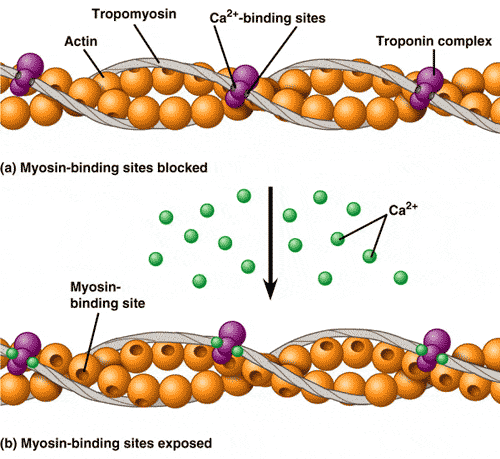
Calcium:
a)
causes ATP binding to actin
b)
increases the action potential along the sarcolemma
c)
binds to proteins on myosin
d)
triggers the binding of myosin to actin
17.

Axon terminal is represented by
a)
1
b)
2
c)
3
d)
4
18.

Number 3 represents which of the following events
a)
action potential reaches the axon terminal
b)
sodium rushes into the muscle fiber
c)
potassium leaving the muscle fiber
d)
ACh crossing the synaptic cleft
19.

Z represents
a)
Dendrite
b)
Axon Terminal
c)
Neurotransmitters
d)
Synapse
20.

The axon terminal is represented by
a)
7
b)
8
c)
9
d)
10
21.

The sarcolemma is represented by
a)
9
b)
10
c)
11
d)
12
22.

The receptors are represented by
a)
8
b)
9
c)
10
d)
11
23.
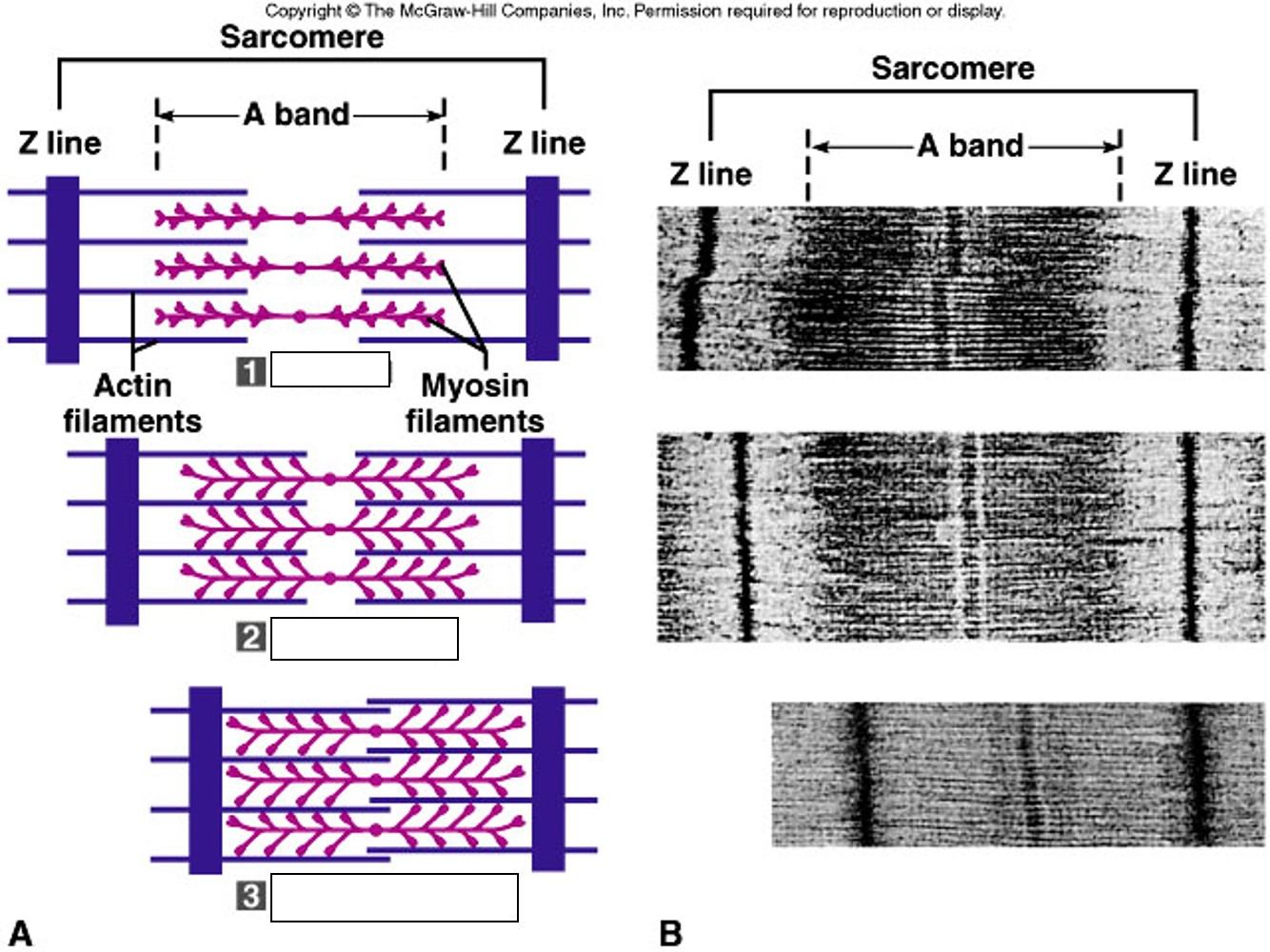
What state is the sarcomere in #1
a)
Relaxed
b)
Contracting
c)
Fully Contracted
d)
None of the above
24.
What state is the sarcomere in #2
a)
Relaxed
b)
Contracting
c)
Fully Contracted
d)
None of the above
25.
What is a crossbridge?
a)
Where myosin binds to actin
b)
Where the calcium crosses into the cytoplasm
c)
Where calcium binds with troponin
d)
None of the answers are correct.
100 %

