
 Worksheets
Earth's Processes
Total questions: 40
Worksheet time: 32mins
Name
Class
Date
1.
This layer is made up of igneous, metamorphic, and sedimentary rock.
a)
outer core
b)
mantle
c)
crust
d)
inner core
2.
The _______ is also partly responsible for the Earth's magnetic field due to the liquid iron and nickel located here.
a)
inner core
b)
outer core
c)
crust
d)
mantle
3.
Which layer of the earth is in the very center?
a)
Crust
b)
Mantle
c)
Outer Core
d)
Inner Core
4.
Which layer of the earth has the lowest temperature?
a)
Crust
b)
Mantle
c)
Outer Core
d)
Inner Core
5.
Which layer of the earth is much thinner than the others?
a)
Crust
b)
Mantle
c)
Outer Core
d)
Inner Core
6.
This layer of Earth is solid Iron and Nickel
a)
Outer Core
b)
Mantle
c)
Inner Core
d)
Crust
7.
Is the Outer core solid or liquid?
a)
solid
b)
liquid
8.
Less dense materials rise to the top.
a)
True
b)
False
9.
What describes the outer core?
a)
solid
b)
liquid
c)
viscous
d)
gas
10.
What is the thickets layer of the Earth
a)
crust
b)
mantle
c)
outer core
d)
inner core
11.
Which layer of Earth has the GREATEST density?
a)
crust
b)
mantle
c)
outer core
d)
inner core
12.
This layer of Earth is the thickest part
a)
crust
b)
outer core
c)
mantle
d)
inner core
13.
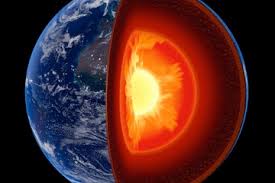
As you travel from the inner core to the crust, how would temperature, pressure and density of the material change?
a)
The would all increase
b)
The would all decrease.
c)
They would stay the same.
d)
Temperature would decrease, but pressure and density would increase.
14.
Rock sediment that have already been compacted are now glues tightly together with mineral and water mixture
a)
Compaction
b)
Uplift
c)
Deformation
d)
Cementation
15.
Rock sediment are placed or deposited on top of one another from wind or sand pushing it downwards.
a)
Melting
b)
Uplift
c)
Weathering and Erosion
d)
Deposition
16.
Energy: heat from the Earth's core
a)
Melting
b)
Weathering and Erosion
c)
Uplift
d)
Compaction
17.
Energy and Force: Sun and gravity moving wind and rain to carry sediment
a)
Cooling and Crystallization
b)
Cementation
c)
Deformation
d)
Weathering and Erosion
18.
Rock is heated to the point that it turns from solid to liquid - becomes known as "molten" rock (magma or lava)
a)
Melting
b)
Weathering and erosion
c)
uplift
d)
compaction
19.
Molten rock cools so that it is going from liquid to solid again. While this occurs, crystals form, giving the rock colors and odd formations.
a)
Cementation
b)
Compaction
c)
Cooling and Crystallization
d)
Uplift
20.
Rocks are broken down by wind, water, and chemicals into smaller pieces, many times as small as a speck of sand
a)
Cementation
b)
Weathering and Erosion
c)
Deposition
d)
Deformation
21.
a rock formed from the consolidation of sediment that has accumulated in layers or within water
a)
igneous rock
b)
sedimentary rock
c)
metamorphic rock
d)
mineral
22.
a rock that forms when an existing rock is altered through heat and/or pressure
a)
igneous rock
b)
sedimentary rock
c)
metamorphic rock
d)
mineral
23.
True or False: Once a rock is sedimentary, it cannot become an igneous rock.
a)
True
b)
False
24.

This rock started as lava that cooled and then was heated and put under pressure over time. What type of rock is this?
a)
Sedimentar
b)
Igneous
c)
Metamorphic
25.
What two processes make sediment?
a)
Weathering
b)
Erosion
c)
Weathering & Erosion
26.
The three groups of rocks are classified by
a)
How they form
b)
Color
c)
Grain size
d)
Chemical Composition
27.

This rock formed when bits of other rocks became pressed into a solid. What type of rock is it?
a)
Sedimentary Rock
b)
Metamorphic Rock
c)
Igneous Rock
28.

This rock was formed when magma cooled very slowly inside the Earth. What specific type of rock is it?
a)
Intrusive Igneous Rock
b)
Extrusive Igneous Rock
c)
Foliated Metamorphic Rock
d)
Clastic Sedimentary Rock
29.

This rock formed when lava cooled very quickly on Earth's surface. What specific type of rock is it?
a)
Extrusive Igneous Rock
b)
Intrusive Igneous Rock
c)
Non-Foliated Metamorphic Rock
d)
Biochemical Sedimentary Rock
30.
What are the 3 major types of rocks?
a)
Igneous, Metamorphic, Sedimentary
b)
Metamorphic, Igneous, Cementation
c)
Brown, Red, Gray
d)
Streak, Hardness, Breakage
31.
Which of the words below describe mud, sand, and tiny bits of rocks that cement together to form a type of rock?
a)
stalactites
b)
magmas
c)
metamorphs
d)
sediments
32.
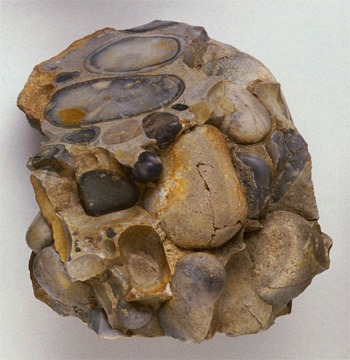
This rock was formed by smaller pieces of rock that settled at the bottom of a lake millions of years ago. What type of rock is this?
a)
Sedimentary
b)
Igneous
c)
Metamorphic
33.

When sediments are pressed together tightly, this is called ____________.
a)
Compaction
b)
Cementation
c)
Weathering
d)
Erosion
34.

The process when rocks break into smaller pieces due to exposure to natural elements is called
a)
erosion
b)
weathering
c)
sediments
35.
This rock was formed when molten rock cooled into a solid. What type of rock is it?
a)
Igneous Rock
b)
Metamorphic Rock
c)
Sedimentary Rock
36.

Each rock type can follow only one pathway of the rock cycle.
a)
True
b)
False
37.
The process by which metamorphic rocks are formed...
a)
heat and pressure
b)
compaction and cementation
c)
melting and cooling
38.
The process by which igneous rocks are formed...
a)
heat and pressure
b)
melting and cooling
c)
compaction and cementation
39.

This rock cooled on the outside of a volcano and contained air bubbles when it was forming. What type of rock is this?
a)
Sedimentary
b)
Igneous
c)
Metamorphic
40.

This rock was another type of rock that was heated and compressed over time. What type of rock is this?
a)
Sedimentary
b)
Igneous
c)
Metamorphic
100 %

