
 Worksheets
Energy of Chemical Reactions
Total questions: 15
Worksheet time: 9mins
Name
Class
Date
1.
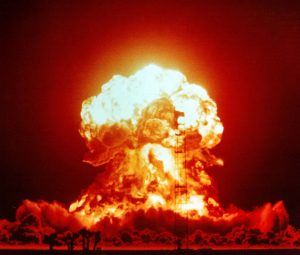
What type of reaction is shown in the photo?
a)
Exothermic
b)
Isothermic
c)
Endothermic
d)
None of the above
2.
How would this reaction be classified?
2Na + Cl2 → 2NaCl + 25kJ energy
2Na + Cl2 → 2NaCl + 25kJ energy
a)
Exothermic
b)
Endothermic
c)
Isothermic
d)
None of the above
3.

What is true of this reaction?
a)
Equal amounts of energy were released and absorbed
b)
The reaction released more energy than it absorbed
c)
The reaction absorbed more energy than it released
4.
How does an exothermic reaction feel?
a)
cold
b)
warm
c)
You can't feel it
d)
None of the above
5.
What tool is used to measure the amount of heat in a material?
a)
meter stick
b)
spring scale
c)
graduated cylinder
d)
thermometer
6.
This is a measurement of the amount of heat in a material.
a)
temperature
b)
degrees
c)
chemical equation
d)
exothermic reaction
7.
What are the reactants in the chemical equation below?
Na+Cl2 → 2NaCl
Na+Cl2 → 2NaCl
a)
Na and Cl
b)
Na only
c)
NaCl
d)
2NaCl
8.

What are the products in the chemical equation pictured?
a)
CO2
b)
CO2 and H2O
c)
CH4 and O2
d)
O2
9.
What is the enthalpy (ΔH) of an exothermic reaction?
a)
+
b)
−
10.
What is true of the reaction described below?
Br2 + Cl2 + 30.0 J of energy → 2BrCl
Br2 + Cl2 + 30.0 J of energy → 2BrCl
a)
It is exothermic because energy was released.
b)
It is endothermic because energy is absorbed.
c)
It is exothermic because energy is absorbed.
d)
It is endothermic because energy is released.
11.
Which of the following indicates an exothermic reaction?
a)
ΔH is positive
b)
Feels cool to the touch
c)
2H2O → H2 + O2 + 50Kj energy
d)
More energy is absorbed to break bonds in the reactant.
12.
How do you know that energy is being absorbed during a chemical reaction?
a)
Temperature increases
b)
Temperature decreases
13.
What is true if there is 1200kJ of energy in the reactant and 1500kJ of energy in the product?
a)
Energy was released.
b)
It is endothermic
c)
Energy was not involved.
d)
It is exothermic.
14.
Sydnee mixes a solution of baking soda and water. The initial temperature of the solution is 22⁰C. She adds 10mL of vinegar and takes the temperature again. The final temperature is 17⁰C. Which of the following is true?
a)
The reaction is exothermic
b)
The reaction is endothermic
c)
ΔH is negative
d)
The reaction lost heat to the environment.
15.
What happens to the temperature of the solution when the reaction is absorbing heat?
a)
The temperature decreases.
b)
The temperature increases.
c)
The temperature stays the same.
100 %

