
 Worksheets
Text Features & Text Structures
Total questions: 47
Worksheet time: 47mins
Name
Class
Date
1.
This feature explains what the illustration/photograph is.
a)
Glossary
b)
Index
c)
Table of contents
d)
Caption
2.
This feature informs the reader of important words/vocabulary found within the paragraph.
a)
Glossary
b)
Bold words
c)
Captions
d)
Table of contents
3.
What text feature gives the
definitions of important vocabulary words?
a)
Captions
b)
Index
c)
Glossary
d)
None of the above
4.
This feature is usually found at the top of a page and explains what the paragraph is about?
a)
Table of contents
b)
Diagram
c)
Index
d)
subheading
5.
Important words are usually?
a)
Circled
b)
Bold print
c)
in the table of contents
d)
lowercase words
6.

This is an example of ____________ text feature?
a)
Index
b)
Table of contents
c)
Glossary
d)
Diagram
7.
This feature is used to show
one or more locations/ geographical regions.
a)
Glossary
b)
Maps
c)
Captions
d)
None of the above
8.
What text feature gives the definitions of important vocabulary words?
a)
Captions
b)
Index
c)
Glossary
d)
None of the above
9.

What is the arrow pointing to?
a)
Caption
b)
Picture
c)
Index
d)
Heading
10.

What is this text feature?
a)
Map
b)
The United States
c)
Picture
d)
Caption
11.
True/False: We should ALWAYS look at the text features.
a)
True
b)
False
12.

The text feature in the yellow box is called a(an)
a)
caption
b)
diagram
c)
timeline
d)
sidebar
13.
What helps us know exactly what something looks like?
a)
Map
b)
Caption
c)
Picture
d)
Heading
14.
What is the difference between an index and a glossary?
a)
There is no difference
b)
A glossary shows what page a word can be found on. The index tells the definition of the word.
c)
The glossary shows a picture with a caption.
d)
The glossary shows the meaning of a word and the index shows what page to find a word on.
15.

This
is an example of a ___________?
a)
Index
b)
Table of contents
c)
Chart/Graph
d)
Caption
16.
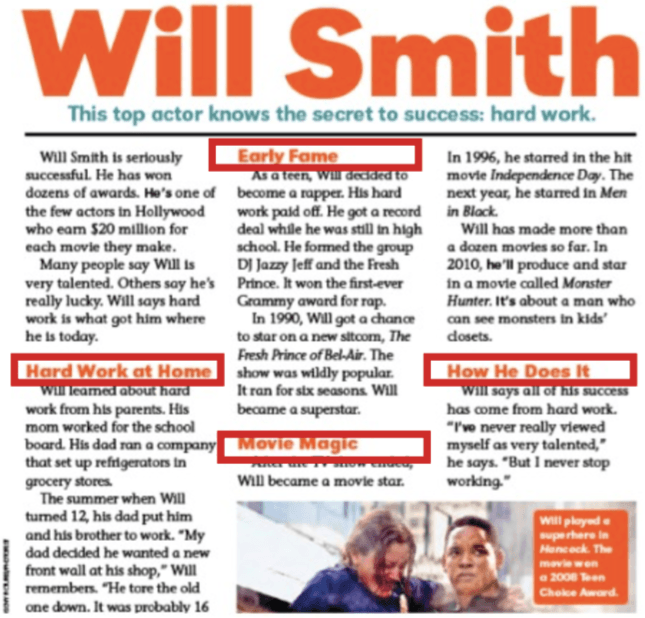
What is the purpose of these subheadings?
a)
To help the
reader understand
the author’s opinion
b)
To help the
reader visualize the
information
c)
To help the
reader find the main
ideas in each
section
d)
To help the
reader place events
in order
17.

a)
PHOTOGRAPH
b)
ILLUSTRATION
c)
CAMERA
d)
MAP
18.

a)
SUBHEADING
b)
HEADING
c)
TEXT BOX
d)
CAPTION
19.

a)
HEADING
b)
SUBHEADING
c)
CAPTION
d)
LABEL
20.

a)
GLOSSARY
b)
INDEX
c)
TABLE OF CONTENTS
d)
SUBHEADING
21.

a)
MAP
b)
CHART
c)
GRAPH
d)
PHOTOGRAPH
22.

What text feature is used on the list to the left?
a)
numbered list
b)
white space
c)
captions
d)
bulleted list
23.

The author uses this text feature to show
a)
How a cell phone
can get wet.
b)
How to remove a
SIM card from
your phone
c)
The dangers of
swimming with
your phone
d)
The proper steps
in saving your cell
phone when wet.
24.

What text feature is shown in the red box?
a)
numbered list
b)
bulleted list
c)
graphic
d)
caption
25.
What is the purpose of these subheadings?
a)
To help the reader understand the author’s opinion
b)
To help the reader visualize the information
c)
To help the reader find the main ideas in each section
d)
To help the reader place events in order
26.

What text feature is used in the red boxes?
a)
sidebar
b)
column
c)
white space
d)
subheading
27.

2. Why did the author choose to put “saliva” in bold text?
a)
To make the paragraph attractive and easy to read.
b)
Draw the reader’s attention to an important word
c)
Point out the main idea of the paragraph or section.
d)
Help the reader visualize the information.
28.

The purpose of graphics (such as graphs, tables, pictures, or maps) is to
a)
Help the reader visualize important information
b)
Describe what is found in a photo or illustration
c)
Separate text into sections based on main ideas
d)
Show information that occurs in a certain order
29.

The text feature found below the snake photograph is called a(an)
a)
font change
b)
white space
c)
caption
d)
side bar
30.

The purpose of the text feature below the photo is
a)
to show the main idea of the article to the reader.
b)
To convince the reader that snakes are dangerous
c)
To provide an explanation of the photo
d)
To inform the reader about the history of snakes.
31.

What is the author’s purpose for the text feature inside the red box?”
a)
To show the main idea
of the first paragraph.
b)
To provide info not
found in the text
c)
To show the main idea
of the article.
d)
To establish where an
event happens and
how far away.
32.
This type of writing considers similarities and differences.
a)
description
b)
compare & contrast
c)
order & sequence
d)
cause & effect
33.
In this type of writing, the reader will see words/phrases such as because, as a result of, and due to.
a)
cause & effect
b)
problem & solution
c)
order & sequence
d)
compare & contrast
34.
In this type of writing the reader will find words/phrases such as a problem is, solve,or solution.
a)
cause & effect
b)
problem & solution
c)
order & sequence
d)
compare & contrast
35.
This type of writing gives information step-by-step.
a)
cause & effect
b)
problem & solution
c)
order & sequence
d)
compare & contrast
36.
This type of writing is usually in chronological order.
a)
cause & effect
b)
problem & solution
c)
order & sequence
d)
compare & contrast
37.
Students who are frequently absent often have lower average grades than those who have good attendance. When they are out of the classroom, students do notget to see a teacher’s lessons. Even if they attend extra help, it’s usually much shorter and less detailed than the actual lesson. In addition, frequently absent students often miss tests or other assignments and don’t always make up the work.
a)
problem & solution
b)
order & sequence
c)
compare & contrast
d)
cause & effect
38.
Every morning, I wake up at about 7:00 AM. The first thing I do is make my bed and pick out the clothes I’m going to wear. Then, I brush my teeth and take a shower. After my shower, I dry my hair and get dressed.
a)
description
b)
compare & contrast
c)
order & sequence
d)
problem & solution
39.
While oranges and lemons are both citrus fruits that grow on trees, they are different colors and have very different tastes.
a)
description
b)
compare & contrast
c)
order & sequence
d)
problem & solution
40.
The school hallway carried the smell of wax, varnish, and cleaning supplies. Bright,yellow light glared into the hall through the freshly cleaned windows. This highlighted the deep scrapes in the lockers, the chips in the wall tiles, and the spider webs hanging in the corner.
a)
description
b)
compare & contrast
c)
order & sequence
d)
problem & solution
41.
The sun shone bright yellow in a cloudless blue sky. A faint haze rose from the glistening pavement, suggesting steam rising off a hot surface.
a)
description
b)
compare & contrast
c)
order & sequence
d)
problem & solution
42.
Before editing your writing, the first step should be to revise. Begin by reading each paragraph separately, and then find the topic sentence for each one. Next, make sure all the sentences relate to that topic sentence. Finally, look at how the paragraphs work together. Make sure there are transitional words between each paragraph so your writing flows together smoothly.
a)
order & sequence
b)
descriptive
c)
compare & contrast
d)
problem & solution
43.
This has been the worse summer in years for acorn production in northeastern forests. While some may think this is not a big deal, in fact it is. If there are fewer acorns, it may result in a decrease in populations of squirrels and field mice. Since these animals are often hosts to insects, including ticks, the ticks will be on the move and more likely to bite humans. As a result, scientists expect to see an increase in the number of cases of Lyme Disease, an infection carried by ticks.
a)
problem & solution
b)
compare & contrast
c)
cause & effect
d)
descriptive
44.
Every year, thousands of car accidents occur because of drivers distracted by their phones. Safe drive Corporation developed a product that will disable cell phones inside a car, and many people feel this product will help save lives.
a)
description
b)
compare & contrast
c)
order & sequence
d)
problem & solution
45.
This type of writing includes many adjectives, examples, or characteristics.
a)
description
b)
compare & contrast
c)
order & sequence
d)
problem & solution
46.
The sun shone bright yellow in a cloudless blue sky. A faint haze rose from the glistening pavement, suggesting steam rising off a hot surface.
a)
description
b)
compare & contrast
c)
order & sequence
d)
problem & solution
47.
The school hallway carried the smell of wax, varnish, and cleaning supplies. Bright,yellow light glared into the hall through the freshly cleaned windows. This highlighted the deep scrapes in the lockers, the chips in the wall tiles, and the spider webs hanging in the corner.
a)
description
b)
compare & contrast
c)
order & sequence
d)
problem & solution
100 %

