
NEW
Font size
S
M
L
XL
 Worksheets
Classification Keys
Total questions: 28
Worksheet time: 25mins
Name
Class
Date
1.

A dichotomous key for trees is provided. Hikers found a tree that has large brown cones and single sharp needles. What species of tree have the hikers found?
a)
Juniper
b)
Pine
c)
Spruce
d)
Fir
2.

A student discovers an arachnid with a segmented abdomen, long legs, and a tail with no stinger. The student uses the dichotomous key below to identify it. Which arachnid has the student found?
a)
Whip Scorpion
b)
Wind Scorpion
c)
Daddy long legs
d)
Scorpion
3.

A labeled diagram of a fiddler crab is provided. Which of the following is an accurate observation of the structures of a fiddler crab? Fiddler crabs have -
a)
five pairs of walking legs on each side.
b)
an enlarged propodus on both front legs.
c)
a pair of eyes on stalks at the top of the body.
d)
two pairs or chelipeds for a total of four.
4.
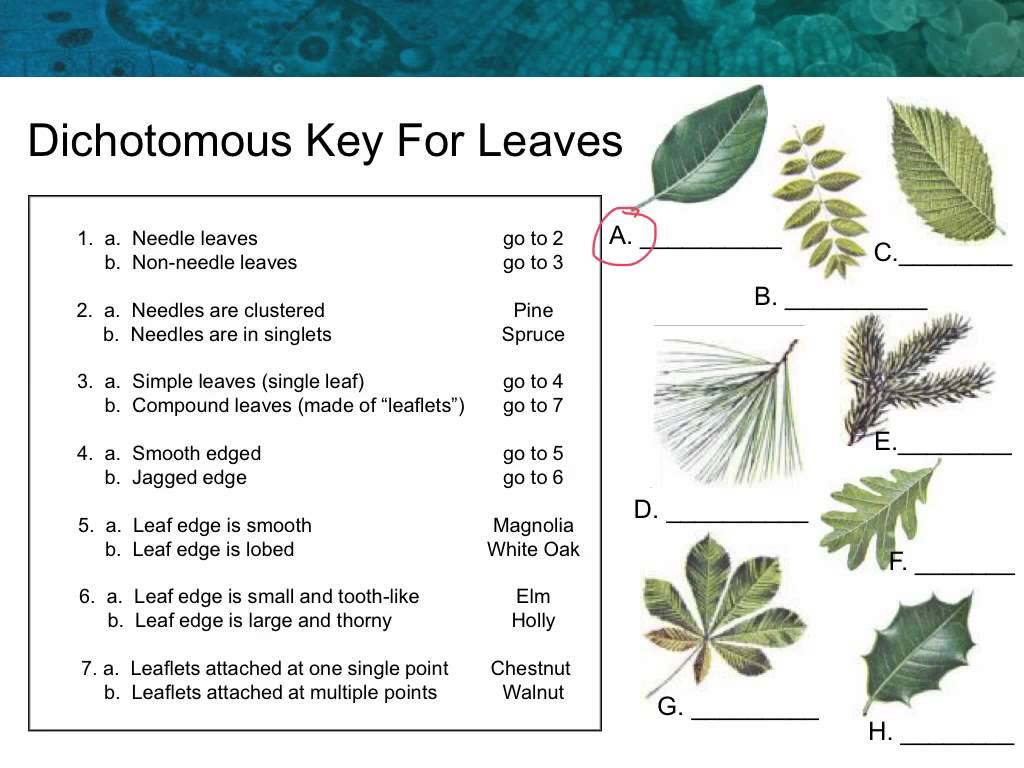
What is a dichotomous key used for in science?
a)
To organize biomes
b)
Classify organisms
c)
Identify bacteria only
d)
None of these
5.

Using this dichotomous key, identify the name of the circled Fish, J.
a)
peacock flounder
b)
band-tail puffer
c)
trumpet fish
d)
spotted goat fish
6.
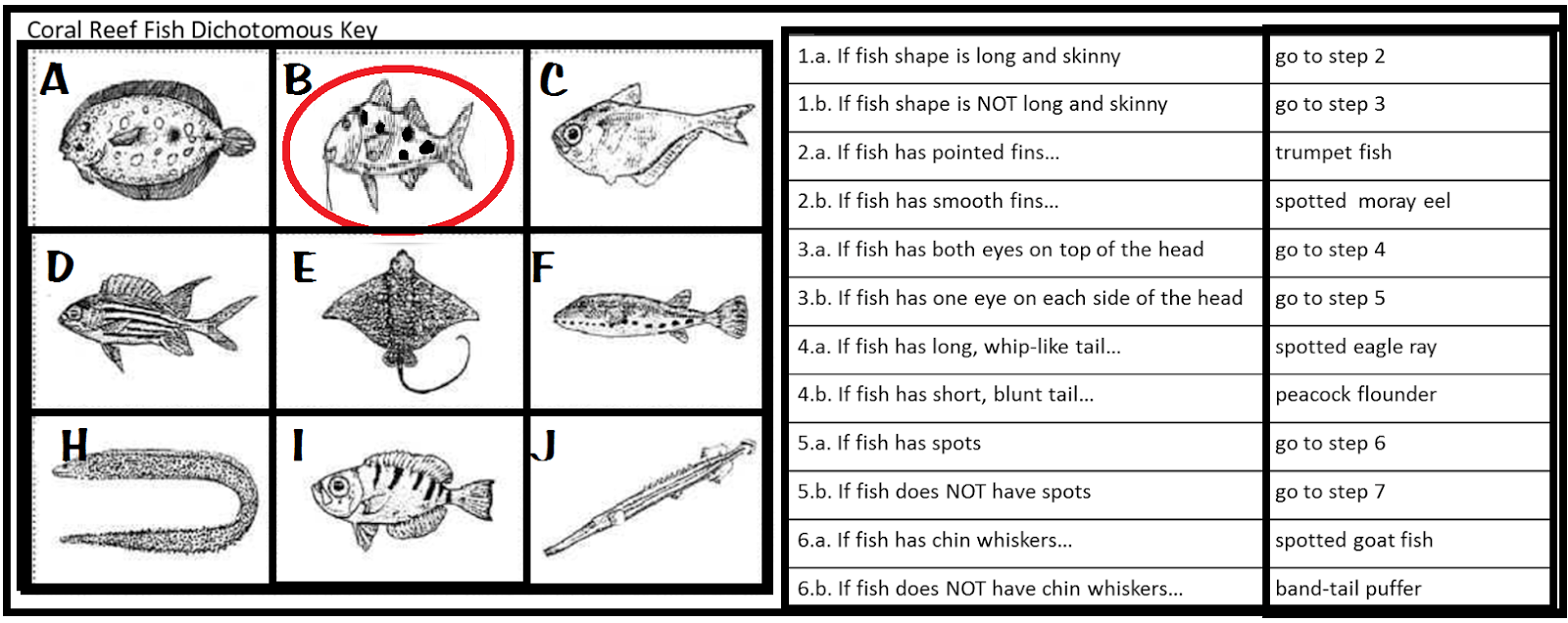
Using this dichotomous key, identity the name of the circled fish.
a)
band-tail puffer
b)
spotted goat fish
c)
peacock flounder
d)
trumpet fish
7.

The first part of a scientific name is an organism's _______________ and the second part is its ________________.
a)
species, genus
b)
phylum, order
c)
class, spices
d)
genus, species
8.
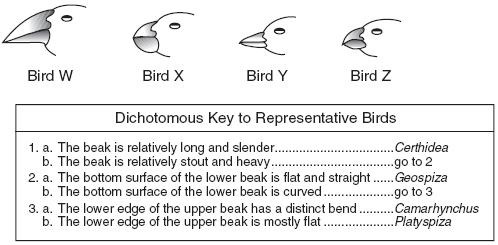
What is the name of bird Z?
a)
Certhidea
b)
Geospiza
c)
Camarhynchus
d)
Platyspiza
9.
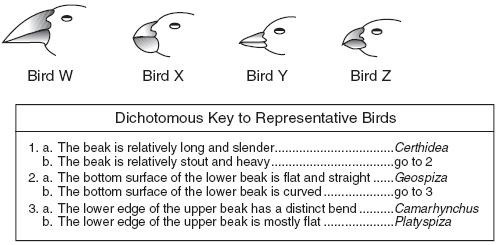
What is the name of bird W?
a)
Certhidea
b)
Geospiza
c)
Camarhynchus
d)
Platyspiza
10.
The 8 levels of classification, most broad to most specific.
a)
Domain, Genus, Family, Order, Class, Phylum, Kingdom, Species
b)
Domain, Species, Kingdom, Genus, Phylum, Family, Class, Order
c)
Domain, Kingdom, Phylum, Class, Order, Family, Genus, Species
d)
Order, Kingdom, Species, Domain, Phylum, Family, Class, Genus
11.
Term given to describe the 2 name naming system is:
a)
dichotmous key
b)
binomial nomenclature
c)
2 scientific names
d)
binomial key
12.
What type of animal has dry scaly skin and lays its eggs on land?
a)
fish
b)
amphibian
c)
reptile
d)
mammal
13.

What type of animal has fur and feeds its young with milk?
a)
birds
b)
reptiles
c)
amphibians
d)
mammals
14.
What are the classifications in order from broadest to most specific?
a)
Kingdom,Phylum,Class,Order,Family,Genus,Species
b)
Kingdom,Domain,Phylum,Class,Order,Family,Genus,Species
c)
Domain,Kingdom,Phylum,Class,Order,Family,Genus,Species
d)
Domain,Kingdom,Phylum,Class,Order,Genus,Family,Species
15.
For the Kingdom Plantae what are the characteristics
a)
none of them grow
b)
They can all move without any help
c)
They can make their own food
d)
none of them can reproduce
16.

A student discovers an arachnid with a segmented abdomen, long legs, and a tail with no stinger. The student uses the dichotomous key to identify it. Which arachnid has the student found?
a)
Whip Scorpion
b)
Wind Scorpion
c)
Tick
d)
Scorpion
17.

When using a dichotomous key to identify organisms, what do we look at?
a)
physical features
b)
weather patterns
c)
environment
d)
diet
18.

Binomial means ...
a)
two gnomes
b)
multiple
c)
two names
d)
organized
19.

This man devised a system to name organisms in the 1700s.
a)
Thomas Edison
b)
Copernicus
c)
Carolus Linnaeus
d)
Fransico Redi
20.

The level of classification below domain and above phylum.
a)
Bacteria
b)
Animalia
c)
Plantae
d)
Kingdom
21.

Use the dichotomous key to identify the organism
a)
Cornus florida
b)
Ulmus americana
c)
Albizia julibrissin
d)
Juglans nigra
22.

lays eggs, has scales, dry, scaly skin, cold-blooded
a)
amphibian
b)
fish
c)
mammal
d)
reptile
23.

warm-blooded, hair or fur, breathes with lungs, live birth
a)
bird
b)
reptile
c)
amphibian
d)
mammal
24.
lays eggs, has scaly skin, breathes with gills
a)
amphibian
b)
reptile
c)
fish
d)
reptile
25.

Hikers found a tree that has large brown cones and single sharp needles. What species of tree have the hikers found?
a)
Juniper
b)
Pine
c)
Spruce
d)
Fir
26.

Who is the closest relative to the birds?
a)
crocodiles
b)
sharks
c)
fish
d)
amphibians
27.
An organism that makes it food through photosynthesis
a)
autotroph
b)
heterotroph
28.

Use the dichotomous key above to classify the unknown organism in the picture
a)
Kentuckyus
b)
Californius
c)
WalaWala
d)
Beverlus
Reset

