
 Worksheets
Quiz - Plate Tectonics
Total questions: 59
Worksheet time: 45mins
Name
Class
Date
1.
The type of plate boundary where two plates come together is a(n) .....
a)
Convergent Boundary
b)
Divergent Boundary
c)
Transform Boundary
d)
Plate Boundary
2.
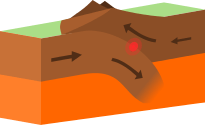
What type of plate boundary is this?
a)
Plate
b)
Divergent
c)
Convergent
d)
Transform
3.

What type of event will occur at this boundary?
a)
Earthquake
b)
Volcano Eruption
c)
Tornado
d)
Mountain Building
4.
A divergent boundary occurs when plates ....
a)
Pull apart
b)
Come together
c)
Slide past each other
d)
subducting
5.
Which of the following is the name of the ancient supercontinent formed 280 Million Years ago.
a)
Pangaea
b)
Gondwanda
c)
Laurasia
d)
Neverland
6.
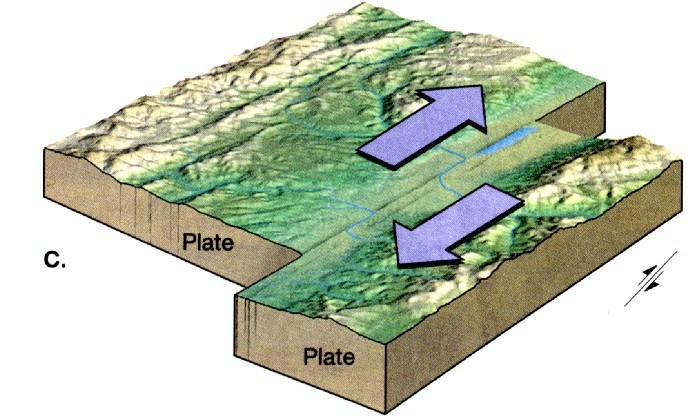
What type of plate boundary is this?
a)
Transform
b)
Convergent
c)
Divergent
d)
Plate
7.
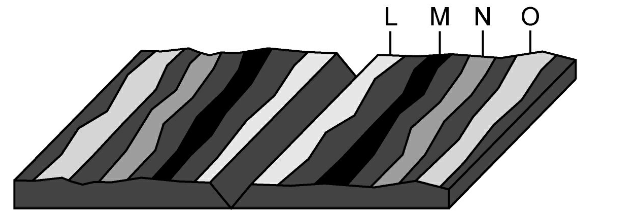
Where would the oldest rock be found?
a)
L
b)
M
c)
N
d)
O
8.
How is it possible for new crust to be formed without increasing the surface area of the Earth?
a)
Crust is destroyed at the same time it is created
b)
New crust is underwater where it sinks
c)
New crust breaks more easily than old crust
9.
Mountains are created when....
a)
Two continental plates collide
b)
Two oceanic plates pull apart
c)
An Oceanic plate subducts under a Continental Plate
d)
Two continental plates pull apart
10.
The Great Rift Valley in Africa and the Mid-Ocean Ridge were all created by this boundary:
a)
Divergent.
b)
Convergent.
c)
Reform.
d)
Transform.
11.
What are the two types of crust?
a)
continental and oceanic
b)
ocean and upper
c)
lower and upper
d)
pizza and subway
12.
Earthquakes and volcanoes are most likely found in which locations?
a)
At plate boundaries
b)
in oceans
c)
in the middle of continents
d)
in the middle of plates
13.
When one plate sides underneath another, it _________ and the magma _________.
a)
hardens, sinks
b)
melts, sinks
c)
hardens, rises
d)
melts, rises
14.
The Himalayas in Asia are an example of what type of plate boundary?
a)
divergent
b)
continent-to-continent convergent
c)
ocean-to-continent convergent
d)
transform
15.
When an oceanic plate and a continental plate collide, which one will subduct?
a)
oceanic
b)
continental
c)
neither
16.
Which of the following is NOT a tectonic boundary?
a)
Convergent
b)
Divergent
c)
Sedergent
d)
Transform
17.

What is this an image of?
a)
Revolving boundary
b)
San Andreas (Transform)
c)
Convergent
d)
Divergent boundary
18.
A mid-ocean ridge occurs at a(n) ________ plate boundary.
a)
transform
b)
convergent
c)
divergent
19.

What type of boundary is the SAN ANDREAS FAULT on?
a)
Covergent
b)
Transformers
c)
Divergent
d)
Transform
20.
What type of boundary does not destroy or create new crust?
a)
Divergent
b)
Transform
c)
Convergent
21.
The area around the Pacific Plate where boundaries form is called...
a)
Death Ring
b)
Fire Zone
c)
Ring of Fire
d)
Zone of Fire
22.
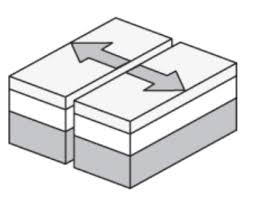
Name the boundary.
a)
convergent boundary
b)
divergent boundary
c)
transform boundary
d)
sergent boundary
23.
Which ocean is expanding due to a mid-ocean ridge (divergent boundary)?
a)
Indian
b)
Dead Sea
c)
Atlantic
d)
Artic
24.

The huge pieces of the earth's crust are called ____________________________.
a)
crust
b)
plates
c)
directions
d)
seismos
25.

Which kind of plate boundary is this?
a)
divergent boundary
b)
transform boundary
c)
convergent boundary (ocean to continent)
d)
convergent boundary (continent to continent)
26.

Which kind of plate boundary is this?
a)
divergent boundary
b)
transform boundary
c)
convergent boundary (ocean to continent)
d)
convergent boundary (ocean to ocean)
27.

Which kind of plate boundary is this?
a)
divergent boundary
b)
transform boundary
c)
convergent boundary (ocean to continent)
d)
convergent boundary (continent to continent)
28.
Wegener proposed a hypothesis in 1912 that a single large landmass broke up into smaller landmasses to form the continents, which then drifted to their present locations. This hypothesis is called...
a)
Pangaea
b)
Continental Drift
c)
Plate Tectonics
d)
Supercontinent Theory
29.
Which of the following is NOT evidence for continental drift?
a)
tropical plant fossils found on Antarctica
b)
mountain chains matched up on neighboring continents
c)
fossils found on different continents of organisms who could never have swum across the ocean
d)
volcanoes and earthquakes occur mostly on plate boundaries
30.
The region along plate boundaries where one plate moves under another is called a(n)...
a)
rift valley
b)
mid-ocean ridge
c)
subduction zone
d)
convergent boundary
31.
Which Theory has the following Supporting Evidence: fossils, continent shape, landforms...
a)
Continental Drift
b)
Seafloor Spreading
c)
Plate Tectonics
32.
Which Theory has the following Supporting Evidence: subduction, earthquakes, volcanoes, Mid-Atlantic Ridge, older theories...
a)
Continental Drift
b)
Seafloor Spreading
c)
Plate Tectonics
33.
Which Theory has the following Supporting Evidence: discovery of Mid-Atlantic Ridge, core rock samples showing older rocks the farther that you get from the mid ocean ridge...
a)
Continental Drift
b)
Seafloor Spreading
c)
Plate Tectonics
34.
Where are the youngest rocks found in reference to a mid-ocean ridge?
a)
Near the ridge
b)
Away from the ridge
c)
On the continent
d)
In the valley
35.
Who proposed the idea of sea-floor spreading?
a)
Harry Hess
b)
Henry Hess
c)
Alfred Wegener
d)
Darwin
36.
Who proposed the idea of continental drift?
a)
Alfred Wegener
b)
Albert Wegener
c)
Albert Einstien
d)
Harry Hess
37.
Which of the following is not evidence that led to the theory of continental drift
a)
Animal fossils
b)
Plant fossils
c)
Glacial deposits
d)
Human remains
38.
How did animal fossils help to prove continental drift?
a)
Mesosaurus a fresh-water/land animal was found on several continents separated by thousands of miles.
b)
Mesosaurus a salt water animal was found on several different continents
c)
Mesosaurus a fresh-water/land animal was found on Antarctica
39.
How did plant fossils help to prove continental drift?
a)
Mesosaurus a fresh-water/land animal was found on several continents
b)
Mesosaurus a salt water animal was found on several different continents
c)
Glossopterus a tropical plant (fern) was found on many continents including Antarctica
d)
Glossopterus was found on warm climate continents
40.
How did glacial deposits help to prove continental drift?
a)
Glacial deposits were found on cold climate continents
b)
Glacial deposits were found in tropical areas
c)
Glossopterus a tropical plant (fern) was found on many continents including Antarctica
41.
Because ocean crust is more dense what happens to it when it comes in contact with continental crust?
a)
It will get subducted under continental crust and then melted
b)
It will get formed into mountains
c)
It will form an island
d)
It will ride over the top of continental crust.
42.

What is happening at point B?
a)
subduction
b)
a divergent boundary
c)
convection
d)
an earthquake
43.

What type of boundary is shown at A?
a)
transform
b)
convergent
c)
divergent
d)
subduction
44.
During sea floor spreading, molten material rises up from the mantle...
a)
along the continents
b)
at the mid-ocean ridges
c)
deep ocean trenches
d)
at north and south poles
45.

What type of boundary creates a mountain chain?
a)
Oceanic - Oceanic Convergent
b)
Oceanic - Continental Convergent
c)
Continental - Continental Convergent
d)
Divergent
46.
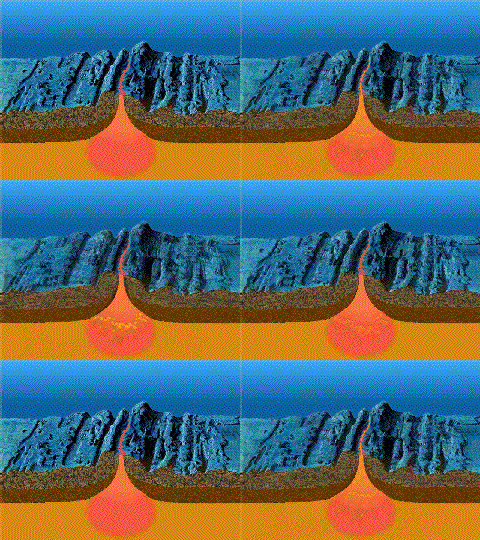
What type of boundary creates new seafloor?
a)
Oceanic - Oceanic Convergent
b)
Oceanic - Continental convergent
c)
Continental - Continental Divergent
d)
Oceanic - Oceanic Divergent
47.
Where would the youngest rock be found?
a)
L
b)
M
c)
N
d)
O
48.
Why was Wegener's theory not accepted?
a)
He had no proof of how they were moving
b)
He had no evidence
c)
He was married
d)
He was not a Scientist
49.

True or False. Wegener's idea of continental drift was supported by all scientist of that time period.
a)
True
b)
False
50.
The device uses sound waves to measure the distance to an object.
a)
Cell phone
b)
Pangaea
c)
Subduction
d)
Sonar
51.
Which of the following causes Earth's tectonic plates to move?
a)
Energy from the Sun
b)
Magnetic Pole Reversal
c)
Convection currents in the mantle
d)
Faults in Mountain Ranges
52.
Which of the following occurs because of convection currents?
a)
Tectonic plates on the crust move.
b)
The mantle increases in size.
c)
Pressure in the crust increases.
d)
Pressure in the crust decreases.
53.
The mantle of Earth is made partly of magma. When magma rises and sinks, this is called ______________.
a)
a conduction current
b)
a hot spot
c)
a volcanic eruption
d)
a convection current
54.
Where does the heat come from that drives this convection current in the mantle?
a)
The sun
b)
The crust
c)
the mantle
d)
the core
55.
The mantle of Earth is made partly of magma. When magma rises and sinks, this is called ______________.
a)
a conduction current
b)
a hot spot
c)
a volcanic eruption
d)
a convection current
56.
Which is true about hotter material in the mantle?
a)
more dense, sinks
b)
less dense, sinks
c)
less dense, rises
d)
more dense, rises
57.
During sea floor spreading, molten material rises up from the mantle...
a)
along the continents
b)
at the mid ocean ridges
c)
deep ocean trenches
d)
at north and south poles
58.
Which of the following is where one plate slides under another plate?
a)
submarine zone
b)
divergence zone
c)
subduction zone
d)
lower zone
59.
subduction zones can create
a)
Trenches
b)
volcanoes
c)
earthquakes
d)
all of the above
100 %

