
 Worksheets
Overall Review of Electric Field
Total questions: 35
Worksheet time: 24mins
Name
Class
Date
1.
A proton is released from rest at the origin in a uniform electric field in the positive x direction with magnitude 850 N/C. What is the change in the electric potential energy of the proton–field system when the proton travels to x = 2.50 m?
a)
3.40 × 10⁻¹⁶ J
b)
-3.40 × 10⁻¹⁶ J
c)
2.50 × 10⁻¹⁶ J
d)
4-2.50 × 10⁻¹⁶ J
2.
An electron volt is
a)
the force acting on an electron in a field of 1 N/C
b)
the force required to move an electron 1 meter
c)
the energy gained by an electron in moving through a potential difference of 1 volt
d)
the energy needed to move an electron through 1 meter in any electric field
3.
A tiny sphere carrying a charge of 6.5 µC sits in an electric field, at a point where the electric potential is 240 V. What is the sphere’s potential energy?
a)
2.7 x 10⁻⁸ J
b)
6.5 x 10⁻⁶ J
c)
1.6 x 10⁻³ J
d)
240 J
4.
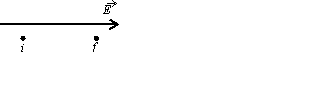
An electron moves from point i to point f, in the direction of a uniform electric field. During this motion:
a)
the work done by the field is positive and the potential energy of the electron-field system increases
b)
the work done by the field is negative and the potential energy of the electron-field system increases
c)
the work done by the field is positive and the potential energy of the electron-field system decreases
d)
the work done by the field is negative and the potential energy of the electron-field system decreases
5.
If 500 J of work are required to carry a 40-C charge from one point to another, the potential difference between these two points is:
a)
12.5 V
b)
20,000 V
c)
0.08 V
d)
depends on the path
6.
The potential difference between two points is 100 V. If a particle with a charge of 2 C is transported from one of these points to the other, the magnitude of the work done is:
a)
200 J
b)
100 J
c)
50 J
d)
2 J
7.
During a lightning discharge, 30 C of charge move through a potential difference of 1.0 x 10⁸ V in 2.0 x 10⁻² s. The energy released by this lightning bolt is:
a)
1.5 ´ 1011 J
b)
3.0 ´ 109 J
c)
6.0 ´ 107 J
d)
3.3 ´ 106 J
8.

An electron goes from one equipotential surface to another along one of the four paths shown below. Rank the paths according to the work done by the electric field, from least to greatest.
a)
1, 2, 3, 4
b)
4, 3, 2, 1
c)
1, then 3, then 4 and 2 tie
d)
4 and 2 tie, then 3, then 1
9.
The electric field around an isolated electron has a certain strength 1 cm from the electron. The electric field strength 2 cm from the electron is
a)
half as much.
b)
the same.
c)
twice as much.
d)
one fourth times as much.
10.
A 2-C charge experiences a force of 40 N when put at a certain location in space. The electric field at that location is .
a)
2 N/C.
b)
20 N/C
c)
30 N/C.
d)
40 N/C.
11.
A 5-C charge is located near a positively charged sphere so that it has 50 J of electric potential energy. Its electric potential is
a)
2 V.
b)
5 V.
c)
10 V.
d)
20 V
12.
If you use 17 J of work to push a charge into an electric field and then release the charge, as the charge flies past its starting position, its kinetic energy is
a)
more than 17 J.
b)
less than 17 J.
c)
17 J.
13.
The electrical force on a 2-C charge is 20 N. What is the value of the electric field at the location of the charge?
a)
2 N/C
b)
10 N/C
c)
20 N/C
d)
40 N/C
14.
What do you call the process of charging a conductor by bringing it near another charged object?
a)
induction
b)
polarization
c)
neutralization
d)
conduction
15.
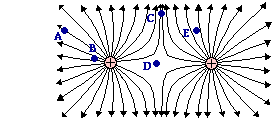
Which of the following labeled points is in the region with the strongest force of electric charge
a)
A
b)
B
c)
C
d)
D
16.
What does it mean when the electric field lines are close together?
a)
the field is positive
b)
the field is negative
c)
The field is strong
d)
the field is weak
17.
The electric flux Φ through a surface
a)
is the amount of electric field piercing the surface
b)
is the electric field multiplied by the area.
c)
does not depend on the area involved
d)
is the line integral of the electric field around the edge of the surface
18.
Charge Q is distributed uniformly throughout a spherical insulating shell. The net electric flux through the inner surface of the shell is:
a)
0
b)
Q/e0
c)
2Q/e0
d)
Q/4*Pi*e0
19.
The area vector for a flat surface
a)
is parallel to the surface and has a magnitude equal to the length of a side of the surface.
b)
is perpendicular to the surface and has a magnitude equal to the length of a side of the surface.
c)
is parallel to the surface and has a magnitude equal to the area of the surface.
d)
is perpendicular to the surface and has a magnitude equal to the area of the surface.
20.
When a piece of paper is held with one face perpendicular to a uniform electric field the flux through it is 25 N×m2/C. When the paper is turned 25° with respect to the field the flux through it is:
a)
0 N×m2/C
b)
11 N×m2/C
c)
12 N×m2/C
d)
23 N×m2/C
21.
A cylindrical wastepaper basket with a 0.15-m radius opening is in a uniform electric field of 300 N/C, perpendicular to the opening. The total flux through the sides and bottom is:
a)
0 N×m2/C
b)
4.2 N×m2/C
c)
21 N×m2/C
d)
280 N×m2/C
22.
A point particle with charge q is placed inside a cube but not at its center. The electric flux through any one side of the cube:
a)
is zero
b)
is q/2ε0
c)
is q/4ε0
d)
is q/6ε0
23.
The flux of the electric field (24 N/C)i + (30 N/C)j + (16 N/C)k through a 2.0 m2 portion of the yz plane is:
a)
32 N × m2/C
b)
34 N × m2/C
c)
42 N × m2/C
d)
48 N × m2/C
24.

In the diagram below, P is a point near a negatively charged sphere. Which direction best represents the direction of the electric field at point P?
a)
Right
b)
Left
c)
Up
d)
Down
25.
Which quantity and unit are correctly paired?
a)
electric field strength and N/C
b)
electricity and Coulombs
c)
electrostatic force and electrons
d)
electric field strength and E
26.
A point charge Q is far from all other charges. At a distance of 2 m from Q, the electric field is 20 N/C. What is the force a charge of 5 Coulombs feels?
a)
4 N
b)
100 N
c)
40 N
d)
10 N
27.
Which of the following statements is false about electric field lines
a)
electric field lines cannot cross
b)
electric field lines point away from positive charge
c)
electric field lines are always straight lines
d)
electric field lines show how a proton would move in an electric field
28.

At which point is the electric field the strongest
a)
A
b)
B
c)
C
d)
D
29.
At which point is the electric field the weakest?
a)
A because it is the furthest away
b)
A because the field lines are further apart
c)
C because the field lines are further apart
d)
C because it is the furthest away
30.

Consider the electric field lines shown in the diagram below. From the diagram, it is apparent that object A is ____ and object B is ____.
a)
+,+
b)
+,-
c)
-,+
d)
-,-
31.
Two charges separated by a distance of 1 meter exert a 20-N force on each other. If the charges are pulled to a 2 meter separation distance, the force on each charge will be
a)
10 N
b)
5 N
c)
2.5 N
d)
40 N
32.
An electrostatic force of 2 X 10². newtons is exerted on a charge of 4 coulomb at point P in an electric field. The magnitude of the electric field intensity at P is
a)
8 X 10² N/C
b)
5 N/C
c)
2 X 10⁻² N/C
d)
50 N/C
33.
It is observed that Balloon A is charged negatively. Balloon B exerts a repulsive effect upon balloon A. Would the electric field vector created by balloon B be directed towards B or away from B and why?
a)
towards because electric field lines point away from negative charges
b)
towards because electric field lines point away from positive charges
c)
away because electric field lines point away from negative charges
d)
away because electric field lines point toward positive charges
34.

QA and QB are two charges creating an electric field. Based on the electric field lines, we can conclude
a)
QA and QB are both positive
b)
QA and QB are both negative
c)
QA is positive and QB is negative
d)
QA is negative and QB is positive
35.

Which of the following is a true statement about the electric field between the two plates?
a)
The field is attractive between the plates and uniform in strength
b)
The field is repulsive between the plates and uniform in strength
c)
The field is attractive between the plates and strongest near the positive
d)
The field is repulsive between the plates and strongest near the positive
100 %

