
 Worksheets
Earthquakes and Seismic Activities
Total questions: 20
Worksheet time: 12mins
Name
Class
Date
1.
The magnitude of an earthquake measures...
a)
the amount of energy released.
b)
the amount of time the earthquake lasted.
c)
the depth at which the earthquake occurred.
d)
the temperature of the magma below the epicenter.
2.
S- and P- waves are both types of __________ waves.
a)
interior
b)
exterior
c)
surface
d)
body
3.
______________ waves cause the most destruction during an earthquake.
a)
Surface
b)
P-
c)
S-
d)
Body
4.
If a seismograph detects S - waves shortly after it detects P - waves, the earthquake must be...
a)
very strong.
b)
very weak.
c)
close to the seismic station.
d)
far away from the seismic station.
5.
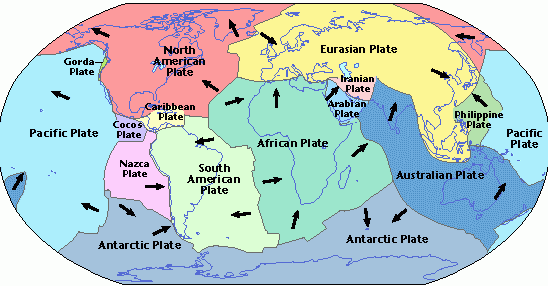
Many earthquakes happen along the borders of...
a)
countries.
b)
tectonic plates.
c)
climate zones.
d)
None of the above.
6.

Earthquakes happen every day. Most are too small for humans to notice.
a)
True
b)
False
c)
There is no way of knowing if this statement is true or false!
7.
How much stronger is a magnitude 9.0 earthquake compared to a magnitude 7.0 quake on the Richter Scale?
a)
twice as big
b)
10 times bigger
c)
20 times bigger
d)
100 times bigger
8.
Which kind of wave arrives second at a seismic station?
a)
P (primary)
b)
S (secondary)
c)
L (love)
d)
R (Rayleigh)
9.
Which type of body wave usually causes the most damage during an earthquake?
a)
P wave
b)
S wave
c)
Love wave
d)
Rayleigh
10.
The energy caused by earthquakes travels outward from the focus in the form of...
a)
electromagnetic waves.
b)
seismic waves.
c)
gravity waves.
d)
chemical energy.
11.

At about what time did all of the S-waves hit?
a)
20 sec
b)
45 sec
c)
50 sec
d)
10 seconds
12.

This is the area beneath the Earth's surface where the earthquake begins.
a)
epicenter
b)
focus
c)
fault line
d)
tectonic plate
13.
You use a P- and S- wave travel-time graph to find:
a)
distance from seismic station to epicenter.
b)
distance from fault to epicenter.
c)
distance from epicenter to core.
d)
distance from seismic station to focus.
14.
Who lives in a pineapple under the sea?
a)
Crazy uncle philip
b)
Spongebob Squarepants
c)
Old Greg
d)
Cthulhu
15.
A wave of energy that travels through the Earth, away from the earthquake and in all directions is a(n) ____________ wave.
a)
seismic
b)
sound
c)
electromagnetic
d)
nuclear
16.
A type of seismic wave that causes particles of rock to move in the same direction as the wave movement.
a)
Love
b)
P- wave
c)
S- wave
d)
Rayleigh
17.
Liquefaction is when...
a)
the soil behaves like liquid.
b)
the ground becomes liquid.
c)
magma rises to the surface.
d)
buildings are damaged, crumbling like liquid.
18.
The motion of the ground during energy transfer by a seismic wave is recorded on a ...
a)
seismogram.
b)
seismograph.
c)
seismometer.
d)
Richter scale.
19.
What is the minimum number of seismograph stations needed to locate an earthquake epicenter?
a)
1
b)
2
c)
3
d)
1 billion
20.

To what are the arrows pointing?
a)
Triangulation points
b)
Seismograph stations
c)
Pulses of seismic waves
d)
Location of the epicenter
100 %

