
 Worksheets
Natural Selection Quiz Bio Acc 2017
Total questions: 20
Worksheet time: 54mins
Name
Class
Date
1.

Differences in the wing patterns of butterflies is an example of
a)
overproduction
b)
variation
c)
vestigial structures
d)
competition
2.

According to Darwin's Theory of Natural Selection, giraffes with long necks possessed variations that made them better adapted for survival in their environment. As a result, long neck giraffes survived and passed on their long neck trait to their offspring. This is an example of
a)
overproduction
b)
struggle for existence
c)
survival of the fittest
d)
descent with modification
3.

Over a long period of time, horses have evolved to become larger mammals with hooves instead of toes. Which principle of Darwin's Theory of Natural Selection is this?
a)
variation
b)
struggle for existence/competition
c)
survival of the fittest
d)
descent with modification
4.

Male lions will display aggression and fight for reproductive dominance over female lionesses. Which principle of Darwin's Theory is this?
a)
variation
b)
overproduction
c)
competition
d)
descent with modification
5.

Sea turtles usually lay 120-150 eggs, however, only a few of them hatch to produce young turtle hatchlings. Which principle of Darwin's Theory of Natural Selection is this example?
a)
variation
b)
overproduction
c)
descent with modification
d)
struggle for existence
6.

Darwin wrote that organisms with traits that are best suited to the environment will ________________
a)
survive and produce offspring
b)
become extinct
c)
evolve into new species
7.
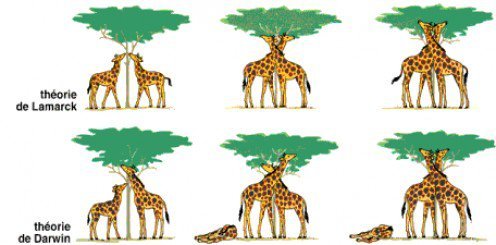
What would happen if giraffes DO NOT evolve?
a)
They would survive longer
b)
They would produce many offspring
c)
They would become extinct
d)
They would find another source of food
8.

According to the diagram, which bird has the most similar DNA to a medium ground finch (red dot)?
a)
small tree finch
b)
medium tree finch
c)
large ground finch
d)
green warbler finch
9.

According to the diagram, which organism is older: the coral, fern or trilobite?
a)
ammonite
b)
coral
c)
trilobite
10.

Which traits do only humans have, according to the cladogram?
a)
jaws
b)
mammary glands & hair
c)
terrestrial during all life stages
d)
bipedal; opposable thumbs
11.

Individuals that are well adapted to their environment will survive and produce:
a)
Fewer mutations
b)
Stronger genes
c)
More offspring
d)
Better traits
12.

a bird that can easily outcompete other birds for food and that can produce many eggs has a high
a)
sexuality
b)
mutation rate
c)
fitness
d)
adaptability
13.

According to this cladogram, birds are MOST CLOSELY related to -
a)
Amphibians
b)
Sharks
c)
Ray Finned Fish
d)
Crocodiles
14.
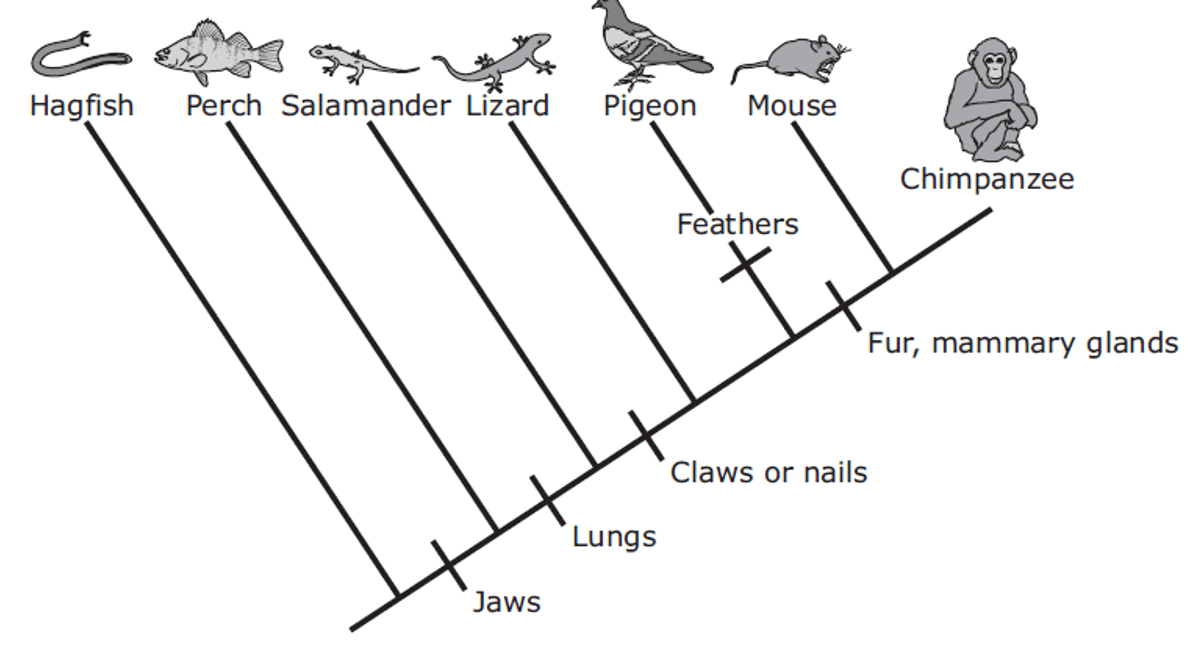
All the animals to the right of the hagfish would have the common characteristic of -
a)
Fur
b)
Claws or nails
c)
Lungs
d)
Jaws
15.

Which best describes these fossils?
a)
The oldest fossils can be found on the lower layers
b)
The oldest fossils can be found at the top layers
c)
The youngest fossils are always found on the bottom layers
d)
You can not tell the age of any of these fossils
16.
Giant tortoises on the Galapagos Islands possess variation in their neck length and carapace (shell) shape that make them well adapted for eating plants and vegetation. In which environment would this long necked tortoise with a saddle-shaped carapace have the greatest fitness?
a)
Island with low grasses
b)
Island with shrubs and higher vegetation
17.

Species of Darwin's finches can be BEST distinguished by their
a)
beak shape & song
b)
leg length & size
c)
feather color
d)
wing length
18.
Many trait such as eye color, hair color, etc. are
a)
inherited
b)
acquired
19.
Artificial selection occurs when
a)
animals compete for survival.
b)
humans breed for specific traits.
20.

A bird with the beak shown in the image would be best adapted for
a)
grabbing insects from the air
b)
spooning fish and plankton from the ocean
c)
poking its beak in the sand to eat small crabs
d)
cracking large seeds open
100 %

