
 Worksheets
MS-LS4-4
Total questions: 28
Worksheet time: 7hrs 46mins
Name
Class
Date
1.
When converting from DNA to RNA, A pairs with __ and C pairs with __
a)
T, G
b)
U,G
c)
U,T
d)
G,C
2.
Any change to a gene located on a chromosome is called a
a)
malfunction
b)
codon
c)
ribosome
d)
mutation
3.

Three nucleotide bases on a strand of mRNA are a(n) ____.
a)
mutation
b)
chromosome
c)
codon
d)
anticodon
4.
DNA molecule segment is : TTACGCAAG
The mutated DNA segment is TTACGCAAC. This is an example of ___ mutation.
The mutated DNA segment is TTACGCAAC. This is an example of ___ mutation.
a)
Base Substitution
b)
Base Insertion
c)
Base Inversion
d)
Translocation
5.
Which one of these is NOT traditionally a form of competition among organisms
a)
Sleep
b)
Food
c)
Water
d)
Space
6.

This fiddler crab is the male of his species. The female crabs have two smaller claws. What type of competition was the main factor in selecting for this kind of change?
a)
Food
b)
Water
c)
Space
d)
Mates
7.
What does the T stand for in V.I.C.T.O.R?
a)
Traits that give advantages ensure success
b)
Traits develop as a result of mutations
c)
Tasty prey makes organisms stronger
d)
Trick or Treat is the best way to get candy.
8.

Organisms with traits that are best suited to the environment will ________________
a)
increase in number
b)
become extinct
9.
Which of the following is NOT an example of natural selection?
a)
breeding farm animals that have traits that farmers desire.
b)
Insect populations developing resistance to certain pesticides.
c)
Bacteria becoming resistant to antibiotics.
d)
Male birds of certain species developing colorful feathers to attract female mates.
10.
What characteristic did Darwin observe about the finches on the Galapagos Islands?
a)
Their feathers
b)
Genotypes
c)
Their beaks
d)
Their body sizes
11.
The environment around Manchester, England, changed during the Industrial Revolution. How did this change affect peppered moths living in the area?
a)
Natural selection favored moths with dark wings because predators could not see them on the soot-colored trees.
b)
Natural selection favored moths with white wings that were easy for predators to see.
c)
Natural selection favored moths with white wings because predators could not see them on the soot-colored trees.
d)
Natural selection caused moths with white wings to become extinct.
12.
The white feathers of a snowy owl allow it to blend in with its environment during the winter months (snow). This is an example of ________________
a)
Species
b)
Environmental Change
c)
Adaptation
d)
Variation
13.

The difference in the physical traits of an individual from those of other individuals in a group is called a(n)
a)
change
b)
adaption
c)
species
d)
variation
14.

All of these finches have different shaped beaks, they are an adaptation to gain access of
a)
Water
b)
Food
c)
Shelter
15.
According to the theory of natural selection, why are some individuals more likely than others to survive and reproduce?
a)
Some individuals pass on to their offspring new characteristics they have acquired during their lifetimes.
b)
Some individuals are better adapted to exist in their environment than others are.
c)
Some individuals do not pass on to their offspring new characteristics they have acquired during their lifetimes.
d)
Some individuals tend to produce fewer offspring than others in the same environment.
16.
Studies of the finches of the Galapagos Islands have shown that
a)
DNA will change to produce structures needed by birds to survive intense competition
b)
a bird’s beak changes annually in response to the type of food that is most abundant each year
c)
natural selection occurs when there are scarce resources and intense competition
d)
the beak of a finch will change if the environment of the bird remains stable
17.
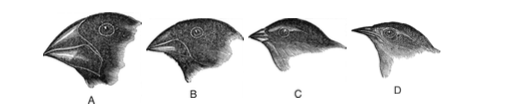
Base your answer(s) to question(s) on the diagram below and on your knowledge of biology. The diagram shows the heads of four different species of Galapagos Islands finches.
The four different types of beaks shown are most likely the result of
The four different types of beaks shown are most likely the result of
a)
gene manipulation
b)
natural selection
c)
unchanging environmental conditions
d)
patterns of behavior learned from parents
18.
The differences among a species, like different bird beaks, are called
a)
genes.
b)
variations.
c)
traits.
d)
theories.
19.
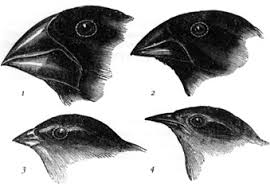
Which process produced the two different types of beaks in the ground finch and the tree finch?
a)
artificial selection
b)
geographical distribution
c)
natural selection
d)
disuse of the beak
20.
Mutations are a change in what?
a)
DNA
b)
tRNA
c)
genotype
d)
phenotype
21.
How did different beak sizes first arise?
a)
They arose because of their need to be able to eat different food.
b)
The arose by chance (random mutation).
c)
The environment made the change happen.
d)
The finches beaks changed a little at a time each generation.
22.

Toothpick fish are effective parasites because they are able to sniff out Urea given off by host fist. This adaptation was probably driven by competition over
a)
Food
b)
Water
c)
Space
d)
Mates
23.

What process would help explain how the dorsal fin on a remora fish turned into a sucker that lets it attach to sharks for free rides?
a)
P.E.M.D.A.S
b)
R.O.Y.G.B.I.V
c)
V.I.C.T.O.R
d)
S.W.A.T
24.
When individuals choose traits possessed by the opposite sex it is called…
a)
Mutation
b)
Gene Flow
c)
Genetic Drift
d)
Sexual Selection
25.
What is the process in which humans breed organisms for certain traits?
a)
natural selection
b)
inheritance
c)
artificial selection
d)
descent withOUT modification
26.
Natural selection acts directly on
a)
genotypes
b)
phenotypes
c)
mutations
d)
alleles
27.

What did Charles Darwin observe in finch populations of the Galapagos Islands off the coast of South America?
a)
different species on different islands
b)
all species on one of the islands
c)
identical species on all the islands
d)
the same species as North America
28.
Related organisms have similar _______.
a)
Genetic Material
b)
Diet
c)
Behavioral Patterns
100 %

