
 Worksheets
Heart
Total questions: 30
Worksheet time: 24mins
Name
Class
Date
1.

What do capillaries, the smallest blood vessels, do?
a)
Exchange O2 only
b)
Exchange CO2 only
c)
exchange nutrients and oxygen for waste
d)
break down foods
2.

Which component of blood makes up 1% of the blood?
a)
White blood cells & Platelets
b)
Plasma & Platelets
c)
Plasma & White blood cells
d)
Platelets & Red blood cells
3.

What are the 4 components of blood?
a)
White blood cells, Platelets, bone marrow, and oxygen
b)
Plasma, Platelets, yellow blood cells, and nutrients
c)
Plasma, White blood cells, red blood cells, and Platelets
d)
Platelets, Red blood cells
4.

Which does not make up the circulatory system?
a)
heart
b)
blood
c)
lungs
d)
blood vessels
5.

About how many times does the heart beat during an average life time?
a)
60,000
b)
3 billion
c)
3,000
d)
300,000
6.

What is the largest artery in the body?
a)
femoral artery
b)
brachial artery
c)
carotid artery
d)
aorta
7.

Where does blood go after the right atrium?
a)
left atrium
b)
left ventricle
c)
right ventricle
d)
aorta
8.

Where does the blood go after it goes into the pulmonary arteries?
a)
lungs
b)
heart
c)
head
d)
hands
9.

Which blood vessels carry blood to the heart?
a)
Aorta
b)
veins
c)
arteries
d)
arterioles
10.

Which blood vessels carry blood away from the heart?
a)
capillaries
b)
veins
c)
arteries
11.

Un-oxygenated blood enters the right atrium from the top of the heart.
a)
inferior vena cava
b)
superior vena cava
c)
aorta
12.

Un-oxygenated blood enters the right atrium from the bottom of the heart.
a)
inferior vena cava
b)
superior vena cava
c)
pulmonary veins
13.

Separates the chambers of the heart.
a)
Septum
b)
Veins
c)
aortic valve
14.

2?
a)
Heart
b)
Right Ventricle
c)
Left Atrium
d)
Left Ventricle
15.

1?
a)
Septum
b)
Right Pulmonary Vein
c)
Superior Vena Cava
d)
Inferior Vena Cava
16.

7?
a)
Left Atrium
b)
Left Ventricle
c)
Aortic Valve
17.

9?
a)
Left Ventricle
b)
Left Atrium
c)
Left Pulmonary Vein
d)
Left Pulmonary Artery
18.

Receives blood from the body that is low in oxygen and high in carbon dioxide
a)
Right Atrium
b)
Right Ventricle
c)
Left Atrium
d)
Left Ventricle
19.

A flap of tissue that prevents blood from flowing backward
a)
Aorta
b)
Atrium
c)
Septum
d)
Valve
20.

Carries the blood from the ventricle to the body
a)
Aorta
b)
Atrium
c)
Valve
d)
Septum
21.

Which of the following define diastole and systole
a)
systole is the contraction of the heart and diastole is the relaxation of the heart
b)
diastole is the contraction of the heart and systole is the relaxation of the heart
c)
diastole and systole are both contractions of the heart
d)
diastole and systole are both relaxation phases of the heart
22.

How many chambers does the heart have ?
a)
4
b)
6
c)
3
d)
1
23.

Identify
a)
Aorta
b)
Pulmonary Vein
c)
Superior Vena Cava
d)
Inferior Vena Cava
24.

What does Deoxygenated mean?
a)
Oxygen-rich
b)
Blood flow
c)
Oxygen-poor
d)
Water Flow
25.

Where does the blood go after it goes into the pulmonary arteries?
a)
lungs
b)
heart
c)
head
d)
hands
26.

Identify
a)
Left atrium
b)
Right atrium
c)
Left ventricle
d)
Right ventricle
27.

Identify
a)
Left atrium
b)
Right atrium
c)
Left ventricle
d)
Right ventricle
28.

The heart is the main organ in the _________ system
a)
respiratory
b)
endocrine
c)
circulatory
d)
nervous
29.
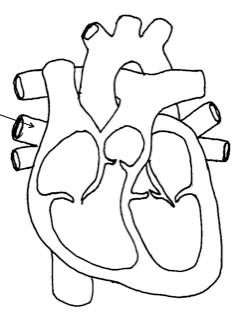
Name this part.
a)
Pulmonary veins
b)
Left atrium
c)
Aorta
d)
Pulmonary artery
30.

Name this part.
a)
Left ventricle
b)
Pulmonary artery
c)
Right atrium
d)
Pulmonary veins
100 %

