
NEW
Font size
S
M
L
XL
 Worksheets
Solar System Review
Total questions: 26
Worksheet time: 44mins
Name
Class
Date
1.

The students in Ms. Pigatt’s class wanted to create the phases of the moon using Oreo cookies. Which phase is shown in the picture?
a)
Full Moon
b)
Quarter Moon
c)
New Moon
d)
Crescent Moon
2.

A student observed the shape of the Moon once every 7 days during the month of June. Which of the following sets of drawings shows how the Moon’s shape could have changed during the month of June? (crescent not shown)
a)
A.
b)
B.
c)
C.
d)
D.
3.
The Moon reflects light from the Sun in order to shine at night. Why does the Moon depend on light from the Sun?
a)
Light from the Sun is brighter.
b)
The Moon produces no light of its own.
c)
The Moon produces heat.
d)
The Moon revolves around the Sun.
4.
Which of the following best describes the Moon compared to Earth?
a)
It is warmer than Earth.
b)
It has more oxygen in its atmosphere than Earth.
c)
It is rockier and drier than Earth.
d)
It is closer to the Sun than to Earth.
5.
A tool used for determining latitude using the position of the sun and stars in the sky is which of the following?
a)
Compass
b)
Sextant
c)
Astrolabe
d)
Telescope
6.
Which of the following is an instrument used to find the angle between two objects in order to calculate solar noon, find Polaris, or find one’s latitude?
a)
Compass
b)
Sextant
c)
Astrolabe
d)
Telescope
7.

Which planet on the diagram represents Earth?
a)
H
b)
J
c)
M
d)
G
8.
The Sun is a:
a)
Planet
b)
Star
c)
Satellite
d)
Solar System
9.
Timothy is looking through his telescope and sees a round body rotating the sun. What word best describes what he sees?
a)
Planet
b)
Moon
c)
Sun
d)
Star
10.
Mercury, Venus, Earth, and Mars are all planets in our Solar System. How are they all alike?
a)
They are all gas giants
b)
They all support life
c)
They are all rocky planets
d)
They all contain water and oxygen
11.
Which two planets are closest to Earth?
a)
Mercury and Saturn
b)
Mars and Mercury
c)
Venus and Mercury
d)
Venus and Mars
12.
Which is a good description of Earth’s moon?
a)
a large planet with no atmosphere
b)
a small, rocky satellite with no water and no atmosphere
c)
a tiny, icy satellite with liquid water and a thick atmosphere
d)
a hot, molten satellite with no gravity or atmosphere
13.

Use the Venn diagram to answer the following question. Which of these would fit best in area 3 of this Venn diagram?
a)
Rocky surface
b)
Living Organisms
c)
Liquid water present
d)
Gases in atmosphere
14.
The layers of the gases that surround the Earth is the....
a)
atmosphere
b)
lithosphere
c)
hydrosphere
d)
mesosphere
15.
What are the percentages of the main gases on Earth?
a)
78% oxygen, 21% nitrogen and 1% other
b)
78% other, 21% oxygen and 1% nitrogen
c)
78% nitrogen, 21% oxygen and 1% other
d)
95% carbon dioxide and 5% oxygen
16.
What 4 planets make up the outer planets?
a)
mercury, venus, earth, mars
b)
jupiter, saturn, uranus, venus
c)
mercury, venus, earth, saturn
d)
jupiter, saturn, uranus, neptune
17.
Saturn is known for it's _______.
a)
rings
b)
atmopshere
c)
moons
d)
temperature
18.

True or False
The Earth is the center of the solar system.
The Earth is the center of the solar system.
a)
True
b)
False
19.
The order of the planets is:
a)
Mars,Venus,Earth,
Mercury,Saturn
Jupiter, Uranus, Neptune
Mercury,Saturn
Jupiter, Uranus, Neptune
b)
Earth,Venus,Mars
Jupiter, Neptune,
Mercury,Saturn,
Uranus
Jupiter, Neptune,
Mercury,Saturn,
Uranus
c)
Mercury,Venus,Earth
Mars,Jupiter,
Saturn,Uranus
Neptune
Mars,Jupiter,
Saturn,Uranus
Neptune
20.

Look at the picture. Would the sun be low or high in the sky in the afternoon picture?
a)
The sun would be directly above.
b)
You would not be able to see the sun at all.
c)
The sun would be low in the sky.
d)
The sun has nothing to do with shadows.
21.
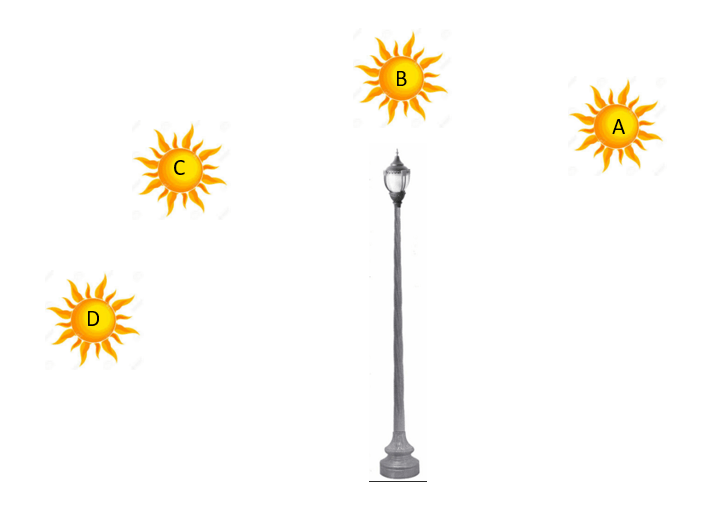
At which location of the sun would the shadow of the light pole be the longest?
a)
A at 11 a.m
b)
B at noon
c)
C at 2 p.m.
d)
D at 6 p.m.
22.

When was this picture most likely taken?
(Hint: think about the shadow's length)
a)
morning or evening
b)
night
c)
noon
23.

Which picture was taken in the afternoon?
a)
A
b)
B
c)
C
d)
D
24.

What are the three important constellations?
a)
Ursa Major, Ursa Minor, Orion
b)
Ursa Major, Big Dipper, Orion
c)
Ursa big, Ursa small, Orion
d)
Polaris, Ursa Minor, Orion
25.

Ursa Major is also called “Great Bear” and is one of the largest constellations.
a)
True
b)
False
26.

What constellation is this?
a)
Orion
b)
Taurus
c)
Canis Major
d)
Gemini
Reset

