Wayground logo

Free Printable Worksheets

Font size

S
M
L
XL
Worksheets

quiz#1

Total questions: 135

Worksheet time: 2hrs 3mins

Name
Class
Date
1.
what is the hardest mineral
a)
diamond
b)
talc
c)
quartz
d)
topaz
2.
what is the softest mineral
a)
fluorite
b)
talc
c)
diamond
d)
gypsum
3.
how many characteristics does  mineral have to have in order to be a mineral
a)
6
b)
2
c)
5
d)
4
4.
We use a triple beam balance to determine how much matter is in an object.  The amount of matter in an object is called ______________________.
a)
Volume
b)
Mass
c)
Density
d)
Element
5.
The Law of Conservation of Matter/Mass states ____________________________________.
a)
matter can be created but not destroyed
b)
 matter cannot be created or destroyed
c)
matter can be created and destroyed
d)
matter cannot be created but can be destroyed
6.
H2O and CO2 are made of two different elements chemically bonded.  They are considered  ________________________________.
a)
Compounds
b)
 Elements
c)
Atoms
d)
Mixtures
7.
What type of rock is granite? 
a)
Igneous
b)
Sedimentary
c)
Metamorphic 
8.
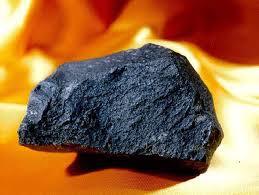
What type of rock is obsidian? 
a)
Igneous
b)
Sedimentary
c)
Metamorphic 
9.
What type of rock is made from magma or lava that has cooled and hardened? 
a)
Igneous
b)
Sedimentary
c)
Metamorphic
10.
What type of rocks are made when existing rocks are heated and squeezed? 
a)
Metamorphic 
b)
Sedimentary 
c)
Igneous
11.
What type of rocks are made from dead plants and animals, shells, minerals, and/or pieces of broken rocks? 
a)
Sedimentary
b)
Igneous
c)
Metamorphic
12.
What is made from 2 or more minerals? 
a)
Rock 
b)
Pizza
c)
Crystal
d)
Mineral
13.
What is made from inorganic material found in nature? 
a)
Minerals
b)
Rocks
c)
Crystals
d)
Pizza
14.
What are atoms with a repeating pattern called? 
a)
Crystals
b)
Minerals
c)
Pizza
d)
Rocks 
15.
This rock started as lava that cooled and then was heated and put under pressure over time. What type of rock is this?
a)
Sedimentar
b)
Igneous
c)
Metamorphic
16.
This rock was molten magma that slowly cooled under the ground. What type of rock is this?
a)
Sedimentary
b)
Igneous
c)
Metamorphic
17.
Extreme Heat and Pressure creates a _________ rock.
a)
Igneous
b)
Metamorphic
c)
Sedimentary
d)
Mineral
18.
True or False: Once a rock is sedimentary, it cannot become an igneous rock.
a)
True
b)
False
19.
The three groups of rocks are classified by
a)
How they form
b)
Color
c)
Grain size
d)
Chemical Composition
20.
This rock formed when bits of other rocks became pressed into a solid. What type of rock is it?
a)
Sedimentary Rock
b)
Metamorphic Rock
c)
Igneous Rock
21.
This rock was formed when magma cooled very slowly inside the Earth. What specific type of rock is it?
a)
Intrusive Igneous Rock
b)
Extrusive Igneous Rock
c)
Foliated Metamorphic Rock
d)
Clastic Sedimentary Rock
22.
This rock formed when lava cooled very quickly on Earth's surface. What specific type of rock is it?
a)
Extrusive Igneous Rock
b)
Intrusive Igneous Rock
c)
Non-Foliated Metamorphic Rock
d)
Biochemical Sedimentary Rock
23.
When you watch a volcano erupt molten rock, you are seeing _____
a)
Lava
b)
Magma
c)
Mineral Crystals
d)
Igneous Rocks
24.
What are the 3 major types of rocks?
a)
Igneous, Metamorphic, Sedimentary
b)
Metamorphic, Igneous, Cementation
c)
Brown, Red, Gray
d)
Streak, Hardness, Breakage
25.
Two ways to describe types of igneous rocks are _____
a)
Extrusive and Intrusive
b)
Foliated and Non-Foliated
c)
Clastic and Biochemical
d)
Black and Gray
26.
This rock was formed by smaller pieces of rock that settled at the bottom of a lake millions of years ago. What type of rock is this?
a)
Sedimentary
b)
Igneous
c)
Metamorphic
27.
This rock was found near the mouth of a volcano. What type of rock is this?
a)
Sedimentary
b)
Igneous
c)
Metamorphic
28.
When sediments are pressed together tightly, this is called ____________.
a)
Compaction
b)
Cementation
c)
Weathering
d)
Erosion
29.
The process in which dissolved minerals crystallize and glue sediment together.
a)
compaction
b)
deposition
c)
organic rock
d)
cementation
30.
The process when rocks break into smaller pieces due to exposure to natural elements is called
a)
erosion
b)
weathering
c)
sediments
31.
The movement of weathered material (sediment) is called?
a)
weathering
b)
erosion
c)
deposition
32.
What is deposition?
a)
Dropping off sediment
b)
Movement of sediment
c)
Breaking down of sediment 
33.
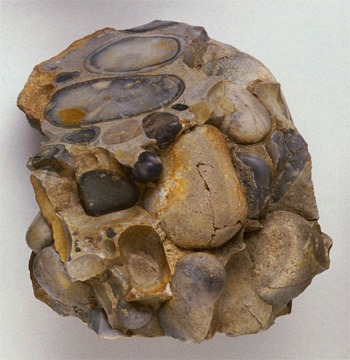
What minerals are in this rock
a)
quartz,hornblende,mica, and feldspar
b)
quartzite,hornblend,mica, and feldspar
c)
Feldspar and quartz
d)
horneblend and mica
34.
This Mineral is feldspar
a)
True
b)
False
35.
this rock can become metamorphic
a)
True
b)
False
36.
what rock is this
a)
granite
b)
quartzite
37.
what number do you have to start on with a tripple beam balance
a)
0
b)
1
c)
2
d)
999.9
38.
Process in which broken rock material comes to rest is _?_.
a)
weathering
b)
erosion
c)
deposition
d)
sediments
39.
Process in which rock is broken down into bits by winds, water, heat, ice and life-forms is _?_
a)
weathering
b)
erosion
c)
deposition
d)
sediments
40.
Process in which broken rock bits are moved by wind, water, ice and gravity is _?_.
a)
weathering
b)
erosion
c)
deposition
d)
sediments
41.
Name of broken rock bits is _?_.
a)
weathering
b)
erosion
c)
deposition
d)
sediments
42.
Intrusive Igneous rocks will be 
a)
coarse grain
b)
fine grain
43.
What is the most common Extrusive igneous rock?
a)
Granite
b)
Basalt
c)
Pumice
d)
Scorie
44.
What is one use of Granite?
a)
gravel
b)
weapons
c)
building materials
d)
skin abrasives
45.
The deeper a rock is buried, the greater the pressure is on it
a)
True 
b)
False
46.
Which of these is a metamorphic rock?
a)
pumice
b)
sandstone
c)
slate
d)
coal
47.
Which of these is a metamorphic rock?
a)
Gneiss
b)
Granite
c)
Scoria
d)
Conglomerate
48.
How do metamorphic rocks form? 
a)
Heat and Pressure
b)
Compaction & Cementation
c)
Cooling of Magma
d)
Sediments & Glue
49.
What is the name of this Metamorphic Rock?
a)
Schist
b)
Slate
c)
Gneiss
d)
Marble
50.
What sedimentary rock is changed into quartzite during metamorphism?
a)
Shale
b)
Sandstone
c)
Limestone
d)
Conglomerate
51.
What sedimentary rock is changed into slate during metamorphism?
a)
Shale
b)
Limestone
c)
Sandstone
d)
Breccia
52.
Metamorphic rocks are formed by ___.
a)
existing rocks are baked and squeezed by pressure
b)
small pieces of rock are compacted and cemented together
c)
magma or lava cools and hardens
d)
igneous rocks are broken into pieces
53.
What are the two main types of metamorphic rocks and how are they different?
a)
intrusive and extrusive; intrusive rocks are formed inside the earth and extrusive rocks are formed on the surface
b)
foliated and nonfoliated; foliated rocks do not have visible bands/layers and nonfoliated rocks do have visible bands/layers
c)
intrusive and extrusive; intrusive rocks are formed on the earth's surface and extrusive rocks are formed in the Earth
d)
foliated and nonfoliated; foliated rocks have visible bands/layers and nonfoliated rocks do not have visible bands/layers
54.
Which of the following is a metamorphic rock?
a)
obsidian
b)
granite
c)
gneiss
d)
sandstone
55.
Which of the following is a metamorphic rock?
a)
conglomerate
b)
pumice
c)
obsidian
d)
marble
56.
Which of the following is a metamorphic rock?
a)
basalt
b)
obsidian
c)
slate
d)
pumice
57.
Which of the following is a metamorphic rock?
a)
phyllite
b)
shale
c)
limestone
d)
pumice
58.
Which of the following is a metamorphic rock?
a)
granite
b)
sandstone
c)
quartzite
d)
conglomerate
59.
When metamorphic rocks are formed, the extreme heat is usually caused by the _______.
a)
gravity in the atmosphere
b)
collision of tectonic plates
c)
the fiery hot magma in the Earth's mantle
d)
weight of the mountains
60.
Igneous rocks are formed by ___.
a)
existing rocks are baked and squeezed by pressure
b)
small pieces of rock are compacted and cemented together
c)
magma or lava cools and hardens
d)
igneous rocks are broken into pieces
61.
Metamorphic rocks change their size, shape, color and/or texture by doing all of the following EXCEPT ____.
a)
changing their chemical composition
b)
melting to form a new rock
c)
changing their mineral composition
d)
changing their crystal structure
62.
The layer of solid rock located beneath the soil on Earth is called  ___.
a)
bedrock
b)
boulder
c)
crust
d)
crystal
63.
The layer of rock that forms Earth's surface is called the ___.
a)
bedrock
b)
boulder
c)
crust
d)
crystal
64.
A solid material made up of molecules that are arranged in repeating patterns is called a ___.
a)
bedrock
b)
boulder
c)
crust
d)
crystal
65.
A very large rock is called a ___.
a)
bedrock
b)
boulder
c)
crust
d)
crystal
66.
The force per unit area exerted on an object is called ___.
a)
mineral
b)
pressure
c)
rock cycle
d)
sedimentary rock
67.
A type of rock formed by gravity pressing fragments of other rocks and minerals together as they settle on land or under the ocean over a long period of time is called  ___.
a)
mineral
b)
pressure
c)
rock cycle
d)
sedimentary rocks
68.
The process during which rocks are formed, change, wear down, and are formed over long periods is called the ___.
a)
mineral
b)
pressure
c)
rock cycle
d)
sedimentary rocks
69.
This rock started as lava that cooled and then was heated and put under pressure over time. What type of rock is this?
a)
Sedimentar
b)
Igneous
c)
Metamorphic
70.
This rock was molten magma that slowly cooled under the ground. What type of rock is this?
a)
Sedimentary
b)
Igneous
c)
Metamorphic
71.
The three groups of rocks are classified by
a)
How they form
b)
Color
c)
Grain size
d)
Chemical Composition
72.
What two processes make sediment?
a)
Weathering
b)
Erosion
c)
Weathering & Erosion
73.
When you watch a volcano erupt molten rock, you are seeing _____
a)
Lava
b)
Magma
c)
Mineral Crystals
d)
Igneous Rocks
74.
This rock formed when bits of other rocks became pressed into a solid. What type of rock is it?
a)
Sedimentary Rock
b)
Metamorphic Rock
c)
Igneous Rock
75.
This rock was found near the mouth of a volcano. What type of rock is this?
a)
Sedimentary
b)
Igneous
c)
Metamorphic
76.
What is sedimentary?
a)
Formed by heat and pressure
b)
Formed by heat and cooling
c)
Layered rock formed by compaction
d)
All of the above
77.
A living thing, such as a plant, that can make its own food
a)
Producer
b)
Consumer
c)
Herbivore
d)
Carnivore
78.
A living thing that can't make its own food and must eat other living things
a)
Carnivore
b)
Consumer
c)
Herbivore
d)
Producer
79.
A living thing that can't make its own food and must eat other living things
a)
Carnivore
b)
Consumer
c)
Herbivore
d)
Producer
80.
An animal that eats only plants or producers
a)
Carnivore
b)
Omnivore
c)
Herbivore
d)
Consumer
81.
An animal that eats only plants or producers
a)
Carnivore
b)
Omnivore
c)
Herbivore
d)
Consumer
82.
An animal that eats only other animals
a)
Carnivore
b)
Omnivore
c)
Consumer
d)
Producer
83.
A living thing that feeds on the wastes and remains of plants and animals
a)
Decomposers
b)
Fungus
c)
Scavenger
d)
Microorganism
84.
What is a mushroom an example of?
a)
Fungus
b)
Microorganism
c)
Scavenger
d)
Producer
85.
Which is not a consumer?
a)
Producer
b)
Herbivore
c)
Carnivore
d)
Omnivore
86.
A living thing, such as a plant, that can make its own food
a)
Producer
b)
Consumer
c)
Herbivore
d)
Carnivore
87.

the ability to stretch or compress

a)

potential energy

b)

elastic energy

c)

law of conservation

d)

thermal energy

88.

what is the definition of friction

a)

the action of one surface or object rubbing against another.

b)

height or mass

c)

energy that is caused because of friction

89.

energy due to an objects position or condition

a)

thermal

b)

kenetic

c)

potential

d)

elastic

e)

law of conservation

90.

energy due to an objects motion

a)

potential

b)

kenetic

91.

this depends on the height and mass of an object

a)

gravitational potential energy

b)

fiction

c)

volume

d)

kenetic

92.

energy can not be created or destroyed

a)

magnet

b)

thermal

c)

law of conservation

d)

gravitational potential energy

93.

energy that is caused because of friction

a)

kenetic

b)

thermal

94.
What type of energy is in this picture?
a)
Kinetic
b)
Potential
c)
Electromagnetic
95.
What kind of energy?
a)
Thermal (kinetic) energy
b)
Thermal (potential) energy
c)
Nuclear (kinetic) energy
d)
Mechanical (kinetic) energy
96.
What form of energy?
a)
Thermal
b)
Electrical
c)
Mechanical
d)
Radiant
97.
What kind of energy?
a)
Radiant
b)
Electrical
c)
Thermal
d)
Chemical
98.
the ability to do work
a)
energy
b)
Matter
c)
photons
d)
potential energy
99.
Energy is made out of...
a)
Matter
b)
Atoms
c)
Photons
d)
Nothing
100.
Energy takes up space
a)
True
b)
False
101.
A baseball held by a pitcher has _____________energy.
a)
Kinetic
b)
Chemical 
c)
Potential
d)
Thermal
102.
At what position does the rock have the greatest kinetic energy?
a)
A
b)
B
c)
D
d)
E
103.
How does light travel?
a)
it bounces off objects
b)
in a zigzag pattern
c)
in a straight line
d)
it swirls upward
104.
Which of the following would sound travel through the fastest?
a)
water
b)
oxygen
c)
wood
d)
koolaid
105.
The picture is a good example of which of the following?
a)
refraction
b)
a broken pencil
c)
opaque
d)
the glass is broken
106.
Almost all light comes from......
a)
glow worms
b)
the sparkle in your eyes
c)
the sun
d)
light bulbs
107.
The boy tossed the ball it fell to the ground.  Why?
a)
magnetism
b)
because of buoyancy 
c)
because of gravity
d)
because of friction
108.

energy in motion is called

a)

potential

b)

reserved

c)

kinetic

d)

mass

109.

"Energy can be transformed from one form into another or transformed from one region or another, but energy cannot be created or destroyed."

Which law is this?

a)

Law of Conservation of Mass

b)

Newton's Second Law

c)

Law of Conservation of Energy

d)

Newton's Third Law

110.
A place or object used for comparison to determine if another object is in motion is called a
a)
comparison point
b)
reference point
c)
point of view
d)
motion detector
111.
An object is _____ if its position changes relative to another object.
a)
in motion
b)
at reset
c)
a frame of refence
d)
magical
112.
A distance vs. time graph shows an object's
a)
frame of reference
b)
speed
c)
acceleration
d)
favorite food
113.
Speed =
a)
distance / time
b)
time / distance
c)
distance * time
114.
On a distance-versus-time graph, a straight line ALWAYS indicates that an object’s speed is _____.
a)
constant
b)
zero
c)
increasing
d)
decreasing
115.
Change in speed over a given period of time is
a)
velocity
b)
motion
c)
speed
d)
acceleration
116.
On a distance vs. time graph, the steeper the slope _____
a)
the slower the speed
b)
the faster the speed
c)
less acceleration
d)
greater acceleration
117.
What is the equation to find speed?
a)
s=t/d
b)
s=d x t
c)
s=d/f
d)
s=d/t
118.
What is the equation to find speed?
a)
s=t/d
b)
s=d x t
c)
s=d/f
d)
s=d/t
119.
Acceleration of an object happens when things ________
a)
slow down
b)
go faster
c)
change direction (turn)
d)
All of the above
120.
LT1 Which would NOT make a good reference point? 
a)
Becker Middle School
b)
A chair
c)
A moving child
121.
LT2 The distance an object travels per unit of time (how far, how fast) is called: 
a)
direction
b)
speed
c)
acceleration
d)
deceleration
122.
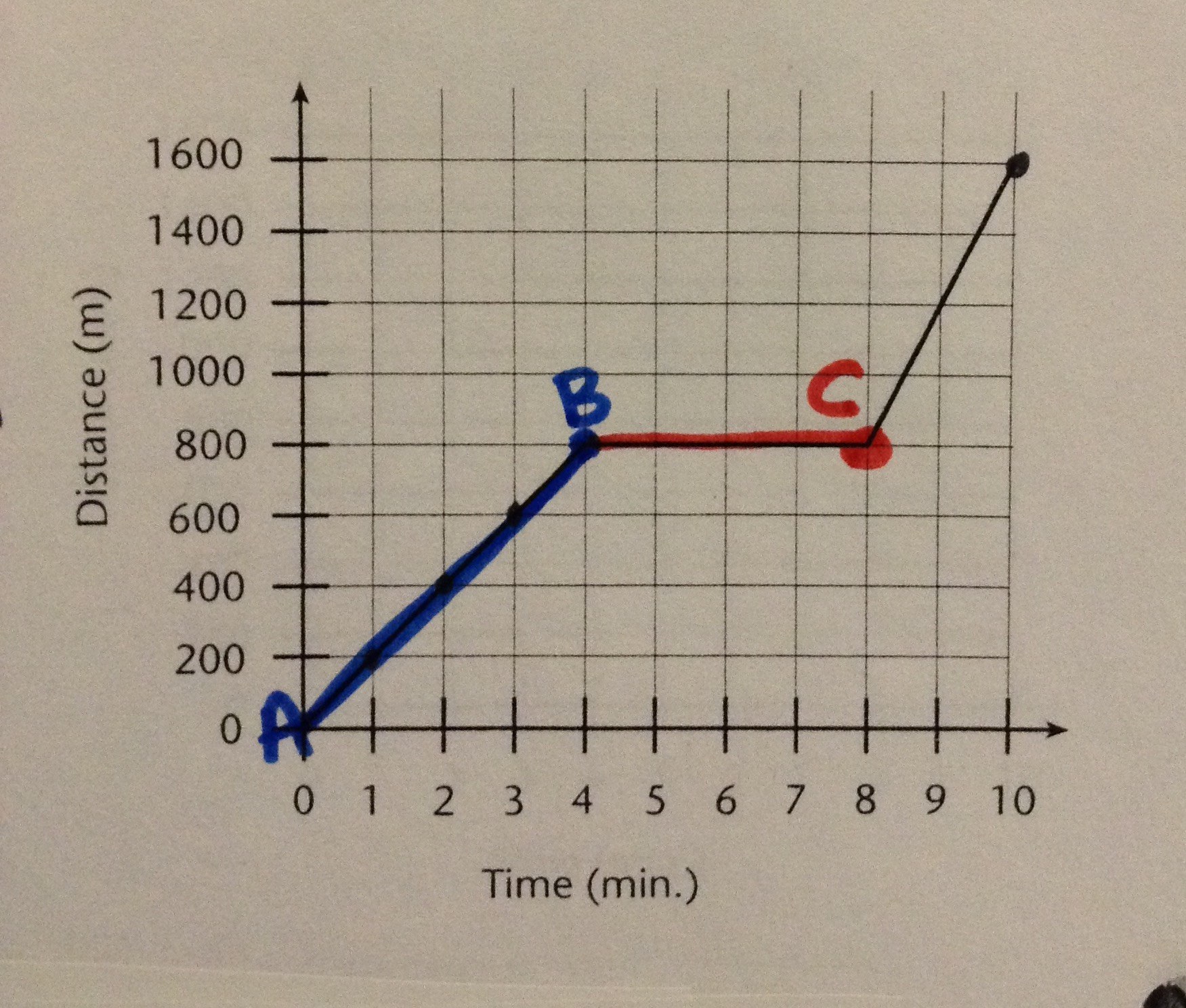
LT4: The graph shows Ashley riding her bike to Maria's house. 
What was occurring from point B to point C?
a)
She was increasing her speed.
b)
She stopped for 4 minutes
c)
She was decreasing in speed
123.
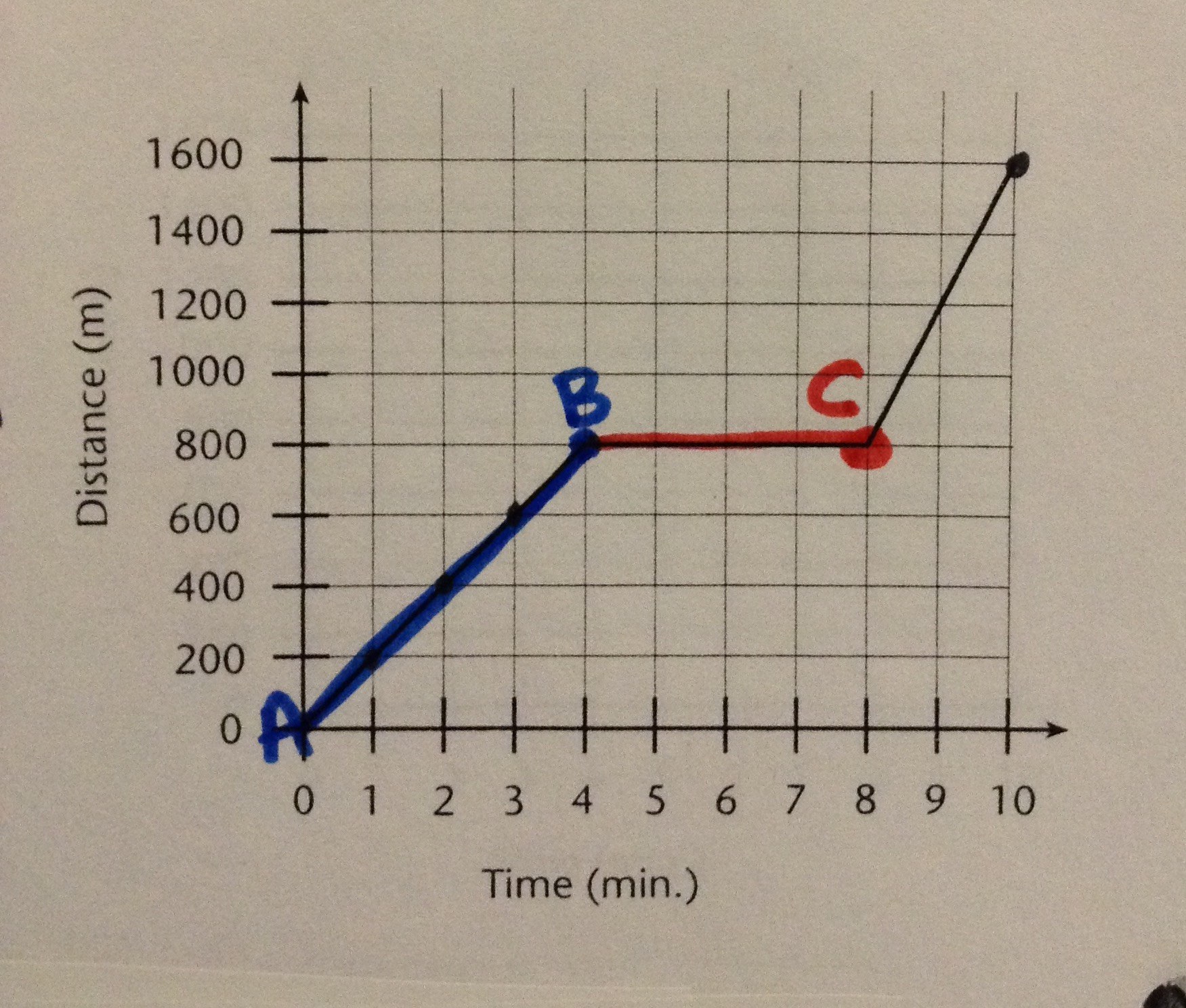
LT4: The graph shows Ashley riding her bike to Maria's house. 
What is occurring from point A to point B?
a)
they are traveling at a constant speed
b)
they are decreasing in speed
c)
they stopped to take a break
124.
The graph respresents
a)
No motion
b)
Constant Velocity
c)
Acceleration
d)
Deceleration
125.
The graph represents
a)
no motion
b)
constant velocity
c)
acceleration
d)
negative acceleration
126.
The location of a place or an object is called its....
a)
position
b)
motion
c)
speed
d)
reference point
127.
A location to which you can compare other locations is called
a)
reference point
b)
motion
c)
location
d)
position
128.
The change of position over time is called
a)
position
b)
motion
c)
speed
d)
location
129.
Speed is equal to the distance divided by
a)
position
b)
time
c)
height
d)
motion
130.
The unit speed is measured in is
a)
m/s
b)
ft/min
c)
m/hr
d)
m/s^2
131.
A wheelchair racer completes a 100 meter course in 20 seconds. What is his speed?
d= 100 m
t= 20 s
a)
10 m/s
b)
5 m/s
c)
2 m/s
d)
0 m/s
132.
In a distance time graph, the steeper the line the...
a)
greater the speed
b)
slower the speed
c)
speed has reached zero
d)
speed has not changed
133.
What is the formula to calculate speed?
a)
S = t/d
b)
S = d/t
c)
S = d x t
d)
S = t x d
134.
What is speed?
a)
how far you go
b)
how much distance is covered over a period of time
c)
how fast you accelerate
d)
the change in the location of a object
135.
The correct equation to calculate speed is
a)
distance/time
b)
time/distance
c)
distance x time
d)
distance/time2