
 Worksheets
Second 9 Weeks Exam Review
Total questions: 36
Worksheet time: 22mins
Name
Class
Date
1.

This country discovered gold and silver. Trade became very important. They later developed plantation systems dependent upon slave labor (Native American and African). They were mainly located in the Caribbean and Amazon Basin. They grew sugar cane as a cash crop.
a)
Spanish and Portuguese
b)
Dutch
c)
French
d)
English
2.

This country started with plantation systems that grew tobacco, rice, indigo and sugar as cash crops. They used slaves and indentured servants to do the work. They also established settlements for permanent habitation; which later attracted people who wanted religious freedom.
a)
English
b)
Dutch
c)
Spanish and Portuguese
d)
French
3.

This was the earliest country to setup colonies. They established plantation and trading post colonies. Their colonization was not very successful.
a)
Dutch
b)
French
c)
Spanish and Portuguese
d)
English
4.

This country established fur trading posts to trade with Native Americans. They were located mainly in North America. They established friendly relationships with Native Americans.
a)
English
b)
Dutch
c)
Spanish and Portuguese
d)
French
5.
Which of the following was NOT an effect of European interaction with Asia?
a)
Europeans established trading posts along the coasts
b)
Europeans gained control by establishing colonies and government
c)
Asian colonies became more dependent on European trade and markets
d)
Asian isolation began to break down and European ideas and religions were spread.
6.

What led to the development of the middle class?
a)
Feudal lords gained greater profits
b)
Individuals had the opportunity to take risks and make profits
c)
Feudal lords began to encourage private ownership
d)
The government established greater control over private trade
7.

The people who came to the American colonies in the 17th century had already been exposed to the idea of limited government thanks mainly to :
a)
the Magna Carta
b)
the Constitution
c)
the Council of Trent
d)
the Articles of Confederation
8.
· There is virtually no ability to limit the actions of the government. · These governments tend to be authoritarian or tyrannical in nature. · Individual rights and freedoms are curbed. · Citizens are expected to display total obedience to the rulers and their decisions.
What type of government do these statements best describe?
What type of government do these statements best describe?
a)
Limited government
b)
a. Unlimited government
c)
a. Tyrannical government
d)
Authoritarian government
9.

Why did the findings of Galileo frighten Catholic and Protestant leaders?
a)
His findings supported the theories of Aristotle.
b)
His findings did not support the Copernician theory.
c)
His findings led him to rebel against the Cardinals.
d)
His findings went against Church teaching and authority.
10.
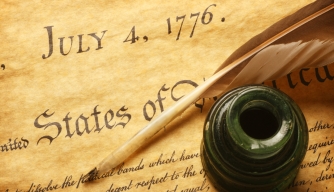
Both John Locke and Thomas Jefferson wrote about the natural rights of man. In what document are these "unalienable rights" specifically mentioned?
a)
the Bill of Rights
b)
the Mayflower Compact
c)
the Preamble to the Constitution
d)
the Declaration of Independence
11.
The political theory that people form governments for their mutual protection and that government rules only with the consent of those people is known as
a)
communism
b)
socialism
c)
divine right theory.
d)
social contract theory
12.

What did the ideas of John Locke, Baron de Montesquieu, and Jean Jacques Rousseau have in common?
a)
The philosophies challenged the traditional role of women.
b)
The philosophies inspired the American and French revolutions.
c)
The theories promoted fairness in the criminal justice system.
d)
The theories encouraged the establishment of absolute monarchs.
13.

According to John Locke, if the government failed to protect natural rights, what did citizens have a right to do?
a)
To divide the government into three separate parts
b)
To elect new government leaders to rule the country
c)
To overthrow the government and establish a new one
d)
To create a direct democracy and allow individuals to govern
14.

French philosopher Jean Jacques Rousseau believed that the best form of government would be one that practiced
a)
direct democracy
b)
popular sovereignty
c)
the right to bear arms
d)
separation of church and state
15.
Montesquieu is credited with devising the basic Constitutional principle of
a)
natural rights
b)
popular sovereignty
c)
separation and balance of governmental power
d)
government was created by man for his own purposes
16.
Leaders of the Enlightenment believed a perfect society could develop through ______.
a)
the military
b)
reason
c)
fear
d)
money
17.
Who served as the authority for science before the Scientific Revolution?
a)
the Church
b)
Absolute Monarchs
c)
University Professors
d)
Mathematicians
18.
The English Bill of Rights did which of the following?
a)
Took away individual rights and limited government power
b)
Took away individual rights and gave government unlimited power
c)
recognize individual rights and gave government unlimited power
d)
recognize the individual rights and limited government power
19.
Historians have regarded the American Revolution as being of worldwide importance because it:
a)
was won without foreign military assistance.
b)
was led by people of recognized intellectual ability.
c)
ended European imperialism in the Western Hemisphere.
d)
marked the successful emergence of a new concept in government.
20.
The French Revolution (1789) began as a reaction to
a)
unequal taxation.
b)
religious persecution.
c)
invasion by the Moors.
d)
a desire for democracy.
21.

Prior to the French Revolution, which class has the most people but the least political power?
a)
Third Estate
b)
Second Estate
c)
Estates General
d)
Estate Assembly
22.
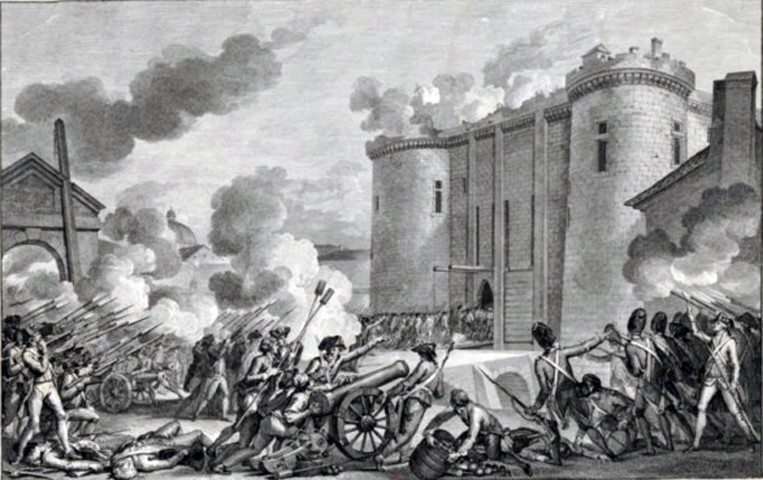
This image depicts an event that is considered to the beginning of the French Revolution. What is the name of the event?
a)
The burning of Paris
b)
The Tennis Court Oath
c)
The storming of the Bastille
d)
The Beheading of King Louis XVI
23.

Napoleon Bonaparte's rise to power came as
a)
an opponent of the Revolution.
b)
husband of Marie Antoinette.
c)
after executing Louis XVI.
d)
a French military hero.
24.

Geography and harsh weather played a major role in Napoleon's defeat during his invasion of :
a)
Russia.
b)
Hungary.
c)
Germany.
d)
Great Britain.
25.

What was the purpose of the Congress of Vienna?
a)
to maintain Napoleon’s empire in Europe
b)
to reestablish the balance of power in Europe
c)
to create a union of nations in Europe
d)
to establish a peace treaty for Europe
26.

What is nationalism?
a)
Conquering other nations
b)
Pride and loyalty in your country, group, or culture
c)
Economic partnership with other nations
d)
A type of limited government
27.
What are possible results of nationalism?
a)
Unification and mercantilism
b)
Unification and separation
c)
Separation and mercantilism
d)
Capitalism and separation
28.

Which statement best describes nationalism in Italy?
a)
People from different nation-states of Italian culture united
b)
Nation-states were happy to be part of Napoleon’s Empire
c)
Nation-states wanted to restore their original monarch to the throne
d)
People from different nation-states wanted to remain independent
29.
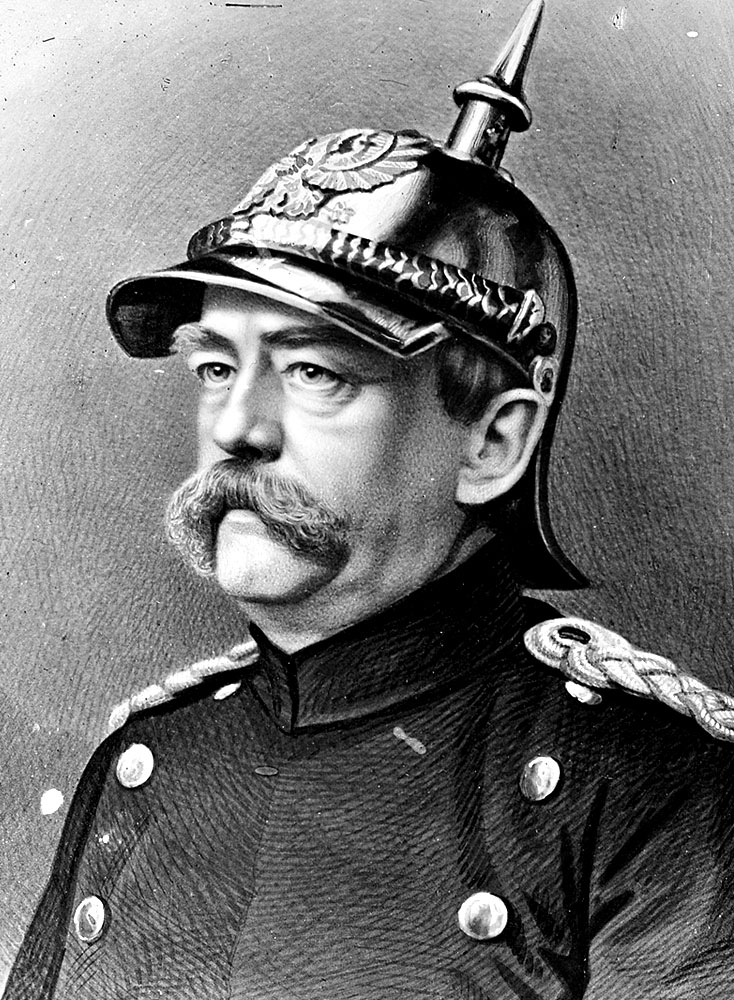
Which statement best describes nationalism in Germany?
a)
Germany was conquered by Russia and became the nation of Prussia
b)
King Emmanuel II joined the north and south of Germany
c)
Germany was united through the policies of ‘realpolitik’ and ‘blood and iron’
d)
Moderates established a parliamentary system to join the nation-states
30.
What is the significance of the unification of Italy and the unification of Germany?
a)
To show the impact nationalists movements can have on a region
b)
To show the impact absolute monarchs have on a region
c)
To show the impact unlimited governments can have on a region
d)
To show the impact limited government can have on a region
31.

In what way was the independence movement in Haiti DIFFERENT from the independence movement led by Simon Bolivar in South America?
a)
Haiti's was a violent slave revolt.
b)
Haiti's movement was not successful.
c)
Haiti revolted against Spanish control.
d)
Haiti won their independence with U.S. assistance
32.

· He is known as the George Washington of South America.
· A South American country is named in his honor.
· Born in Venezuela, he fought to end Spanish control
These statements describe:
· A South American country is named in his honor.
· Born in Venezuela, he fought to end Spanish control
These statements describe:
a)
Pancho Villa.
b)
Pedro Cabral.
c)
Simon Bolivar.
d)
Touissant L'Ouverture.
33.

Latin American revolutions during the early nineteenth century were MOST LIKELY inspired by the French Revolution and the
a)
Cuban Revolution.
b)
Russian Revolution.
c)
American Revolution.
d)
West Indies Revolution.
34.

Industrialization in the 19th century is MOST associated with
a)
revolution.
b)
urbanization
c)
agrarian life.
d)
Manifest Destiny.
35.
Which of these changes during the Industrial Revolution led to greater efficiency?
a)
Workers received labor rights.
b)
Major labor unions were formed.
c)
Slavery and other forms of forced labor were eliminated.
d)
Animal & human power were generally replaced with steam power.
36.

By the end of the nineteenth century, technology in the industrial setting (factories)
a)
generally made human labor obsolete.
b)
raised the need for artisans and carpenters.
c)
led to an increase in the price of American products.
d)
created a rapidly increasing demand for unskilled or semiskilled labor.
100 %

