
 Worksheets
Rocks and Minerals
Total questions: 21
Worksheet time: 18mins
Name
Class
Date
1.
The color of a mineral in powder form is called the mineral's
a)
hardness
b)
specific gravity
c)
luster
d)
streak
2.
How light reflects off of a mineral is called the mineral's
a)
luster
b)
streak
c)
cleavage
d)
fracture
3.
Why is coal not a mineral?
a)
It's not a solid
b)
It is man-made
c)
It is not inorganic
d)
It is made of carbon
4.

The following image shows what mineral property?
a)
Hardness
b)
Streak
c)
Cleavage
d)
Density
5.
Diamond has a hardness of ___ on Mohs Hardness Scale.
a)
1
b)
5
c)
8
d)
10
6.
Dull, silky, waxy, pearly, and earthy are terms that best describe which property of minerals?
a)
luster
b)
color
c)
streak
d)
cleavage
7.

By definition, a mineral has which of the following characteristic(s)?
a)
definite chemical composition
b)
crystal structure
c)
naturally occuring
d)
all of the above
8.
How do you test the hardness of a mineral?
a)
Throw it against a wall
b)
Step on it
c)
Scratch Test
d)
Kick it until it breaks
9.

What mineral is used for pencils?
a)
Graphite
b)
Galena
c)
Magnetite
d)
Quartz
10.
A naturally occurring, inorganic solid with a crystal structure and a definite chemical composition is referring to
a)
density
b)
streak
c)
mineral
d)
non silicate mineral
11.
The solid, geometric form of a mineral produced by a repeating pattern of atoms
a)
crystal
b)
density
c)
element
d)
fracture
12.

This rock formed when bits of other rocks became pressed into a solid. What type of rock is it?
a)
Sedimentary Rock
b)
Metamorphic Rock
c)
Igneous Rock
13.

This rock was formed when magma cooled very slowly inside the Earth. What specific type of rock is it?
a)
Intrusive Igneous Rock
b)
Extrusive Igneous Rock
c)
Foliated Metamorphic Rock
d)
Clastic Sedimentary Rock
14.

This rock formed when lava cooled very quickly on Earth's surface. What specific type of rock is it?
a)
Extrusive Igneous Rock
b)
Intrusive Igneous Rock
c)
Non-Foliated Metamorphic Rock
d)
Biochemical Sedimentary Rock
15.
When you watch a volcano erupt molten rock, you are seeing _____
a)
Lava
b)
Magma
c)
Mineral Crystals
d)
Igneous Rocks
16.
When you are describing the sizes of the mineral grains in a rock, you are detailing the rock's _____
a)
Texture
b)
Composition
c)
Sedimentation
d)
Igneous-ness
17.
What are the 3 major types of rocks?
a)
Igneous, Metamorphic, Sedimentary
b)
Metamorphic, Igneous, Cementation
c)
Brown, Red, Gray
d)
Streak, Hardness, Breakage
18.
Two ways to describe types of igneous rocks are _____
a)
Extrusive and Intrusive
b)
Foliated and Non-Foliated
c)
Clastic and Biochemical
d)
Black and Gray
19.
What process is used to form sedimentary rocks?
a)
Lava cools and hardens to form a rock.
b)
Bits of sand and gravel form layers that turn into rock from pressure.
c)
Extreme heat and pressure from inside the Earth turn rocks into new rocks.
d)
Magma trapped under the Earth's surface cools and solidifies.
20.
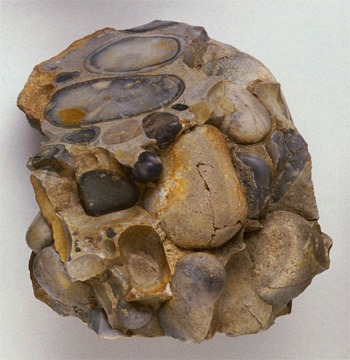
This rock was formed by smaller pieces of rock that settled at the bottom of a lake millions of years ago. What type of rock is this?
a)
Sedimentary
b)
Igneous
c)
Metamorphic
21.
What has to increase for metamorphism to occur?
a)
weathering and erosion
b)
temperature and pressure
c)
melting and cooling
d)
compaction ad cementation
100 %

