
 Worksheets
SS Benchmark Review-#2
Total questions: 100
Worksheet time: 35mins
Name
Class
Date
1.
The American Revolution was a war that was fought for
a)
Religion
b)
Gold
c)
Tobacco
d)
Independence
2.

The French and Indian War was a seven-year long war between which two European countries?
a)
The French and the Indians
b)
France and England
c)
England and Spain
d)
Spain and France
3.

What was the cause of the French and Indian War?
a)
Both countries wanted claim to the Ohio River Valley.
b)
Both countries wanted claim to the Mississippi River.
c)
Both countries wanted claim to Canada.
d)
Both countries wanted to kick out the American Indians.
4.
Which area in North America was the French and Indian fought over?
a)
Ohio River Valley
b)
Florida
c)
the East coast
d)
the West Coast
5.
What were the 2 main reasons for the French and Indian War?
a)
Control of land and trade with Native Americans
b)
Land and Slaves
c)
Gold
d)
Claim to land in Europe
6.
Who was the King of England during this time?
a)
King Ferdinand and Queen Isabella
b)
King Henry VIII
c)
Queen Elizabeth
d)
King George III
7.
Whic country won the French and Indian War?
a)
England
b)
France
c)
Indians
d)
Spain
8.
As a result of the cost of the war, what did King George III do to the colonists?
a)
Killed them
b)
Removed them from the land in the colonies just like the Indians.
c)
Imposed taxes to pay for the war
d)
Paid for the war out of his own pocket
9.
What was the first tax on the colonies passed by Britain?
a)
Proclamation of 1763
b)
Stamp Act
c)
Sugar Act
d)
Townshend Acts
10.
The Stamp Act required people to buy a stamp for
a)
newspapers
b)
clothing
c)
food
d)
furniture
11.
What did the Stamp Act do?
a)
Put a tax on some paper products
b)
Raise the price of postage stamps
c)
Require all colonists leaving by ship to get a stamp on the hand
d)
Banned the sending of letters from one colony to another
12.
What is boycotting?
a)
Agreeing to let customs officials search your ship
b)
Illegally transporting, buying or selling things
c)
Working as a spy
d)
Refusing to buy certain things
13.
What did the British parliament do in response to colonial protests against the Stamp Act?
a)
They doubled the tax
b)
They did nothing
c)
They repealed the tax
d)
They declared war on France
14.
Why were the colonists angry about "taxation without representation?"
a)
The colonists wanted to pay taxes on stamps and tea
b)
The colonists had no representation in Parliament
c)
The colonists fought to write the Declaration of Independence
d)
The colonists were loyal to the British and wanted to keep them happy
15.
What slogan did the colonists begin to use in order to express their frustrations with the British government?
a)
"No Taxation!"
b)
"We Need Representation!"
c)
"No Taxation without Representation!"
d)
"We Want Freedom!"
16.
Liberty means _____________
a)
To make an alliance
b)
To have certain rights from the government
c)
To have freedom from another government
17.
The 13 colonies were fighting for freedom from England. What is another word for freedom?
a)
taxes
b)
tariff
c)
liberty
d)
patriot
18.

a Patriot organization that protested British actions such as the Stamp Act.
a)
Sons of Liberty
b)
Daughters of Liberty
c)
Patriots
d)
Loyalists
19.

a Patriot organization consisting of WOMEN who supported the boycott of British goods.
a)
Daughters of Liberty
b)
Sons of Liberty
c)
Patriots
d)
effigy
20.
Which of the following groups burned newspapers, used tar and feathering tactics, and participated in protests?
a)
The Daughters of Liberty
b)
The British Parliament
c)
The Sons of Liberty
d)
The Powhatan Tribe
21.
_______ was when the Sons of Liberty dumped tea into Boston Harbor.
a)
Tea Act
b)
Boston Tea Party
c)
Quartering Act
d)
Boston Massacre
22.
The Sons of Liberty were founded by John Hancock and ___.
a)
George Washington
b)
Paul Revere
c)
Sam Adams
d)
John Adams
23.

What event does this drawing show?
a)
Tarring and feathering
b)
Boston Tea Party
c)
Boston Massacre
d)
American Revolution
24.

Who is the colonist directly in front of the crowd in this image of the Boston Massacre?
a)
Sam Gray
b)
Crispus Attucks
c)
Patrick Carr
d)
James Caldwell
25.
Who is the African American colonist directly in front of the crowd in this image of the Boston Massacre?
a)
Sam Gray
b)
Crispus Attucks
c)
Patrick Carr
d)
James Caldwell
26.
Who was involved in the Boston Tea Party?
a)
Sons of Liberty
b)
Native Americans
c)
British soldiers
d)
King George III
27.
What Act was passed after the Boston Tea Party?
a)
Stamp Act
b)
Tea Act
c)
Sugar Act
d)
Intolerable Act
28.
Why did the Sons of Liberty dress up as Native Americans and dump tea in the Boston Harbor?
a)
To protest and fight back against taxes on tea and other items
b)
To celebrate 4th of July
c)
To celebrate their American Revolution victory over the British
d)
To protest against the Declaration of Independence
29.
The king of Great Britain who thought taxing the colonists would be the best way to pay for the French and Indian War. He also lost the 13 colonies.
a)
Patrick Henry
b)
George Washington
c)
King George III
30.
Major author of the Declaration of Independence
a)
George Washington
b)
Thomas Jefferson
c)
Samuel Adams
d)
Thomas Paine
31.
British General who SURRENDERED to George Washington at Yorktown
a)
King George III
b)
George Washington
c)
Lord Cornwallis
d)
John Locke
32.
A colonial leader who was also an inventor and scientist. He also helped create the Declaration of Independence.
a)
Benedict Arnold
b)
George Washington
c)
Thomas Jefferson
d)
Benjamin Franklin
33.
One of the most famous 'traitors' in American history.
a)
John Adams
b)
King George III
c)
Benedict Arnold
34.

Commander of the Continental Army
a)
John Adams
b)
Thomas Jefferson
c)
George Washington
d)
Crispus Attucks
35.

Author of Declaration of Independence
a)
Thomas Jefferson
b)
George Washington
c)
John Adams
d)
Thomas Paine
36.
Which of these American leaders warned the colonist in Massachusetts that the British Army was coming?
a)
Paul Revere
b)
Thomas Jefferson
c)
Thurgood Marshall
d)
George Washington
37.
This event broke tensions between the colonist and the British troops where shots were fired. Crispus Attucks was the first to be killed.
a)
Lexington and Concord
b)
Boston Tea Party
c)
Boston Massacre
d)
Bloody Valentine
38.

What was this poster's meaning?
a)
The Colonies needed to be united
b)
Serpents can grow back together
c)
Colonies need to be independent
d)
Ben Franklin didn't know why he made this
39.
What was the FIRST battle of the American Revolution?
a)
Saratoga
b)
Valley Forge
c)
Lexington and Concord
d)
Yorktown
40.

Where was the "shot heard 'round the world?" (April 19th, 1775)?
a)
Concord
b)
Lexington
c)
Bunker Hill
d)
Boston
41.
Which battle is considered the TURNING point of the American Revolution?
a)
Battle of Trenton
b)
Battle of Saratoga
c)
Lexington & Concord
d)
Battle of Bunker Hill
42.
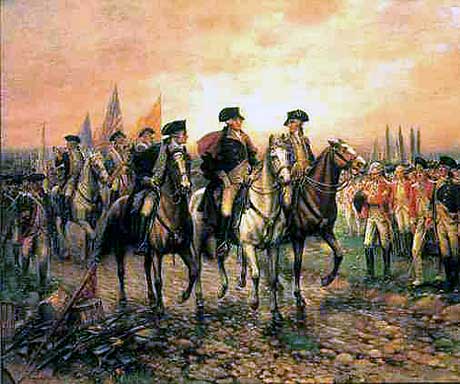
Which battle ENDED the American revolution?
a)
Battle of Lexington and Concord
b)
Battle of Saratoga
c)
Battle of Yorktown
d)
Battle of Trenton
43.
Americans who believed that the colonies had a right to govern themselves
a)
Mercenaries
b)
Patriots
c)
Loyalists
44.
A person LOYAL to the King of England during colonial times.
a)
Loyalist
b)
Patriot
c)
desert
d)
boycott
45.
A colonist who supported the FIGHT for independence
a)
Loyalist
b)
Patriot
c)
militia
d)
blockade
46.
What is independence?
a)
The things laws say are owed to you.
b)
The freedom from control.
c)
The money people must pay to a government.
d)
A war against your own government
47.

Why was the Declaration of Independence written?
a)
To stop taxes from the British Empire.
b)
To make a United States army.
c)
To gain independence from the British Empire
d)
To install their own king in America
48.
What are our 3 NATURAL rights according to Jefferson?
a)
Freedom of speech, religion, and press
b)
Life, liberty, and property
c)
Life, liberty, and the pursuit of happiness
d)
Voting, rebelling, and health
49.

According to the Declaration of Independence, what truth was "self-evident"?
a)
All men are created equal
b)
Rights are given by good kings
c)
Government exists to protect us from ourselves
d)
Only a democracy can protect our rights
50.

According to the Declaration of Independence, WHO does government get its power from?
a)
From the King
b)
From the Supreme Court
c)
From God
d)
From the people
51.

The List of Grievances were the part of the Declaration that
a)
detailed the colonists' complaints with King George.
b)
listed a man's natural rights.
c)
introduced the Declaration.
d)
concluded the Declaration, declaring America a free country.
52.

Who was the MAIN author of the Declaration of Independence?
a)
Benjamin Franklin
b)
Samuel Adams
c)
Thomas Jefferson
d)
Paul Revere
53.

Why is July 4, 1776 an important date in U.S. history?
a)
Common Sense was published.
b)
The Olive Branch Petition sent to King George III.
c)
The American Revolution ends.
d)
The Declaration of Independence is signed.
54.

How do natural rights, as described in the Declaration of Independence, differ from other rights?
a)
People are born with natural rights.
b)
People can vote to choose natural rights
c)
Natural rights are given only to citizens.
d)
Natural rights come from the government.
55.
What country did the United States declare independence from?
a)
Britain
b)
France
c)
Spain
d)
Belgium
56.
Which of the following HAD NOT taken place before the Declaration of Independence was written?
a)
Battles
b)
America named a president
c)
The Revolutionary War
d)
American had cut most ties with England
57.
This type of colonist was ready for rebellion and the fight for independence.
a)
Loyalist
b)
Patriot
c)
Neutral
d)
British
58.
Which act was passed as a result of the Boston Tea Party?
a)
Stamp Act
b)
Quartering Act
c)
Intolerable Acts
d)
Outrageous Acts
59.

The U.S. was founded on July 4, 1776, by the approval of this document.
a)
the Treaty of Paris
b)
the Constitution
c)
the Declaration of Independence
d)
the Virginia Charter
60.

Which man-made feature is represented by a star on the map?
a)
New York City
b)
Philadelphia
c)
Boston
d)
None of these
61.

Which man-made feature is represented by a star on the map?
a)
New York City
b)
Philadelphia
c)
Boston
d)
None of these
62.

What city is represented by the star on the map?
a)
New York City
b)
Philadelphia
c)
Boston
d)
None of these
63.

Which important city or landmark is located at letter E?
a)
Gettysburg, PA
b)
Montgomery, AL
c)
Pearl Harbor, HI
d)
Salton Sea
64.

What's the Capital of the USA?
a)
Las Vegas
b)
LA
c)
California
d)
Washington DC
65.

What is the name of the
man-made waterway that connects Lake Erie to the Hudson River
and then to the Atlantic Ocean
man-made waterway that connects Lake Erie to the Hudson River
and then to the Atlantic Ocean
a)
Panama Canal
b)
Buffalo River
c)
Niagara Falls
d)
Erie Canal
66.

What was the Erie Canal used for?
a)
Disney cruises
b)
Test battle ships
c)
Drinking water for the city of Buffalo
d)
Ship goods faster and cheaper to the Atlantic Ocean
67.
What are natural rights?
a)
Rights all people have
b)
The right to a speedy trial
c)
The right to freedom of religion
68.
An ABUSE of authority, usually by a government or a ruler
a)
liberty
b)
tyranny
c)
natural rights
d)
revolution
69.
A document that recognized the United States of America as an independent nation. It was signed in 1783 and officially marked the END of the American Revolution.
a)
Committees of Correspondence
b)
Treaty of Paris
c)
Common Sense
d)
Declaration of Independence
70.
A group that helped boycott British goods and made their own goods instead.
a)
Boycotts
b)
Sons of Liberty
c)
Committees of Correspondence
d)
Daughters of Liberty
71.
Which plan calls for...
3 branches
2 house in Congress based on POPULATION
3 branches
2 house in Congress based on POPULATION
a)
Virginia Plan
b)
New Jersey Plan
72.
Which plan calls for...
2 branches
1 house in congress based off EQUAL REPRESENTATION
2 branches
1 house in congress based off EQUAL REPRESENTATION
a)
Virginia Plan
b)
New Jersey Plan
73.
What was the 3/5 Compromise?
a)
A portion of the slave population would be counted for representation purposes
b)
A harsh law made to punish runaway slaves
c)
Described how the Supreme Court would be operated
74.
Which group believed most of the government power should reside with the FEDERAL government?
a)
Federalists
b)
Anti-Federalists
75.
The US Constitution was written at the____________ Convention in 1787 (City of Brotherly Love).
a)
Virginia
b)
Philadelphia
c)
South Carolina
d)
New York
76.
Which group wanted a strong national government?
a)
Federalist
b)
Anti-federalist
77.
What document was added to the US Constitution to make sure we have individual liberties (RIGHTS)?
a)
Fundamental Orders of Connecticut
b)
Bill of Rights
c)
US Constitution
d)
Declaration of Independence
78.
What is the name of the FIRST written plan of government in America?
a)
Constitution
b)
Treaty of Paris
c)
Declaration of Independence
d)
Articles of Confederation
79.

Which is a WEAKNESS of the Articles of Confederation?
a)
Congress couldn't collect taxes
b)
Weak central government
c)
Provided for no common currency
d)
All of the these
80.
A TWO house legislature is known as this?
a)
Tripod
b)
Quarter Final
c)
Decando
d)
Bicameral
81.
Federalism is
a)
a system of shared power by the state and national government
b)
A 3 branch government with a system of checks and balances
c)
sole government with authority in the states
d)
same as a unitary government
82.
Powers that are NOT given to the Federal government are
a)
implied powers
b)
expressed powers
c)
reserved powers
d)
super powers
83.
What is the main PURPOSE of the Constitution?
a)
to set out a plan for the United States government and to protect the rights of citizens
b)
to give the President all power like a king
c)
to say why the United States should be its own country
d)
to give jobs to all Americans
84.
The Great Compromise was a compromise between which 2 plans?
a)
Mass. Plan and New Jersey Plan
b)
Virginia Plan and New Jersey Plan
c)
Virginia Plan and New York Plan
d)
Virginia Plan and Delaware Plan
85.

The Virginia Plan wanted representation based on
a)
population
b)
equality for every state
c)
state size
d)
money
86.
The New Jersey Plan wanted representation in government based on
a)
population
b)
equal representation
c)
state size
d)
money
87.
What did the NORTHERN states want related to slavery?
a)
Slaves to count for the state population
b)
To have more slaves.
c)
Slaves to not count for the state population
d)
For each slave to count for two votes.
88.
What did the SOUTHERN states want related to slavery?
a)
Slaves to count as population
b)
Slaves to become free.
c)
Slaves to not count as population
d)
To get rid of slaves in the north.
89.
The Great Compromise said that the ______ would have two representatives from each state
a)
House of Representatives
b)
Presidency
c)
Judges
d)
Senate
90.
Who is the "Father of the Constitution"?
a)
James Franklin
b)
James Potter
c)
King James
d)
James Madison
91.
A system in which the limits are placed on the branches of government, so no one branch becomes too powerful; also known as separation of powers
a)
Ratification
b)
Federal system
c)
Amendment
d)
Checks and Balances
92.
a statement that declares, or announces, an idea
a)
ideal
b)
party
c)
declaration
93.
to give up
a)
cry
b)
ask a question
c)
surrender
94.
Define:
Unalienable
Unalienable
a)
rights which cannot be taken away from you, rights which you have because you are a human being
b)
rights which must be taken from you
c)
rights you have to earn
d)
rights which only some people have
95.
Define:
Grievance
Grievance
a)
a complaint against an unfair action
b)
to cry over a lost loved one
c)
a ceremonial set of armor
d)
complimenting a fair action
96.
Showed that the colonist could stand next to the British forces; the Americans inflicted large casualties on the British but lost the battle due to a shortage of ammunition
a)
Battle of Yorktown
b)
Battle of Bunker Hill
c)
Battle of Trenton
d)
Battle of Saratoga
97.

A soldier who was ready to fight in a minute's notice (very quickly).
a)
Monopoly
b)
Minuteman
c)
Militia
d)
Mercenary
98.
a formal or informal complaint against someone or a group of people
a)
repeal
b)
boycott
c)
grievance
d)
civil disobedience
99.
The Declaration of Independence begins with a _______, or introduction.
a)
Sonnet
b)
Monopoly
c)
Grievance
d)
Preamble
100.
AFTER the Treaty of Paris of 1783, the 13 colonies became
a)
The United States
b)
The States
c)
The 13 States
d)
The New World
100 %

