
 Worksheets
Atmosphere, Weather, and Climate Review
Total questions: 28
Worksheet time: 16mins
Name
Class
Date
1.
The sun shines down on a family as they play on the beach.
a)
conduction
b)
convection
c)
radiation
2.

Walking on the warm sand with your bare feet.
a)
conduction
b)
convection
c)
radiation
3.
Warm air is less dense and the more dense, cool air sinks.
a)
conduction
b)
convection
c)
radiation
4.
Where you will find the ozone layer.
a)
stratosphere
b)
thermosphere
c)
troposphere
d)
mesosphere
5.
Layer of the atmosphere where weather occurs.
a)
stratosphere
b)
thermosphere
c)
troposphere
d)
mesosphere
6.
The hottest layer of the atmosphere.
a)
troposphere
b)
thermosphere
c)
exosphere
d)
mesosphere
7.
The most common gas in the atmosphere (78%).
a)
Nitrogen
b)
Oxygen
c)
Carbon Dioxide
d)
Trace gases
8.

The coldest layer of the atmosphere where meteoroids burn up.
a)
troposphere
b)
thermosphere
c)
exosphere
d)
mesosphere
9.

What weather instrument measures air pressure?
a)
Psychrometer
b)
Barometer
c)
Rain Gauge
d)
Wind Vane
10.
What weather instrument measures heat?
a)
Psychrometer
b)
Barometer
c)
Anemometer
d)
Thermometer
11.

Which instrument measures wind speed?
a)
Anemometer
b)
Barometer
c)
Psychrometer
d)
Wind Vane
12.
The condition of the atmosphere at a certain place and time is known as ________.
a)
climate
b)
weather
13.
The average weather conditions in an area over a long period of time is known as ______.
a)
weather
b)
climate
14.
A severe storm which involves a funnel cloud forming over land is:
a)
hurricane
b)
tornado
c)
thunderstorm
d)
blizzard
15.
A severe storm that involves winds over 119 km/h and forms over warm ocean water is:
a)
tornado
b)
thunderstorm
c)
hurricane
d)
blizzard
16.
The boundary between two air masses is known as:
a)
front
b)
storm line
c)
air mass
d)
maritime
17.

A cold front is approaching Minneapolis. What will happen to the air temperature?
a)
stay the same
b)
increase
c)
decrease
18.
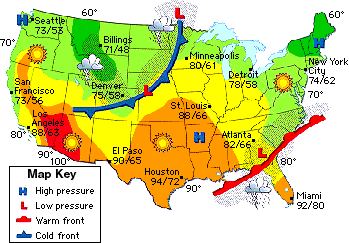
A low pressure system is located over Georgia. What type of weather will they have?
a)
clear, sunny skies
b)
cloudy and rainy
19.
A high pressure system is located north of New York City. What type of weather will be experienced there?
a)
clear, sunny skies
b)
cloudy and rainy
20.

Which type of front is displayed?
a)
Cold
b)
Warm
c)
Stationary
d)
Occluded
21.
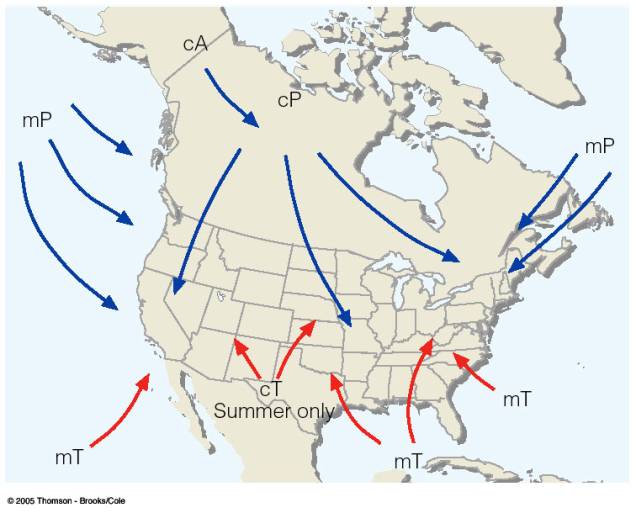
Which abbreviation of an air mass can be identified as warm and wet?
a)
cP
b)
mP
c)
cT
d)
mT
22.
How does higher altitude affect climate?
a)
the higher the elevation, the colder it gets.
b)
The further you get from the equator, the colder it gets.
c)
The closer you get to the equator, the hotter it gets.
23.
Which abbreviation of an air mass can be identified as dry and hot?
a)
cP
b)
mP
c)
cT
d)
mT
24.
Uneven heating of Earth's surface by the sun causes which of these?
a)
wind patterns
b)
cloud formation
c)
ocean tides
25.
How do differences in air pressure affect the movement of air?
a)
Wind always moves from areas of high pressure to areas of low pressure.
b)
Wind always moves from areas of low altitudes to high altitudes.
c)
Wind only moves from west to east.
26.

How does the air move in a sea breeze?
a)
wind moves from north to south
b)
wind moves from ocean to the land during the day
c)
wind moves from the land to the ocean during the night
27.

Is this a land or a sea breeze?
a)
land breeze
b)
sea breeze
28.

Mrs. Siler believes that I can do well on the test.
a)
TRUE
b)
DO NOT SELECT THIS OPTION
100 %

