
 Worksheets
Biology Review (TCHS Teacher Created Questions)
Total questions: 50
Worksheet time: 2hrs 40mins
Name
Class
Date
1.
Kidneys use energy to move molecules and ions in order to keep the blood chemically balanced. The cells of the kidney are using energy to do which of the following?
a)
Carry on chemosynthesis
b)
Control body temperature
c)
Maintain homeostasis
d)
Transmit impulses
2.

Based on the diagrams above, which structures make it easy to identify the cell on the right as a plant cell?
a)
cell wall, chloroplast, and large central vacuole
b)
cell wall, mitochondria, and ribosomes
c)
mitochondria, chloroplast, and cell membrane
d)
nucleus, ribosomes, and large central vacuole
3.
The organelle responsible for linking amino acids to make proteins is the __________.
a)
cytoplasm
b)
nucleus
c)
ribosome
d)
vacuole
4.
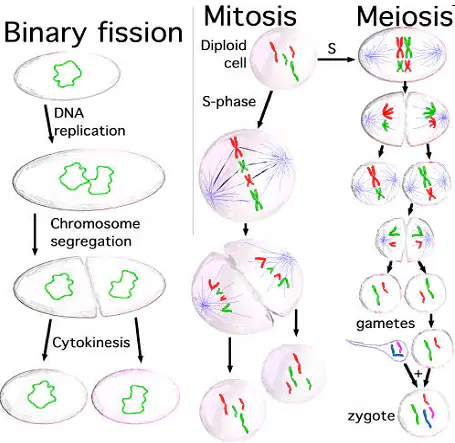
A cell with a diploid number of 12 chromosomes undergoes meiosis. What will be the product at the end of meiosis?
a)
Two cells, each with 6 chromosomes
b)
Two cells, each with 12 chromosomes
c)
Four cells, with 6 chromosomes each
d)
Four cells with 12 chromosomes each
5.

Which of the following statements is false concerning the following genetic processes?
a)
Bacteria reproduce through binary fission.
b)
Meiosis results in four haploid gametes.
c)
Mitosis results in two diploid somatic cells.
d)
Crossing-over adds genetic variation in mitosis.
6.
Which of the following statements is not true about proteins?
a)
Proteins are made of long chains of amino acids.
b)
Proteins build and repair muscle and other tissue.
c)
Proteins provide the body with quick energy.
d)
Some proteins are enzymes that can speed up chemical reactions.
7.
A speed skater is preparing to skate a 1000-meter race in the winter Olympics while a black bear is in hibernation. Which macromolecule would be most beneficial for each organism to obtain adequate energy?
a)
The sprinter will use carbohydrates for quick energy and the bear will use lipids for long-term energy storage.
b)
The sprinter will use lipids for quick energy and the bear will use carbohydrates for long-term energy storage.
c)
The sprinter will use nucleic acid for quick energy and the bear will use proteins for long-term energy storage.
d)
The sprinter will use proteins for quick energy and the bear will use nucleic acids for long-term energy storage.
8.

What is the entire molecule shown in the diagram known as?
a)
amino acid
b)
nucleotide
c)
polysaccharide
d)
protein
9.
While cleaning a saltwater aquarium, students placed a family of fiddler crabs from the saltwater aquarium into a container of distilled water. What effect will this have on the crabs?
a)
The crabs will die if left in the freshwater because their cells will burst.
b)
The crabs will die if left in the freshwater because their cells will shrink.
c)
The crabs will excrete excess salts left in their systems.
d)
The crabs will not be affected at all.
10.
Which statement about diffusion and osmosis is true?
a)
Both are examples of passive transport that does not require energy.
b)
Both processes involve the movement of molecules from an area of low concentration to an area of high concentration
c)
Diffusion requires a protein channel while osmosis does not
d)
Osmosis requires energy while diffusion does not
11.
SB1e Which of the following is the correct sequence of events in cellular respiration?
a)
Glycolysis→Fermentation→Krebs Cycle
b)
Krebs Cycle→ETC→Glycolysis
c)
Glycolysis→Krebs Cycle→ETC
d)
Krebs Cycle→Glycolysis→ETC
12.

SB1e What process is shown in the diagram?
a)
Cellular Respiration
b)
Fermentation
c)
Glycolysis
d)
Photosynthesis
13.

SB1e Identify the reactants or inputs of the following equation.
6CO₂ + 6H₂O + Energy → 6O₂ + C₆H₁₂O₆
6CO₂ + 6H₂O + Energy → 6O₂ + C₆H₁₂O₆
a)
O₂ + C₆H₁₂O₆
b)
CO₂ + H₂O + Energy
c)
O₂ + H₂O
d)
CO₂ + H₂O + O₂ + C₆H₁₂O₆ + Energy
14.
SB2a The cellular process of creating two new DNA molecules from one original copy is called replication. Which statement is the BEST description of this process?
a)
DNA opens up and completely unwinds to make two new molecules
b)
DNA opens up and each strand is used as a template for a new strand.
c)
DNA opens up and RNA copies it
d)
RNA opens up the DNA and uses each strand as a template for a new strand
15.
SB2a What happens during the process of translation?
a)
Copies of DNA molecules are made
b)
Messenger RNA is made from DNA
c)
The cell uses information from messenger RNA to produce proteins
d)
Transfer RNA is made from messenger RNA
16.
SB2a The following is a segment of a DNA strand:
TAC GAT
Which of the following is the complimentary strand of DNA?
TAC GAT
Which of the following is the complimentary strand of DNA?
a)
UAC CAU
b)
TAG CAT
c)
ATG CTA
d)
AUG CUA
17.
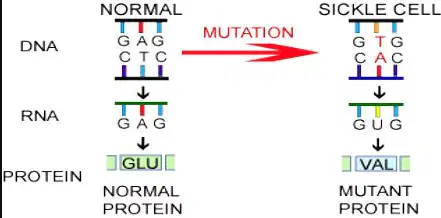
SB2b Sickle cell anemia is the result of a type of mutation in the gene that codes for part of the hemoglobin molecule. Using the image below, identify the mutation type that occurs.
a)
Deletion
b)
Insertion
c)
Frameshift
d)
Substitution
18.
SB2b How does UV radiation from the sun cause skin cancer?
a)
It adds energy to the skin cells and can cause an increase in the rate of photosynthesis
b)
It damages the DNA of the skin cells and can cause them to replicate continuously
c)
It removes water from the skin cells and can cause them to shrivel and die
d)
Skin cancer is not caused by UV radiation from the sun
19.
SB2c GMO crops currently on the market have been developed to address which of the following issues?
a)
GMO crops are less resistant to drought and require more water than traditional plants
b)
GMO crops are more susceptible to insect damage and diseases
c)
GMO crops do not exist
d)
GMO crops have been shown to increase yield and this can help curb world hunger
20.

SB2c A wildlife biologist does a DNA gel to determine how closely related four species of trout are to one another. The results of the gel electrophoresis are shown in the image. Which of these two species of trout are most closely related?
a)
Brown and Golden
b)
Brown and Rainbow
c)
Golden and Brook
d)
Rainbow and Golden
21.
SB3a According to Mendel’s Law of Segregation, a human sperm cell can have
a)
Only an X chromosome
b)
Only a Y chromosome
c)
Either an X or a Y chromosome
d)
Exactly the same genetic information as somatic cells
22.
SB3b There are situations in which one allele for a gene is not completely dominant over another allele for that gene. Snapdragon flowers are a common example of this where pink flowers are produced by crossing a red flower with a white flower.
a)
Incomplete dominance
b)
Multiple alleles
c)
Multiple genes
d)
Polygenic inheritance
23.

SB3b In humans, having freckles (F) is dominant to not having freckles (f). The inheritance of these traits can be studied using a Punnet square similar to the one shown below.
Their offspring have a ______ chance of having freckles.
Their offspring have a ______ chance of having freckles.
a)
25%
b)
50%
c)
75%
d)
100%
24.
SB3b Mr. Jones has blood type B and Mrs. Jones has blood type AB. What is the probability that they will have a child with blood type O?
a)
0%
b)
25%
c)
50%
d)
100%
25.
SB3c Which of the following is an advantage of sexual reproduction?
a)
Adaptation is minimized
b)
More variation in populations
c)
No mate is required
d)
Offspring is identical
26.
SB4a Endosymbiosis is thought to have been necessary for the evolution of which groups?
a)
Eukaryotes
b)
Non-photosynthetic prokaryotes
c)
Photosynthetic prokaryotes
d)
Viruses
27.
SB4c Why do viruses need living hosts, such as bacteria or eukaryotic cells?
a)
The host cell is a source of food for the virus
b)
Viruses depend on a host cell because they lack their own DNA or RNA
c)
Viruses depend on the host cell that they infect to reproduce
d)
Viruses lack cell structures and cannot survive without a host cell
28.

SB4b Using the cladogram above, which organisms are least related evolutionarily?
a)
Hagfish and Perch
b)
Salamander and Lizard
c)
Mouse and Chimp
d)
Perch and Pigeon
29.

SB4b Which organism can be placed after the chimp in the cladogram above?
a)
Gecko
b)
Great white shark
c)
Human
d)
Siberian tiger
30.

SB4b All organisms in the cladogram above can be classified as ______.
a)
Archaea
b)
Bacteria
c)
Prokaryotes
d)
Eukaryotes
31.

SB5a Sea otters protect kelp forests by consuming the sea urchins that chew through the kelp.
The ecosystem of a kelp forest would go through drastic changes including significant damage to the kelp and all organisms that depend on the kelp if the sea otter is removed. This is a perfect example of which of the following?
The ecosystem of a kelp forest would go through drastic changes including significant damage to the kelp and all organisms that depend on the kelp if the sea otter is removed. This is a perfect example of which of the following?
a)
Dominant species
b)
Keystone species
c)
Recessive species
d)
Empirical species
32.
SB5a In a deciduous oak forest of the American northeast, one example of an abiotic component of the ecosystem would be which of the following?
a)
Deer that eat acorns in the forest
b)
Earthworms that feed on organic matter
c)
Roundworms in the soil that feed on plant roots
d)
Sunlight that filters through the canopy
33.

SB5b Examine the food web above. If a non-native predator of rabbits is added to the ecosystem, what is the most likely initial affect on the other organisms?
a)
More competition among the mice for food
b)
More competition among the hawks for food
c)
Less competition among the snakes for food
d)
Less grass available for food
34.
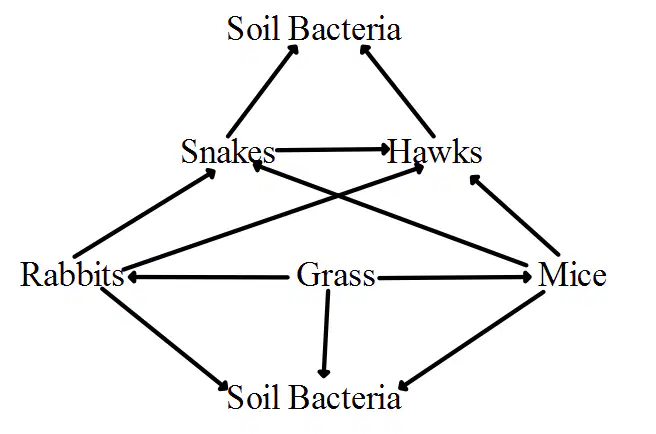
SB5b The producer in the food web above has 10,000 J of energy. Identify the secondary consumer with the correct amount of energy.
a)
100 J would be available to the hawk
b)
1000 J would be available to the snake
c)
10 J would be available to the mouse
d)
100 J would be available to the rabbit
35.
SB5b The soil bacteria in the food web above have a very crucial role in a biogeochemical cycle. What is the main cycle and role they play?
a)
They convert nitrogen from the air into a useable form for plants in the nitrogen cycle
b)
They release carbon into the air in the phosphorous cycle
c)
They release nitrogen into the air in the nitrogen cycle
d)
They remove oxygen from the air in the carbon cycle
36.
SB5c After a community is disrupted by a large-scale event such as a forest fire, a new community is established through which process?
a)
Old field succession
b)
Lake succession
c)
Primary succession
d)
Secondary succession
37.

SB5c Examine the progression of the 6 images below.
What conclusions can be drawn according to them images?
What conclusions can be drawn according to them images?
a)
What conclusions can be drawn according to them images?
b)
Bodies of water can go through a series of changes until they reach a terrestrial climax community
c)
The first picture contains the greatest amount of biodiversity
d)
Trees can grow in water
38.
SB5d Which of the following is the best way for humans to reduce their impact on the carbon cycle?
a)
Clear-cut forests to expand cities which reduces the number of plants that remove carbon dioxide from the air through photosynthesis
b)
Increase the usage of automobiles and decrease the usage of bicycles as a means of transportation
c)
Stop exhaling carbon dioxide as a product of cellular respiration
d)
Reduce usage of fossil fuels which release carbon dioxide into the air when burned
39.
SB5e A plant leans towards a window that allows sunlight to enter. Which plant behavior does this demonstrate?
a)
Negative geotropism
b)
Positive geotropism
c)
Phototropism
d)
Thigmotropism
40.
SB5e Which of these adaptations would be seen in a tropical rainforest plant but would not be suited for survival in a desert plant?
a)
A waxy coating on leaves to keep water inside the plant while it is exposed to the hot desert temperature
b)
Large, thin leaves that absorb large amounts of sunlight
c)
Protective spines to keep herbivores from eating them to obtain water
d)
Shallow, widespread roots to absorb any precipitation close to the ground surface
41.
SB6a In the phrase “Survival of the Fittest”, the term “fittest” refers to the organism’s what?
a)
Brain size
b)
Number of genes
c)
Physical strength and speed
d)
Suitability for its environment
42.
SB6a Who is considered to be the founder of modern evolutionary theory?
a)
Darwin
b)
Lamarck
c)
Pasteur
d)
Redi
43.
SB6b Sharks and dolphins look very much alike--both have streamlined bodies, fins, and sharp teeth. Sharks and dolphins, however, are not closely related. The body structures that characterize sharks and dolphins have evolved independently. Which term is used by evolutionary biologists to describe the process by which two separate species may evolve in a similar way and come to resemble one another?
a)
Adaptive radiation
b)
Convergent evolution
c)
Coordinated development
d)
Punctuated evolution
44.
SB6b An earthquake causes a huge canyon to form, permanently dividing a population of wild donkeys. On the windward side of the canyon, dry conditions develop and grasses grow. On the leeward side of the canyon, rainfall is frequent and a forest grows. What result is least likely to happen over the course of 100,000 years?
a)
After a long period of time, the two donkey populations may not be able to successfully interbreed with one another
b)
Donkeys from the forest side may become smaller and darker in color
c)
The two donkey populations will remain physically identical to each other
d)
Two new species of donkeys will form
45.

SB6c The amino acid sequence from the organisms in the table below is a partial sequence for hemoglobin, a protein that carries oxygen in the blood.
Based on the table, which two organisms are most alike?
Based on the table, which two organisms are most alike?
a)
Chimpanzee and Gorilla
b)
Chimpanzee and Human
c)
Gorilla and Human
d)
Horse and Zebra
46.

SB6c Based on the bones, the limbs shown below developed from the same embryonic tissue. These are examples of which types of structures?
a)
Analogous
b)
Homologous
c)
Fossil
d)
Vestigial
47.

SB6d In the image below, there is a population of green-winged and brown-winged beetles. As someone walks by, most of the green-winged beetles get squished under foot. Their demise eliminates the green-winged allele from the small population. This elimination of the allele is an example of which of the following?
a)
Artificial selection
b)
Gene flow
c)
Genetic drift
d)
Natural selection
48.
SB6d Birds of the same species were blown from the mainland to a nearby island in a storm. While living on the island, natural selection acts in favor of the birds with smaller beaks, as birds with large and medium-sized beaks have a harder time gather food. This process is an example of which of the following choices?
a)
Directional selection
b)
Disruptive selection
c)
Sexual selection
d)
Stabilizing selection
49.
SB6e A man treated his home with a pesticide that kills roaches. The first application of the pesticide killed 92% of the roaches. Two months later he applied the pesticide to his home again, but the second application killed only 65% of the roaches. What would best explain the decrease in the effectiveness of the pesticide?
a)
The pesticide is effective only against mature roaches.
b)
Once roaches learned how to fight the pesticide, they taught others.
c)
The pesticide caused some of the roaches digestive systems to mutate and metabolize the pesticide.
d)
The surviving roaches were naturally resistant to the pesticide, and that resistance was inherited by their offspring.
50.
SB6e How does the overuse of antibiotics lead to resistant strains of bacteria?
a)
Antibiotics cause natural selection to select for existing resistant bacteria.
b)
Antibiotics change the structure of bacteria, making them resistant.
c)
Antibiotics introduce too many bacteria into a population at one time.
d)
Antibiotics provide a breeding ground in which bacteria can reproduce rapidly.
100 %

