
NEW
Font size
S
M
L
XL
 Worksheets
Evolution
Total questions: 20
Worksheet time: 19mins
Name
Class
Date
1.

The difference in the physical traits of an individual from those of other individuals in a group is called a(n)
a)
change
b)
adaption
c)
species
d)
variation
2.

a bird that can easily outcompete other birds for food and that can produce many eggs has a high
a)
life expectancy
b)
mutation rate
c)
fitness
d)
adaptability
3.

which of the folllowing is an exammple of a vestigial structure?
a)
the wings of a red-tailed hawk
b)
the hind limbs of a house cat
c)
the fins of sharks
d)
the wings of an ostrich
4.

Some organisms that share a common ancestor have features that have different functions, but similar structures. These are known as
a)
vestigial structures
b)
analogous structures
c)
homologous structures
d)
fossil structures
5.

If an organism has a vestigial structure, that structure likely once had a function in a(n)
a)
close relative
b)
early ancestor
c)
unrelated organism
d)
embryological stage
6.

the hind leg bones in a whale are examples of
a)
homologous structures
b)
analogous structures
c)
fossils
d)
vestigals
7.
What is the process in which humans breed organisms for certain traits?
a)
natural selection
b)
inheritance
c)
artificial selection
d)
descent withOUT modification
8.
Natural selection results in change over time by acting on traits that are
a)
heritable
b)
new
c)
mutated
d)
better than the best
9.
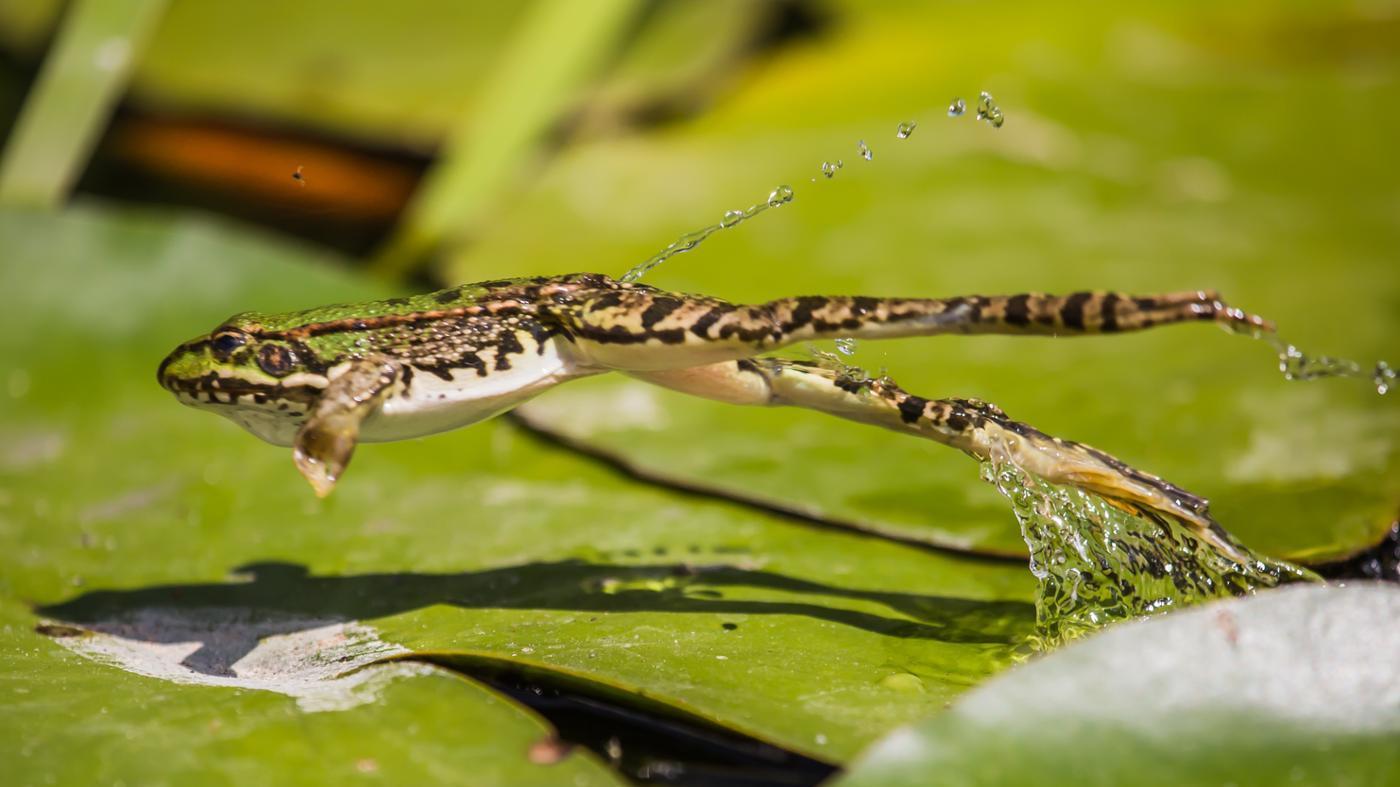
Frogs have webbed feet that help them to swim in water. Webbed feet in frogs are an example of a
a)
niche
b)
variation
c)
adaptation
d)
learned behavior
10.
Suppose an ecosystem changes. One
kind of organism CANNOT adapt to this change and they begin to die off faster
than they can reproduce. This organism is most likely to ___________.
a)
a. recover
b)
b. become angry hiding
c)
c. become extinct
d)
d. go into hiding
11.

characteristic or trait that helps an organism survive in its environment
a)
skills
b)
speciation
c)
natural instinct
d)
adaptation
12.

Farmers breed cows to produce high amounts of milk. This is an example of...
a)
Natural Selection
b)
Variations in a species
c)
Selective Breeding
13.

When an animal tries to look, sound, or act like
another animal to fool predators into thinking it is poisonous or dangerous,
this is called?
a)
camouflage
b)
hibernation
c)
migration
d)
mimicry
14.
A squirrel eats walnuts. Through natural selection only the thickest and strongest walnuts survive. What is the most reasonable adapation for the squirrel?
a)
Better eyesight
b)
Brighter colored fur
c)
Shorter claws
d)
larger/stronger teeth
15.
The flowers that produce the most scent get more insects to pollinate them. Which of the following is the most logical description of how natural selection will affect these flowers?
a)
The flowers with the most colorful petals will have more offspring
b)
The flowers with the strongest smell will have more offspring
c)
The flowers with the largest petals will reproduce more
d)
The flowers will go extinct
16.
Any inherited trait that gives an organism an advantage in its environment is called ___.
a)
a mutation
b)
an adaptation
c)
evolution
d)
natural selection
17.
Which of the following means "genetic change over time"
a)
natural selection
b)
speciation
c)
evolution
d)
fitness
18.

According to fossil records, the horses that lived 50 million years ago were much smaller, weaker, and slower than modern horses. Which process is most likely responsible for the changes that have led to the increased size, strength, and speed in horses?
a)
commensalism
b)
inbreeding
c)
migration
d)
natural selection
19.
Who is the father of evolution?
a)
Darwin
b)
Mendel
c)
Newton
d)
Einstein
20.
What is another name for natural selection?
a)
survival of the smartest
b)
survival of the fastest
c)
survival of the biggest
d)
survival of the fittest
Reset

