
 Worksheets
Socasatee Astronomy Unit Review
Total questions: 43
Worksheet time: 48mins
Name
Class
Date
1.
The spinning of an object on its axis is called______
a)
orbit
b)
rotation
c)
revolution
d)
tide
2.
Day and night is caused by the _____________ of earth.
a)
revolution
b)
orbit
c)
rotation
3.
The earth revolves around...
a)
The sun.
b)
the moon
c)
other planets
d)
the Milky Way
4.
The Earth's _______ is an imaginary line that goes from the North Pole to the South Pole.
a)
vernal equinox
b)
axis
c)
solar eclipse
d)
solar flare
5.
The Earth rotates ____ to _____. This causes the sun and stars to rise in the ____, appear to move across the sky,and set in the ____.
a)
west, east west, east
b)
east, west east, west
c)
west, east east, west
d)
east, west north, south
6.
The different shapes of the moon you see from Earth are called ________.
a)
lunar eclipse
b)
phases
c)
solar eclipse
d)
spring
7.
The cycle of the moon lasts about a _.
a)
day
b)
year
c)
week
d)
month
8.
Does the moon revolve?
a)
yes
b)
no
9.
Does the moon have an atmosphere?
a)
yes
b)
no
10.
What is at the center of the Solar System?
a)
Earth
b)
Moon
c)
Sun
d)
Jupiter
11.
When the Earth travels all the way around the Sun, it is called a . . .
a)
Day
b)
Rotation
c)
Year
d)
Spin
12.
It takes the Earth _______ days to travel all the way around the Sun.
a)
28
b)
100
c)
24
d)
365
13.
When the Earth spins around its own axis one whole time, it is called a ....
a)
Year
b)
Day
c)
Hemisphere
d)
Seasons
14.
It takes the Earth ___ hours to complete a rotation.
a)
12
b)
24
c)
50
d)
365
15.
The earth is the ___________ planet from the sun.
a)
1st
b)
2nd
c)
3rd
d)
4th
16.
The rotation of the Earth causes . . .
a)
day & night
b)
summer & winter
c)
fall & spring
d)
Leap Year
17.

What is the phase of this moon?
a)
Third Quarter
b)
Waning Crescent
c)
First Quarter
d)
Waning Gibbous
18.
Which of the following is a characteristic of both the Earth and the Moon?
a)
Atmosphere containing oxygen
b)
Rocky surface covered with landforms
c)
Flowing water in oceans and rivers
d)
Fossils and fossil fuels under the surface
19.
What is responsible for the moon's illumination?
a)
infrared rays
b)
sunlight reflecting on the surface of the moon
c)
sunlight bouncing off the earth's atmosphere
d)
gamma rays
20.
The sun appears to move across the sky each day. What causes this?
a)
the spinning of the Earth's axis
b)
The path of the sun around the Earth
c)
the production the nuclear energy around the sun
d)
the tilt of the Earth on its axis
21.
Seasons are a results of_______________.
a)
The Earth's rotation on its axis
b)
The tilt of the Earth on its axis and the revolution of Earth around the Sun.
c)
The moon blocking the sunlight from the Earth.
d)
The Earth's distance from the Sun.
22.
A group of stars.
a)
orbit
b)
galaxy
c)
constellation
d)
pretty
23.
A layer of gases that surrounds the Earth.
a)
atmosphere
b)
revolution
c)
orbit
d)
weather
24.
When would the shortest shadows be caused by the Sun?
a)
3am
b)
midnight
c)
noon
d)
3pm
25.
Where does the sun rise?
a)
North
b)
South
c)
East
d)
West
26.
Where does the sun set?
a)
North
b)
South
c)
East
d)
West
27.
Refers to the spinning of our planet on its axis. This takes 24 hours and is responsible for day and night.
a)
Rotation
b)
Revolution
c)
Shadow
d)
Axis
28.
The elliptical orbit of the Earth around the sun. It takes about 365 days to complete one orbit.
a)
Revolution
b)
Rotation
c)
Shadow
d)
Axis
29.
The star at the center of the solar system around which the Earth and other planets orbit.
a)
Sun
b)
Moon
c)
Jupiter
d)
Mars
30.
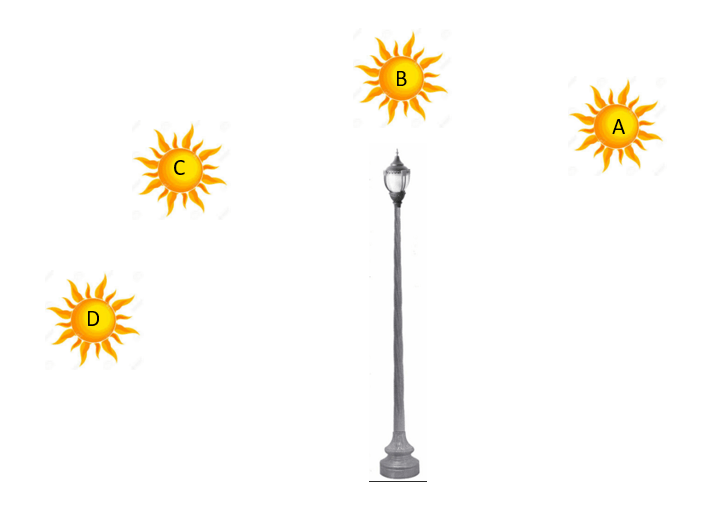
At which location of the sun would the shadow of the light pole be the longest?
a)
A at 11 a.m
b)
B at noon
c)
C at 2 p.m.
d)
D at 6 p.m.
31.
A shadow is the longest ________ .
a)
at midday
b)
in the morning
c)
in the evening
d)
in the morning and the evening
32.

What causes the seasons to change?
a)
The warming and cooling of Earth's core.
b)
The distance from the sun.
c)
Earth's tilt in relation to the sun.
d)
Earth's rotation on its axis.
33.
What is the order of the seasons?
a)
summer, winter, fall, spring
b)
fall, winter, spring, summer
c)
summer fall, spring, winter
d)
winter, summer, fall, spring
34.

What constellation is this?
a)
Orion
b)
Taurus
c)
Canis Major
d)
Gemini
35.

As the earth rotates on its axis, the constellations and stars in them appear to _________.
a)
move across the sky
b)
stand still in the sky
c)
move around each other
d)
rotate
36.

The stars we see in each constellation are very close to us.
a)
True
b)
False
37.

Near the poles, the stars appear to rotate in a circle in the sky and never set.
a)
True
b)
False
38.

People in the Northern Hemisphere see the same constellations as the people in the Southern Hemisphere.
a)
True
b)
False
39.

Ursa Major is also called “Great Bear” and is one of the largest constellations.
a)
True
b)
False
40.

Ursa Minor means “Little Bear” in Latin and is commonly known as the Big Dipper.
a)
True
b)
False
41.

Orion is visible during the winter night sky and is one of the most recognizable constellations – it contains some of the____stars that we can see and is named for the hunter from Greek mythology.
a)
biggest
b)
brightest
c)
smallest
d)
darkest
42.

A constellation is a group of visible ____ that form a pattern when viewed from Earth.
a)
planets
b)
stars
c)
patterns
d)
creatures
43.
The North Star (Polaris) is part of the constellation...
a)
Orion
b)
The Little Dipper (urea Minor)
c)
The Big Dipper (Ursa Major)
100 %

