
 Worksheets
Weathering, Erosion, and Deposition
Total questions: 32
Worksheet time: 1hrs 26mins
Name
Class
Date
1.
The process that breaks rock apart without changing their chemical composition.
a)
Chemical Weathering
b)
Physical Weathering
c)
Deposition
d)
Erosion
2.
The process that moves bits of rock or soil from one place to another.
a)
Chemical Weathering
b)
Physical Weathering
c)
Deposition
d)
Erosion
3.
Changes within the rock's minerals that break down bonds holding the rocks together.
a)
Chemical Weathering
b)
Physical Weathering
c)
Deposition
d)
Erosion
4.
The process in which sediments, soil, and rocks are added to a landform.
a)
Chemical Weathering
b)
Physical Weathering
c)
Deposition
d)
Erosion
5.
Chemical weathering is NOT caused by
a)
Abrasion
b)
Carbonation
c)
Hydrolysis
d)
Oxidation
6.
Physical weathering is caused by all of these EXCEPT
a)
Abrasion
b)
Burrowing
c)
Ice Wedging
d)
Oxidation
7.
What is the primary agent of erosion?
a)
Tornadoes
b)
Running Water
c)
Wind
d)
Gravity
8.
This is a form of chemical weathering that occurs when iron combines with oxygen to make rust.
a)
Carbonation
b)
Hydrolysis
c)
Oxidation
d)
Ice Wedging
9.
This is a form of chemical weathering that occurs when water softens minerals in a rock.
a)
Carbonation
b)
Hydrolysis
c)
Oxidation
d)
Ice Wedging
10.
This is a form of chemical weathering that occurs when carbon dioxide in rain water creates acid.
a)
Carbonation
b)
Hydrolysis
c)
Oxidation
d)
Ice Wedging
11.
The six types of physical (mechanical) weathering are abrasion, ice wedging, plant roots, burrowing, temperature changes, and gravity.
a)
True
b)
False
12.
Abrasion is a type of mechanical weathering that occurs when rapidly moving water, glaciers or wind break rocks apart.
a)
True
b)
False
13.
Plant roots growing into the cracks of rocks and breaking them apart is a type of ______________________.
a)
Chemical Weathering
b)
Physical Weathering
c)
Erosion
d)
Deposition
14.
This is a type of mechanical weathering that occurs from the repeated freezing and thawing of water within a crack of a rock.
a)
Abrasion
b)
Ice Wedging
c)
Burrowing
d)
Ice Roots
15.
What are the four types of erosion?
a)
Water, Wind, Ice and Gravity
b)
Water, Wind, Burrowing, and Plant Roots
c)
Ice, Glaciers, Rivers, and Mountains
d)
Wind, Gravity, Burrowing, and Abrasion
16.
Deposition creates which of the following features:
a)
Deltas
b)
Sandbars
c)
Sand Dunes
d)
All of the Above
17.
Deposition occurs when the forces moving sediments are no longer able to overcome the forces of __________________
a)
gravity and glaciers
b)
friction and wind
c)
ice and water
d)
gravity and friction
18.
As a river's velocity increases, the size of the particles it carries __________________.
a)
dissolves
b)
disappears
c)
decreases
d)
increases
19.
What are the three ages of rivers?
a)
young, mature, and old
b)
young, teenage, and adult
c)
young, adult, and elderly
d)
young, mature, and extinct
20.
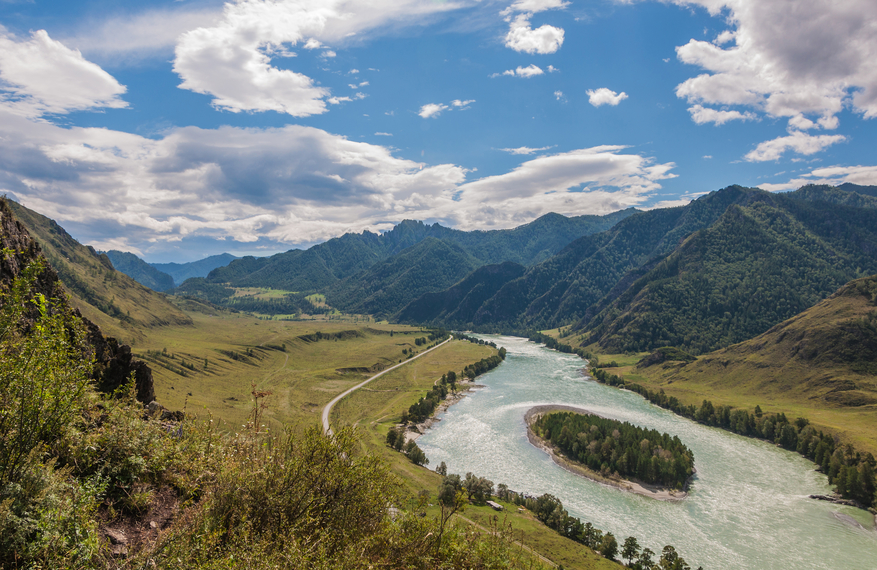
What is the age of this river?
a)
young
b)
mature
c)
old
21.

What is the age of this river?
a)
young
b)
mature
c)
old
22.

What is the age of this river?
a)
young
b)
mature
c)
old
23.
These rivers have less energy, sandbars, and slowly meander.
a)
Young Rivers
b)
Mature Rivers
c)
Adult Rivers
d)
Old Rivers
24.
These rivers are very slow and shallow, and they have large amounts of sediment, narrow channels, islands, and deltas.
a)
Young Rivers
b)
Mature Rivers
c)
Adult Rivers
d)
Old Rivers
25.
These rivers are fast-flowing and have V-shaped valleys, waterfalls, and rapids.
a)
Young Rivers
b)
Mature Rivers
c)
Adult Rivers
d)
Old Rivers
26.
What features are caused by abrasion from wind blown sand?
a)
Arches
b)
Sand dunes
c)
Mushroom rocks
d)
All of the Above
27.
Landslides, mud flows, and slumps/creeps are all features created by ________________.
a)
Wind
b)
Gravity
c)
Ice
d)
Water
28.
U-shaped valley, hanging valley, horn, moraine, cirque, and a tarn lake are examples of features causes by ______________.
a)
Glaciers
b)
Gravity
c)
Wind
d)
Water
29.
The western U.S. coastline has more ______________ features.
a)
Erosional
b)
Depositional
30.
The eastern U.S. coastline has more ______________ features.
a)
Erosional
b)
Depositional
31.
Which of the following are ways to conserve soil?
a)
Contour Plowing
b)
Conservation Plowing
c)
Crop Rotation
d)
All of the Above
32.
What is Earth's most valuable resource? This is loose, weathered material where plants grow.
a)
Water
b)
Soil
c)
Sunshine
d)
Trees
100 %

