
 Worksheets
7.07 - Natural Selection and Evolution
Total questions: 90
Worksheet time: 5hrs 37mins
Name
Class
Date
1.
Why are advantageous traits more likely to be passed on to offspring?
a)
Because they are more likely to survive and reproduce.
b)
Because they come from dominant alleles.
c)
Because they come from recessive alleles.
d)
Because the trait is an acquired phenotype.
2.
Mutations are a change in what?
a)
DNA
b)
tRNA
c)
genotype
d)
phenotype
3.
Any inherited trait that gives an organism an advantage in its environment is called ___.
a)
a mutation
b)
an adaptation
c)
evolution
d)
natural selection
4.
Almost all adaptations started off as?
a)
selective breeding
b)
physiological
c)
structural
d)
mutation
5.

Frogs and many other organisms reproduce by producing very large numbers of eggs. Why do frogs and other organism produce so many eggs or offspring?
a)
so that their babies can have friends to play with
b)
the more offspring the more likely the offspring will survive
c)
the more offspring the less likely offspring will survive
d)
the more offspring the less competition
6.
Which of the following means "genetic change over time"
a)
natural selection
b)
speciation
c)
evolution
d)
fitness
7.
A group of birds in an area eats many kinds of seeds. A disease kills all the plants in an area except for tall trees that produce hard seeds. Which of these traits will future generations of the birds most likely have?
a)
Webbed feet and strong wings
b)
Strong wings and strong beaks
c)
Strong beaks and webbed feet
d)
Showy feathers and Small beaks
8.
Why are advantageous traits more likely to be passed on to offspring?
a)
Because they are more likely to survive and reproduce.
b)
Because they come from dominant alleles.
c)
Because they come from recessive alleles.
d)
Because the trait is an acquired phenotype.
9.
A population of plants live in a field. The plants lose water through their leaves. Their stems store water. What will most likely happen if the environment becomes drier?
a)
Each plant will evolve thicker stems and smaller leaves
b)
After 1 generation, most of the plants will have very thin stems
c)
Plants with larger leaves will be more likely to pass on their traits to their offspring
d)
After several generations, most of the plants will have thicker stems and smaller leaves
10.

Which feature of a rose helps it grow without being eaten by large animals?
a)
flowers with bright colors
b)
sharp thorns
c)
small seeds
d)
deep roots
11.

Some organisms have colorful appearances to warn their predators (animals that would try to eat them) that they are harmful or do not taste good. If other species, that are not harmful, mimic these colors how would that help them reproduce?
a)
The bright colors would help them attract more mates and allow them to reproduce
b)
Because they have similar colors they can mate with the harmful species to create hybrids
c)
Bright colors help them be more visible in the dark and most mating occurs after dark
d)
The similar markings and colors will increase their chance of predators avoiding them and allow them to survive to reproduce
12.
Birds in a desert climate survive on soft parts of cactus. Scientists observed that during a drought, many of the birds died. The ones that survived had a mutation which resulted in them having larger beaks and were able to crack open and eat hard seeds that would ordinarily not be used. The next generation of birds all had large beaks. How did inherited traits help some birds survive?
a)
all surviving birds migrated to new areas and are no longer present
b)
inherited traits helped birds change foods which allowed them enough food to reproduce
c)
inherited traits helped camouflage birds from predators allowing them to reproduce
d)
the inherited traits changed the environment
13.

Many animals that live in the ocean. They are often dark blue colored above and white below. Why would this color pattern be a helpful inherited trait for the ocean environment?
a)
This color allows them to blend in and avoid being seen by prey so they get food and they can reproduce
b)
This color pattern has no effect on reproduction it is only for variation during the seasons
c)
Their white underbelly helps them absorb more light and heat from the sun helping them grow and reproduce
d)
White reflects sunlight allowing the organisms to see better in the ocean
14.

Some animals are born with a gene that causes hairlessness. Which of the following would be an example of how this is a beneficial mutation
a)
Higher rates of skin cancer in hairless animals.
b)
Animals that are hairless have better tolerance for heat
c)
Animals with no hair have more skin infections than those with hair
d)
animals with less hair are less able get food because they can't forage in cold weather
15.

Mutations cause changes to genes which results in changes in traits. These changes in traits can eventually create new species through the process of natural selection and evolution. Which of the following are ways you can describe mutations
a)
harmful
b)
beneficial
c)
nuetral
d)
ALL OF THESE
16.

Charles Darwin came up with this theory
a)
Natural Selection
b)
Mutation
17.

Darwin wrote that organisms with traits that are best suited to the environment will ________________
a)
increase in number
b)
become extinct
18.
Which term refers to the process by which individuals that are better suited to the environment survive and reproduce therefore passing down their genes to their offspring?
a)
Evolution
b)
Variation
c)
Adaptation
d)
Natural Selection
19.
The environment around Manchester, England, changed during the Industrial Revolution. How did this change affect peppered moths living in the area?
a)
Natural selection favored moths with dark wings because predators could not see them on the soot-colored trees.
b)
Natural selection favored moths with white wings that were easy for predators to see.
c)
Natural selection favored moths with white wings because predators could not see them on the soot-colored trees.
d)
Natural selection caused moths with white wings to become extinct.
20.
Which of the following is NOT an example of natural selection?
a)
People selectively breeding hamsters.
b)
Insect populations developing resistance to certain pesticides.
c)
Bacteria becoming resistant to antibiotics.
d)
Male birds of certain species developing colorful feathers to attract female mates.
21.
Which term refers to the process by which individuals that are better suited to the environment survive and reproduce therefore passing down their genes to their offspring?
a)
Evolution
b)
Variation
c)
Adaptation
d)
Natural Selection
22.

Which species’ DNA is most similar to the DNA of the toothed whale?
a)
Hippopotamus
b)
Baleen Whale
c)
Grazing Mammals
d)
Camels
23.
A remnant or trace of an organism from the past is called a _______.
a)
Ancestor
b)
Skeleton
c)
Fossil
d)
Imprints
24.
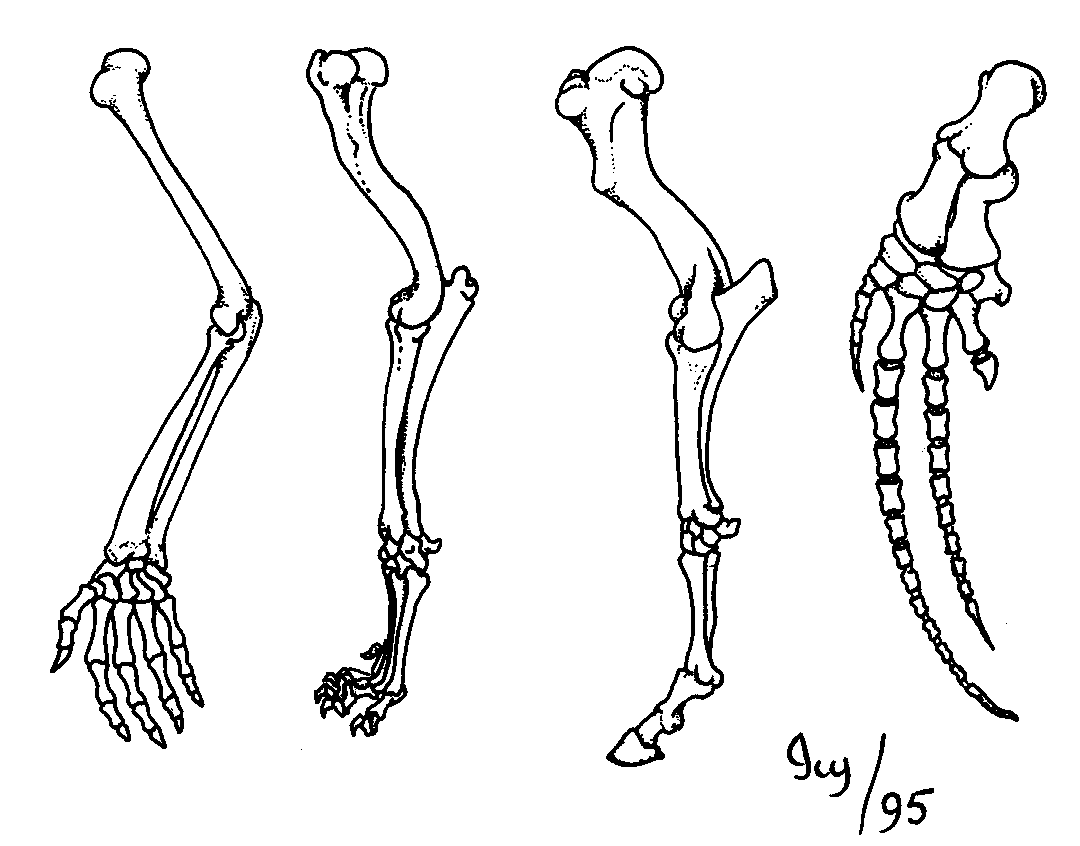
Structures with the same parts have different functions; suggests that organisms share a common ancestry
a)
vestigial structures
b)
homologous structures
c)
adaptive radiation
d)
fossil
25.
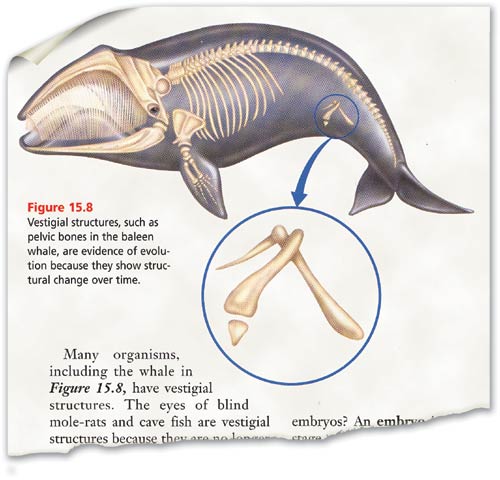
Which of the following is an example of a vestigial structure?
a)
the wings of a red-tailed hawk
b)
the hind limbs of a house cat
c)
the fins of sharks
d)
the tailbone of a human
26.

The diagram shows fossils in different rock layers. Which of these statements about the age of these fossils is most likely correct?
a)
Fossil A and C are the same age
b)
Fossil B is older than fossil C
c)
Fossils A is older than fossil B
d)
Fossil D is older than fossil C
27.

According to the diagram, which organism is older: the ammonite or the coral?
a)
ammonite
b)
coral
28.

According to fossil records, the horses that lived 50 million years ago were much smaller, weaker, and slower than modern horses. Which process is most likely responsible for the changes that have led to the increased size, strength, and speed in horses?
a)
commensalism
b)
inbreeding
c)
migration
d)
natural selection
29.
The similarities in the development of different embryo’s provides which evidence of evolution?
a)
evidence of similar structures
b)
evidence of common ancestors
c)
evidence of similar functions
d)
all options are correct
30.
Finding fossil remains of organisms that no longer exist today was early evidence of...
a)
… the fact that species change over time
b)
… the fact that climate and geology change over time
c)
...evidence that natural laws operate in the past the same as today
d)
all are correct
31.
Charles Darwin came up with this theory
a)
Natural Selection
b)
Mutation
32.
Darwin wrote that organisms with traits that are best suited to the environment will ________________
a)
increase in number
b)
become extinct
33.
Which term refers to the process by which individuals that are better suited to the environment survive and reproduce therefore passing down their genes to their offspring?
a)
Evolution
b)
Variation
c)
Adaptation
d)
Natural Selection
34.
The environment around Manchester, England, changed during the Industrial Revolution. How did this change affect peppered moths living in the area?
a)
Natural selection favored moths with dark wings because predators could not see them on the soot-colored trees.
b)
Natural selection favored moths with white wings that were easy for predators to see.
c)
Natural selection favored moths with white wings because predators could not see them on the soot-colored trees.
d)
Natural selection caused moths with white wings to become extinct.
35.
Which of the following is NOT an example of natural selection?
a)
People selectively breeding hamsters.
b)
Insect populations developing resistance to certain pesticides.
c)
Bacteria becoming resistant to antibiotics.
d)
Male birds of certain species developing colorful feathers to attract female mates.
36.
Which term refers to the process by which individuals that are better suited to the environment survive and reproduce therefore passing down their genes to their offspring?
a)
Evolution
b)
Variation
c)
Adaptation
d)
Natural Selection
37.
Which species’ DNA is most similar to the DNA of the toothed whale?
a)
Hippopotamus
b)
Baleen Whale
c)
Grazing Mammals
d)
Camels
38.
A remnant or trace of an organism from the past is called a _______.
a)
Ancestor
b)
Skeleton
c)
Fossil
d)
Imprints
39.
Structures with the same parts have different functions; suggests that organisms share a common ancestry
a)
vestigial structures
b)
homologous structures
c)
adaptive radiation
d)
fossil
40.
Which of the following is an example of a vestigial structure?
a)
the wings of a red-tailed hawk
b)
the hind limbs of a house cat
c)
the fins of sharks
d)
the tailbone of a human
41.
The diagram shows fossils in different rock layers. Which of these statements about the age of these fossils is most likely correct?
a)
Fossil A and C are the same age
b)
Fossil B is older than fossil C
c)
Fossils A is older than fossil B
d)
Fossil D is older than fossil C
42.
According to the diagram, which organism is older: the ammonite or the coral?
a)
ammonite
b)
coral
43.
According to fossil records, the horses that lived 50 million years ago were much smaller, weaker, and slower than modern horses. Which process is most likely responsible for the changes that have led to the increased size, strength, and speed in horses?
a)
commensalism
b)
inbreeding
c)
migration
d)
natural selection
44.
The similarities in the development of different embryo’s provides which evidence of evolution?
a)
evidence of similar structures
b)
evidence of common ancestors
c)
evidence of similar functions
d)
all options are correct
45.
Finding fossil remains of organisms that no longer exist today was early evidence of...
a)
… the fact that species change over time
b)
… the fact that climate and geology change over time
c)
...evidence that natural laws operate in the past the same as today
d)
all are correct
46.
The gradual change over time is called..
a)
Mutation
b)
Evolution
c)
Variation
d)
Adaptation
47.
Almost all adaptations started off as?
a)
selective breeding
b)
physiological
c)
structural
d)
mutation
48.
Any inherited trait that gives an organism an advantage in its environment is called ___.
a)
a mutation
b)
an adaptation
c)
evolution
d)
natural selection
49.
A group of birds in an area eats many kinds of seeds. A disease kills all the plants in an area except for tall trees that produce hard seeds. Which of these traits will future generations of the birds most likely have?
a)
Webbed feet and strong wings
b)
Strong wings and strong beaks
c)
Strong beaks and webbed feet
d)
Showy feathers and Small beaks
50.
Birds in a desert climate survive on soft parts of cactus. Scientists observed that during a drought, many of the birds died. The ones that survived had a mutation which resulted in them having larger beaks and were able to crack open and eat hard seeds that would ordinarily not be used. The next generation of birds all had large beaks. How did inherited traits help some birds survive?
a)
all surviving birds migrated to new areas and are no longer present
b)
inherited traits helped birds change foods which allowed them enough food to reproduce
c)
inherited traits helped camouflage birds from predators allowing them to reproduce
d)
the inherited traits changed the environment
51.
Many animals that live in the ocean. They are often dark blue colored above and white below. Why would this color pattern be a helpful inherited trait for the ocean environment?
a)
This color allows them to blend in and avoid being seen by prey so they get food and they can reproduce
b)
This color pattern has no effect on reproduction it is only for variation during the seasons
c)
Their white underbelly helps them absorb more light and heat from the sun helping them grow and reproduce
d)
White reflects sunlight allowing the organisms to see better in the ocean
52.
Some animals are born with a gene that causes hairlessness. Which of the following would be an example of how this is a beneficial mutation
a)
Higher rates of skin cancer in hairless animals.
b)
Animals that are hairless have better tolerance for heat
c)
Animals with no hair have more skin infections than those with hair
d)
animals with less hair are less able get food because they can't forage in cold weather
53.
Mutations cause changes to genes which results in changes in traits. These changes in traits can eventually create new species through the process of natural selection and evolution. Which of the following are ways you can describe mutations
a)
harmful
b)
beneficial
c)
nuetral
d)
ALL OF THESE
54.
Which of the following means "genetic change over time"
a)
natural selection
b)
speciation
c)
evolution
d)
fitness
55.
Which feature of a rose helps it grow without being eaten by large animals?
a)
flowers with bright colors
b)
sharp thorns
c)
small seeds
d)
deep roots
56.
Some organisms have colorful appearances to warn their predators (animals that would try to eat them) that they are harmful or do not taste good. If other species, that are not harmful, mimic these colors how would that help them reproduce?
a)
The bright colors would help them attract more mates and allow them to reproduce
b)
Because they have similar colors they can mate with the harmful species to create hybrids
c)
Bright colors help them be more visible in the dark and most mating occurs after dark
d)
The similar markings and colors will increase their chance of predators avoiding them and allow them to survive to reproduce
57.
Why are advantageous traits more likely to be passed on to offspring?
a)
Because they are more likely to survive and reproduce.
b)
Because they come from dominant alleles.
c)
Because they come from recessive alleles.
d)
Because the trait is an acquired phenotype.
58.
Mutations are a change in what?
a)
DNA
b)
tRNA
c)
genotype
d)
phenotype
59.
Frogs and many other organisms reproduce by producing very large numbers of eggs. Why do frogs and other organism produce so many eggs or offspring?
a)
so that their babies can have friends to play with
b)
the more offspring the more likely the offspring will survive
c)
the more offspring the less likely offspring will survive
d)
the more offspring the less competition
60.
Why are advantageous traits more likely to be passed on to offspring?
a)
Because they are more likely to survive and reproduce.
b)
Because they come from dominant alleles.
c)
Because they come from recessive alleles.
d)
Because the trait is an acquired phenotype.
61.
A population of plants live in a field. The plants lose water through their leaves. Their stems store water. What will most likely happen if the environment becomes drier?
a)
Each plant will evolve thicker stems and smaller leaves
b)
After 1 generation, most of the plants will have very thin stems
c)
Plants with larger leaves will be more likely to pass on their traits to their offspring
d)
After several generations, most of the plants will have thicker stems and smaller leaves
62.
Structures with the same parts have different functions; suggests that organisms share a common ancestry
a)
vestigial structures
b)
homologous structures
c)
adaptive radiation
d)
fossil
63.

If an organism has a vestigial structure, that structure likely once had a function in a(n)
a)
close relative
b)
early ancestor
c)
unrelated organism
d)
embryological stage
64.
The process by which populations slowly change over time is called__________
a)
selective breeding
b)
adaptation
c)
sepeciation
d)
evolution
65.

Some organisms that share a common ancestor have features that have different functions, but similar structures. These are known as
a)
vestigial structures
b)
analogous structures
c)
homologous structures
d)
fossil structures
66.

Study of embryos of various organisms to show a common ancestor because of similarities in development
a)
natural selection
b)
embryology
c)
speciation
d)
evolution
67.
Which of the following is an example of a vestigial structure?
a)
the wings of a red-tailed hawk
b)
the hind limbs of a house cat
c)
the fins of sharks
d)
the tailbone of a human
68.

What type of structures are these?
a)
homologous
b)
vestigial
c)
analogous
d)
fossil
69.
Structures that have the same function but different structures are...
a)
homologous structures
b)
analogous structures
c)
vestigial structures
d)
embryology
70.

Two organisms that are closely related would have
a)
very similar DNA sequence
b)
exactly the same DNA sequences
c)
no proteins in common
d)
completely different DNA sequence
71.

Which layer is the oldest
a)
B
b)
A
c)
E
d)
C
72.
The diagram shows fossils in different rock layers. Which of these statements about the age of these fossils is most likely correct?
a)
Fossil A and C are the same age
b)
Fossil B is older than fossil C
c)
Fossils A is older than fossil B
d)
Fossil D is older than fossil C
73.
If two organisms have similar traits of DNA they are probably
a)
share a common ancestor
b)
share a common environment
c)
share a common population
d)
speciation
74.
What does Darwin's theory of evolution suggest?
a)
species change over time
b)
extinct species are not related to living species
c)
different species can interbreed
d)
animals that look alike are most closely related
75.

Which best describes these fossils?
a)
The oldest fossils can be found on the lower layers
b)
The oldest fossils can be found at the top layers
c)
The youngest fossils are always found on the bottom layers
d)
You can not tell the age of any of these fossils
76.
Whales are aquatic mammals that contain a pelvis bone. Even though it does not aid in its movement, the function must have been used by a common ancestor of the whale. Thus, the pelvis is referred to as a(n)
a)
vestigial structure
b)
analogous structure
c)
homologous structure
77.
If species A and B have very similar genes and proteins, what is probably TRUE?
a)
species A and B share a relatively recent common ancestor
b)
species A evolved independently of species B for a long period
c)
species A is younger than species B
d)
species A is older than species B
78.
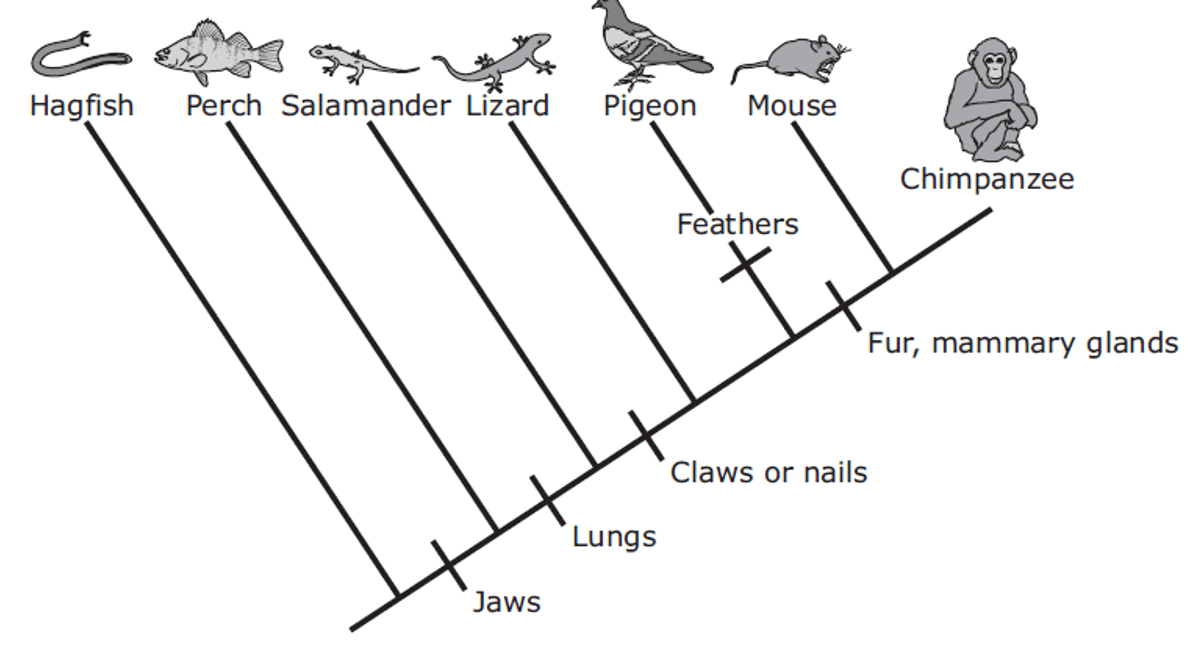
All the animals to the right of the hagfish would have the common characteristic of -
a)
Fur
b)
Claws or nails
c)
Lungs
d)
Jaws
79.

According to this cladogram, birds are LEAST related to -
a)
Amphibians
b)
Sharks
c)
Ray Finned Fish
d)
Crocodiles
80.
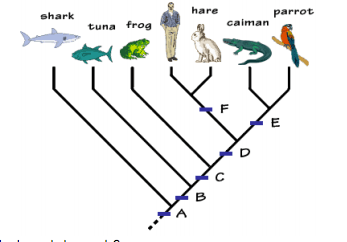
On the cladogram, which organism is the closest relative of the human?
a)
Frog
b)
Hare
c)
Caiman
d)
Parrot
81.

Individuals that are well adapted to their environment will survive and produce:
a)
Fewer mutations
b)
Stronger genes
c)
More offspring
d)
Better traits
82.

Which trait do only humans have, according to the cladogram?
a)
jaws
b)
mammary glands & hair
c)
terrestrial during all life stages
d)
opposable thumbs
83.

According to the cladogram, which organism is most distantly related to the human?
a)
crayfish
b)
rat
c)
perch
d)
frog
84.
According to the diagram, which organism is older: the ammonite or the coral?
a)
ammonite
b)
coral
85.

According to the diagram, which bird has the most similar DNA to a large tree finch?
a)
small tree finch
b)
medium tree finch
c)
large ground finch
d)
green warbler finch
86.

On this map there are many different geographical barriers, which could be mountains, rivers, or oceans. Animals that do not have a barrier between them have more similarities, which set shows that common ancestry existed?
a)
1 and 2
b)
3 and 4
c)
7 and 8
87.

If an organism has a vestigial structure, that structure likely once had a function in a(n)
a)
close relative
b)
early ancestor
c)
unrelated organism
d)
embryological stage
88.
Which of the following pieces of evolution evidence contain both homologous and vestigial structures?
a)
fossil record
b)
comparing embryology
c)
comparing biochemistry
d)
comparing anatomy
89.
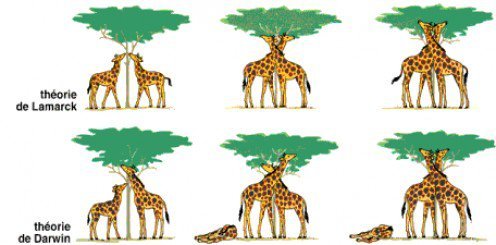
What would happen if the Giraffes never evolve?
a)
they would survive
b)
They would thrive
c)
They would become extinct
d)
They will find another source of food
90.
Study of embryos of various organisms to show a common ancestor because of similarities in development
a)
natural selection
b)
embryology
c)
speciation
d)
evolution
100 %

