
 Worksheets
Earth Science Semester 1 review
Total questions: 41
Worksheet time: 29mins
Name
Class
Date
1.
materials in the environment that are useful to people
a)
fossil fuels
b)
natural resources
c)
renewable resources
d)
biofuels
2.
fuels formed from decaying remains of plants and animals that lived millions of years go
a)
conservation
b)
hydroelectric power
c)
nonrenewable resources
d)
fossil fuels
3.
natural resources that nature can produce again, such as tress, plants, animals, water, oxygen, and soil
a)
renewable resources
b)
nonrenewable resources
c)
alternative energy source
d)
geothermal energy
4.
natural resources, such as fossil fuels, that will eventually be used up and can never be replalced
a)
renewable resource
b)
biofuels
c)
hydroelectric energy
d)
nonrenewable resources
5.
hydroelectric energy
a)
heat energy naturally produced within Earth
b)
fuels made from organic matter
c)
electricity made from the energy of moving watetr in a dam
d)
sources of energy that do not come from fossil fuels
6.
geothermal energy
a)
sources of energy that do not come from fossil fuels
b)
fuels made from organic matter
c)
electricity made from the energy of moving water in a dam
d)
heat energy naturally produced with Earth
7.
How are Sedimentary Rocks formed?
a)
Cooling and Hardening
b)
Heat and Pressure
c)
Compacting and Cementing
d)
Melting
8.
What are the 3 main fossil fuels?
a)
Coal, Oil, and Gasoline
b)
Coal, Oil, and Natural Gas
c)
Electricity, Gasoline, Petroleum
d)
Coal, Oil, Non-renewable Resources
9.
Some students made a model to show one of the first steps in the formation of sedimentary rock. The students pour 2 cm of light-colored sand into a clear plastic box. Then they add 1 cm of gravel. Finally, they pour 2 cm of dark-colored sand on top of the gravel. Which characteristic of sedimentary rock does this model best show?
a)
Sedimentary rock is made of layers.
b)
Sedimentary rock is cemented bits of rock.
c)
Sedimentary rock is often limestone.
d)
Sedimentary rock is common in Texas.
10.
Coal often forms where once there was swamps. What characteristic of swamps is important to the formation of coal?
a)
High Temperature
b)
Abundant Plant Life
c)
Frequent Rains
d)
Reptile Predators
11.

Which layer formed first?
a)
Rock Layer W
b)
Rock Layer X
c)
Rock Layer Y
d)
Rock Layer Z
12.
Sedimentary rocks form when broken bits of other rock are deposited and then -
a)
buried and squeezed and cemented together
b)
melted by the heat of the Earth's core
c)
completely dissolved in the salt water of the ocean
d)
used by humans as a natural resource
13.
What is a problem that is linked to the burning of fossil fuels?
a)
Global Warming
b)
geothermal energy
c)
solar power panels
d)
none of the above
14.
What is biomass?
a)
energy from the sun
b)
energy from water
c)
energy from wind
d)
energy from plant and animal waste
15.
“gluing” or sticking of sediments together
a)
cementation
b)
compaction
c)
fossil
d)
sedimentary rock
16.
The careful use of a resource is....
a)
recycling
b)
pollution
c)
depositing
d)
conservation
17.
The energy resource that is most affected by change in weather is_____________?
a)
geothermal
b)
wind
c)
nuclear
d)
natural gas
18.
The cleanest burning fossil fuel is ______.
a)
coal
b)
oil
c)
wind
d)
natural gas
19.
What are two advantages of geothermal energy?
a)
cheap and a lot pollution
b)
expensive and a lot of pollution
c)
cheap and little pollution
d)
expensive and little pollution
20.
What is a disadvantage to Hydroelectricity?
a)
lots and lots of pollution
b)
Kills wild bird population
c)
Radioactive waste
d)
Increases potential for flooding
21.
If a business is considered to be "green", how could you add to the electrical power system?
a)
use hydroelectricity
b)
add solar panels to roof
c)
use nuclear power
d)
use a coal powered generator
22.
If a river is located in a deep canyon, and has changing amounts of water , how can this be developed as an energy source?
a)
A dam could be built to store water
b)
A well could be dug to hold the water
c)
Wind turbines could be built on the banks.
d)
You could fish in the river.
23.
The color of a mineral in powder form is called the mineral's
a)
hardness
b)
specific gravity
c)
luster
d)
streak
24.
How light reflects off of a mineral is called the mineral's
a)
luster
b)
streak
c)
cleavage
d)
fracture
25.
Why is coal not a mineral?
a)
It's not a solid
b)
It is man-made
c)
It is not inorganic
d)
It is made of carbon
26.

The following image shows what mineral property?
a)
Hardness
b)
Streak
c)
Cleavage
d)
Density
27.
Dull, silky, waxy, pearly, and earthy are terms that best describe which property of minerals?
a)
luster
b)
color
c)
streak
d)
cleavage
28.

By definition, a mineral has which of the following characteristic(s)?
a)
definite chemical composition
b)
crystal structure
c)
naturally occuring
d)
all of the above
29.
How do you test the hardness of a mineral?
a)
Throw it against a wall
b)
Step on it
c)
Scratch Test
d)
Kick it until it breaks
30.
What mineral is the softest mineral on Moh's Hardness Scale and the main ingredient in baby powder?
a)
feldspar
b)
talc
c)
gypsum
d)
kaolinite
31.
Large crystals are going to form
a)
when lava erupts from a volcano
b)
when a shallow sea evaporates
c)
when magma underground cools off
d)
all of the above
32.
A rock containing iron is soft, crumbly, reddish in color. It's been chemically weathered by__.
a)
Carbon Dioxide
b)
Oxygen
c)
Nitrogen
d)
Sulfer
33.
Soil formation begins with the weathering of_______.
a)
Humas
b)
Subsoil
c)
Litter
d)
Rock
34.
The layer of soil which the topsoil is found.
a)
Horizon A
b)
Horizon B
c)
Horizon C
d)
Horizon D or R
35.
The MAIN thing Decomposers do for the the soil is the following:
a)
Store moisture
b)
Burrow deep in the soil
c)
Make space for air and water
d)
Break down and digest dead organisms
36.
Decayed organic material in soil is called______.
a)
Litter
b)
Silt
c)
Humus
d)
Clay
37.
The two main factors that determine the rate of weathering are the TYPE of rock and_____.
a)
Music
b)
Climate
c)
Size of rock
d)
Weight of rock
38.
Soil conservation includes all of the following EXCEPT_______.
a)
Desertification
b)
Contour plowing
c)
Terracing
d)
Crop rotation
39.
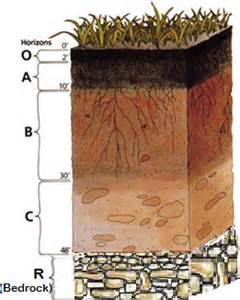
In which horizon is most of the HUMUS?
a)
Horizon A
b)
Horizon B
c)
Horizon C
d)
Horizon D or R
40.
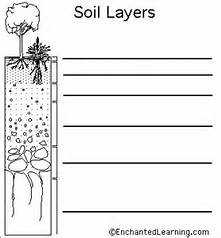
Which horizon contains clay, silt, minerals, and a little humus?
a)
Horizon A
b)
Horizon B
c)
Horizon C
d)
Horizon D or R
41.
In which horizon is the Bedrock
a)
Horizon A
b)
Horizon B
c)
Horizon C
d)
Horizon D or R
100 %

