
 Worksheets
Semester Exam Review 2017
Total questions: 20
Worksheet time: 10mins
Name
Class
Date
1.

Which of the following civilizations were influenced by the Chinese system of writing and/ or grammar?
a)
Korea, Vietnam, and Japan
b)
Korea, Taiwan, and Vietnam
c)
Vietnam, Japan, and Siam
d)
Korea, Vietnam, and Tibet
2.

Which civilization was the MOST responsible for the preservation of ancient Greek philosophy and ideas?
a)
The Byzantine Empire
b)
The Islamic Caliphates
c)
The Coptic Christians
d)
The Safavid Dynasty
3.

Which of the following is NOT a good method to use to trace the Bantu Migrations?
a)
Archaeological evidence of iron-making technology
b)
Evidence of the spread of yam cultivation
c)
Evidence of the diffusion of the Bantu language family
d)
Cultural evidence of the spread of Islam into Sub-Saharan Afria
4.

What are the characteristics of a universalizing religion?
a)
All religious ideas are accepted as equally valid.
b)
The religion is widely practiced on multiple continents.
c)
The religion views all as equal in the eyes of their god(s).
d)
The religion requires absolute adherence to Universal Laws of Morality.
5.
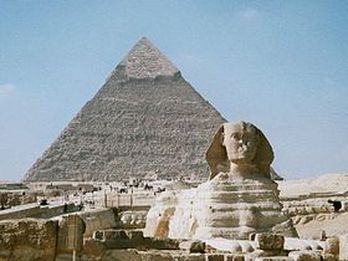
Which of the following was NOT a reason civilizations devoted resources to the building of monumental architecture?
a)
They wanted to improve and further their use of technology.
b)
They wanted to prove the legitimacy of their power.
c)
They wanted to showcase the splendor of their civilization.
d)
They wanted to leave permanent evidence of their grandeur.
6.

What is the PRIMARY significance of the Code of Hammurabi to a social historian?
a)
It reveals the origins of the concept "An eye for an eye," a very common concept in early legal systems.
b)
It reveals the relative gender equality that could be found in Mesopotamia.
c)
It gives insight into the value religion played in the Babylonian government.
d)
It can be used to compare the relative social status of different classes in the ancient world.
7.

Which of the following outside influences had the GREATEST impact on China in the post-classical era?
a)
Wealth from Japanese silver
b)
Buddhist religious ideas
c)
Korean social structure
d)
Vietnamese rice strains
8.

What was a major cause of the weakening of the Byzantine Empire in the 7th century CE?
a)
The widespread destruction caused by the sacking of Constantinople in the Third Crusade
b)
The initial wave of Muslim conquest following the death of Muhammad.
c)
The Chariot Riots between the Blues and the Whites.
d)
The lack of a clear line of succession after the death of Justinian.
9.

Which of the following factors was a major DIFFERENCE between the Persian method of empire building and that used by the Mongols?
a)
Allowing religious tolerance among their conquered peoples.
b)
Having a sophisticated message delivery system to quell possible rebellions.
c)
Building roads to allow for easier trade and travel by their armies.
d)
Allowing conquered people to achieve high status in their empires if those people swore to be loyal.
10.

What was the primary contribution made by the Mongols to Post-Classical civilizations?
a)
By promoting local scholars to positions of power, literacy was preserved throughout their empire.
b)
By emphasizing religious tolerance, they ushered in an era of peace and prosperity throughout much of Eurasia.
c)
Through the use of the Yam system, they were able to govern all of their provinces efficiently and fairly.
d)
By emphasizing the importance of revenue and taxation, they fostered large, safe trade networks.
11.

Which of the following factors contributed the most to the success of the Mongol Empires of Genghis Khan and his immediate successors?
a)
The hybrid civilization that they created and spread throughout their empire.
b)
Their ability to build an extensive alliance system uniting all of the Khanates.
c)
The union of nomadic peoples of central Eurasia with the agricultural civilizations outer Eurasia.
d)
The synergistic melding of Chinese, Russian, and Mongol technology on the battlefield.
12.

Which of the following is NOT an attribute of ancient China that was seen in ancient Egypt?
a)
Being led by powerful dynasties that claimed to derive their power from the Gods.
b)
Giving high status to educated and trained governmental workers.
c)
Having a belief that the Gods withdrew their favor from rulers, at times.
d)
Giving high social status to priests and clerics.
13.

During which era in human history might one find societies dominated mostly by the need for mobility and pastoral agriculture?
a)
Between 600 BCE and 600 CE
b)
Between 1000 BCE and 600 BCE
c)
Between 600 CE and 1000 CE
d)
Between 600 CE and 1450 CE
14.

Which of the following aspects of Indian society made the creation of a strong, Imperial-style government more difficult than many other Classical civilizations?
a)
Their vast economic power and rich agricultural lands
b)
Their diverse cultural and geographic heritage
c)
Their widely practiced religion with its emphasis on reincarnation
d)
Their large population and relative gender equality.
15.
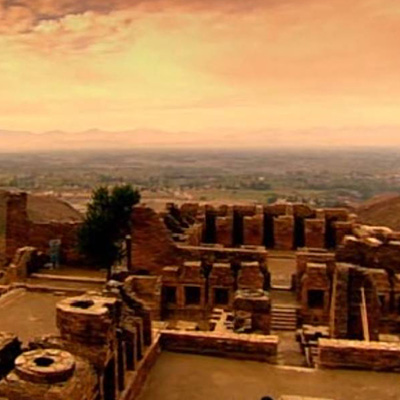
What conclusion CANNOT be drawn from the use of a grid-system of city planning and uniform building materials in Harappan civilizations?
a)
Harappans had an organized governmental structure.
b)
Harappan civilizations were relatively peaceful compred to other RVCs.
c)
The Harappan civilization understood mathematical and geometric concepts.
d)
Harappan city states used a centralized governmental structure.
16.

Which of the following cultural advances is correctly linked with its most probable cause?
a)
Agricultural surpluses led to specialization of labor.
b)
The development of writing led to organized governments.
c)
The development of textile weaving led to trade with pastoral nomads.
d)
The use of patriarchal social structures led to a more egalitarian division of labor.
17.

Which of the following civilizations used the building of infrastructure, such as roads and sewers, to integrate conquered peoples and suppress rebellions?
a)
Harappan
b)
Persian
c)
Mongolian
d)
Roman
18.

Which of the following was used by the Chinese to improve their centralized bureaucracies?
a)
They promoted only the most experienced workers to high positions, selecting sons of nobles whenever possible.
b)
They moved bureaucrats from proivince to province to aviod corruption when dealing with family members.
c)
The used a system of checks and balances to spy on bureaucrats to ensure their honesty.
d)
They used a robust education and testing system, allowing people from all social classes to advance on merit.
19.

Which of the following Chinese philosophies ascribed high standing to farmers as necessary to the maintenance of a strong government?
a)
Legalists
b)
Confucianists
c)
Daoists
d)
Shintoists
20.

Which of the following is NOT a universalizing religion?
a)
Islam
b)
Zoroastrianism
c)
Christianity
d)
Buddhism
100 %

