
 Worksheets
Neuromuscular Junction & Sliding Filament Theory
Total questions: 26
Worksheet time: 19mins
Name
Class
Date
1.
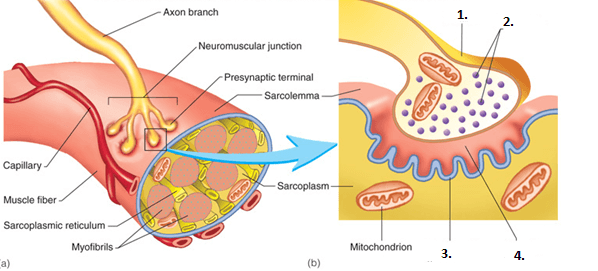
The gap between a neuron and a muscle cell: (#4 in the diagram)
a)
synaptic cleft
b)
sarcolemma
c)
vesicle
d)
Ca2+ ion
2.
A bundle of fascicles best describes a
a)
muscle fiber
b)
muscle tissue
c)
myofibril
d)
tendon
3.
What layer of connective tissue covers the muscle fiber?
a)
epimysium
b)
endomysium
c)
perimysium
4.
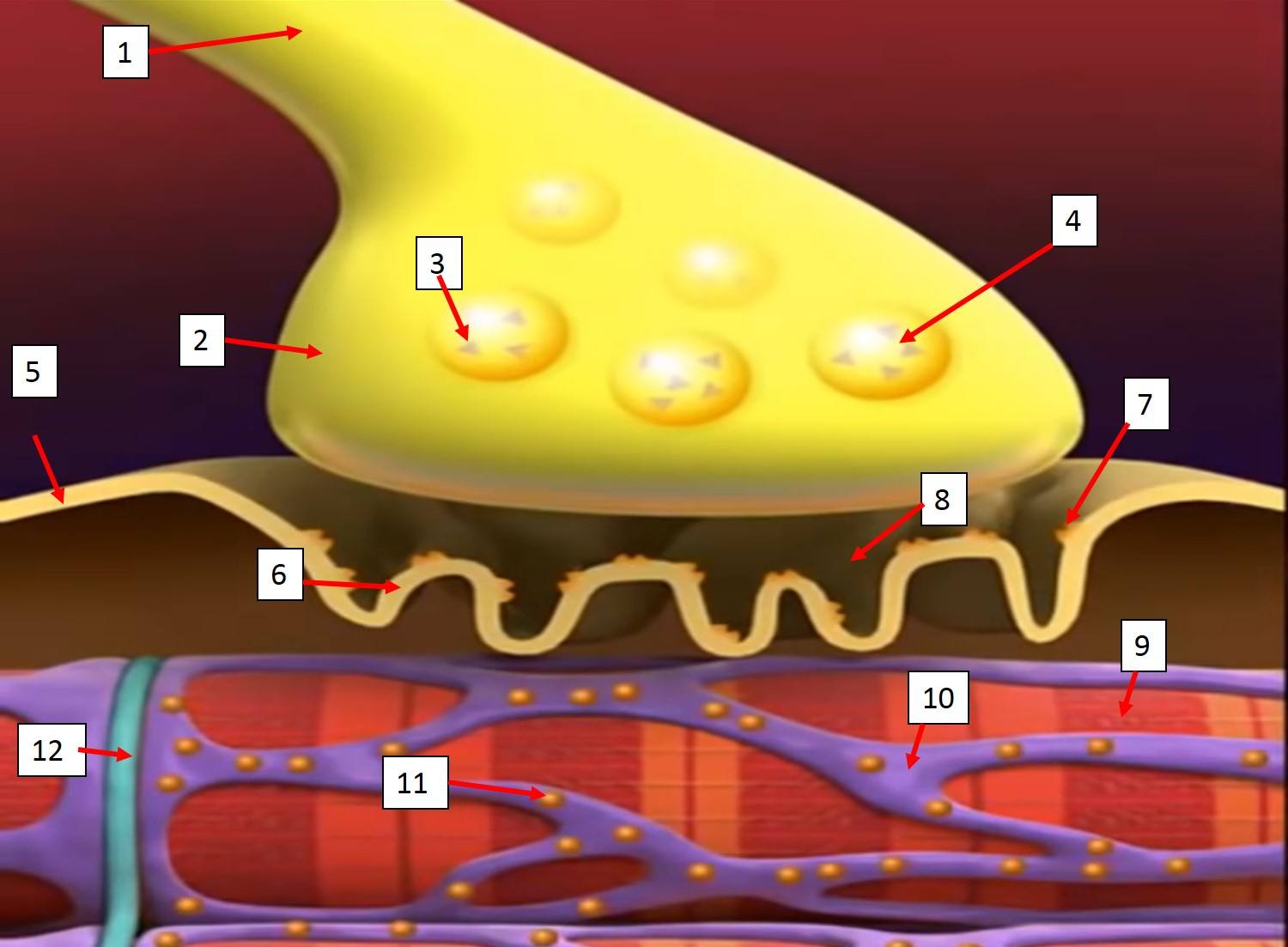
The neurotransmitter stored in the axon terminal identified as #3
a)
Acetylcholine
b)
Protein Channel
c)
Calcium Ion (Ca2+)
d)
Syanptic Cleft
5.
The organelle that stores ACh in the axon is identified as #4
a)
Motor Neuron
b)
Axon Terminal of Motor Neuron
c)
Sarcolemma
d)
Vesicle
6.
The specialized part of the cell membrane of the muscle fiber identified as #5
a)
Sodium ion (Na+)
b)
Axon Terminal of Motor Neuron
c)
motor end plate
d)
Vesicle
7.
The organelle containing actin and myosin identified as #9
a)
ACh
b)
Sarcolemma
c)
Vesicle
d)
Myofibril
8.
This is a neurotransmitter used to create a muscle impulse
a)
Acetylcholine
b)
Calcium Ions (Ca2+)
c)
Sodium Ions (Na+)
d)
Protein Channels
9.
Muscles are attached to bones by _____.
a)
Ligaments
b)
Tendons
c)
Cartilage
d)
Axons
10.
The organelle that contains actin and myosin.
a)
Tendon
b)
myofilament
c)
myofibril
d)
Fiber
11.
Another name for a muscle cell.
a)
Fiber
b)
Sacrolemma
c)
Sacromere
d)
Fascicle
12.
Contractile unit of a muscle.
a)
sarcomere
b)
motor unit
c)
fascicle
d)
myofibril
13.
A bundle of muscle cells.
a)
sarcomere
b)
fiber
c)
fascicle
d)
Tendon
14.
Ribbon like organelle found in muscle cells that have a banded appearance
a)
sarcomere
b)
myofibril
c)
fascicle
d)
actin
15.
Thick filaments are in a myofibril are
a)
ATPase
b)
Sarcoplasmic reticulum
c)
Actin
d)
Myosin
16.
Thin filaments in a myofibril are
a)
Sarcomeres
b)
Sarcoplasm
c)
Actin
d)
Myosin
17.

The plasma membrane of a skeletal muscle cell is called the:
a)
sarcomere
b)
myofilament
c)
sarcolemma
d)
sarcoplasm
18.
The functional unit of the muscle cell is the:
a)
Sarcomere
b)
Osteon
c)
Myofilament
d)
Muscle fiber
19.
What two chemicals are necessary for muscle contraction to occur?
a)
Niacin and Potassium
b)
Calcium and ATP
c)
Sodium and Potassium
d)
Ach and Potassium
20.
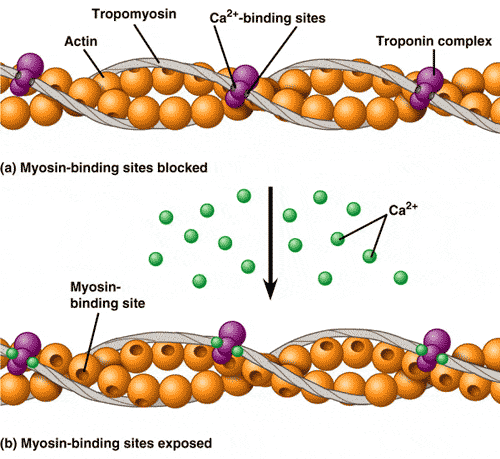
Calcium:
a)
causes ATP binding to actin
b)
increases the action potential along the sarcolemma
c)
binds to proteins on myosin
d)
triggers the binding of myosin to actin
21.
What is a crossbridge?
a)
Where myosin binds to actin
b)
Where the calcium crosses into the cytoplasm
c)
Where calcium binds with troponin
d)
None of the answers are correct.
22.
A muscle contraction that does not appear to relax and is sustained by continuous stimulation.
a)
Unfused Tetanus
b)
Fused Tetanus
c)
Twitch
23.
The energy needed to perform a muscle contraction comes directly from
a)
ATP
b)
Oxygen
c)
Glucose
d)
Calcium
24.
Cellular respiration that occurs without oxygen present is called
a)
aerobic
b)
anaerobic
c)
isotonic
d)
isometric
25.
Anaerobic respiration results in "oxygen debt" in the form of ________.
a)
ATP
b)
lactic acid
c)
pyruvic acid
d)
creatine
26.
Isometric contractions result in muscle contraction with movement of the body/bone
a)
True
b)
False
100 %

